Best Dual Bank Marine Battery Charger for Boats and Yachts
Finding the right dual-bank marine battery charger ensures reliable power on board with minimal maintenance. This guide highlights five top options, detailing who each product is best for and why. Buyers seeking durable, water-ready chargers for lead-acid and lithium batteries will find practical distinctions here. The list is designed for boaters, anglers, and vacation skippers who need dependable, 12V charging that can handle two batteries simultaneously, even in harsh marine environments.
| Product | Bank Count | Max Output | ||
|---|---|---|---|---|
| NOCO Genius GEN5X2 | 2 | 10A total (5A/Bank) | Lead-Acid & Lithium | Compact boats needing precision charge with temperature sensing |
| FirstPower Pro 5X2 | 2 | 10A total (5A/Bank) | Lead-Acid & Lithium | Rugged, IP68-rated for wet installations |
| NOCO GENPRO10X2 | 2 | 20A total (10A/Bank) | Lead-Acid & Lithium | Higher amperage needs and faster top-offs |
| Zrfmib Smart 2 Bank | 2 | 10A total (5A/Bank) | Lead-Acid & Lithium | Budget-friendly with independent bank modes |
| Guest 2707A | 2 | 8A total | Marine 12V | Simple, proven dual-bank maintenance |
NOCO Genius GEN5X2: 2-Bank, 10A Onboard Battery Charger

Best for compact installations that still demand robust performance. The GEN5X2 provides a total of 10 amps across two banks (5 amps per bank) and supports 12V, 12V AGM, 12V Lithium, and a Repair Mode per bank. It is designed to be smaller and more powerful than previous models, with temperature compensation for stable charging in varying marine conditions. Suitable for boats with both lead-acid and lithium batteries, including deep-cycle and starting batteries. A potential limitation is the 10A total output, which may be slower for large or multiple high-demand batteries compared with higher-capacity dual-bank chargers.
Best for: Boat owners needing a compact, versatile charger that handles multiple battery chemistries with built-in protection and temperature compensation.
FirstPower Pro 2 Bank Marine Battery Charger 5X2, 10A

Best for boats requiring a rugged, fully-sealed charger that can survive wet environments. This two-bank charger delivers 5A per bank and offers 12V SLA/AGM, 12V Lithium, and 12V Calcium modes, with independent battery charging. It supports 24/7 onboard operation and features a Force Mode to recover deeply discharged batteries. A caution is that high-ambient temperatures can affect efficiency; ensure ventilation and mounting away from direct heat sources.
Best for: Marine vessels needing a durable, IP68-rated charger with flexible chemistry support and the ability to revive dead batteries.
NOCO GENPRO10X2: 2-Bank, 20A Onboard Battery Charger

Best for faster charging on larger boat electrical systems. The GENPRO10X2 delivers 20 amps total (10A per bank) and supports 12V, 12V AGM, 12V Lithium, and a Repair Mode per bank. It remains compact relative to its power and provides advanced protection against overcharging with temperature compensation. It’s a strong pick for boats with higher continuous power needs or frequent charging of multiple batteries. A potential limitation is space requirements for installation due to its higher amperage footprint.
Best for: Vessels with multiple high-demand batteries or frequent shore-power charging where faster restoration of charge matters.
Zrfmib Smart 2 Bank Marine Battery Charger

Best for budget-conscious buyers who still want smart dual-bank control. This 2-bank, 10A total charger provides independent mode selection for each battery and supports 12V SLA/AGM, Lithium, and Calcium chemistries. It includes a “Force Mode” style capability to recover deeply discharged batteries. The main caveat is limited brand recognition and potentially longer-term support compared with premium brands.
Best for: Budget-minded boat owners needing independent bank control and multi-chemistry support without premium pricing.
Guest 2707A On-Board Battery Charger 8A

Best for users who want a straightforward dual-bank charger with reliable marine-grade protection. The Guest 2707A provides 8A total (2×4A banks) and is IP67-rated for marine conditions. It includes safety features such as reverse polarity, over-current, over-voltage, over-temperature, and ignition protection. A limitation is lower total amperage compared with higher-end models, which may not fully suit high-demand battery systems or rapid replenishment needs.
NOCO GENIUS2X2: 4A 2-Bank Smart Charger

Best for smaller battery banks and trickle maintenance. The GENIUS2X2 delivers 4A total (2A per bank) and supports both lead-acid and lithium batteries with temperature compensation and overcharge protection. It is well-suited for auxiliary systems, smaller boats, or as a maintain-and-trickle option when battery capacity is modest. A limitation is the lower per-bank current, which can prolong full charging from deeply discharged batteries.
ECO-WORTHY 2 Bank Marine Battery Charger 10A

Best for boats needing IP68-rated waterproof protection with independent charging profiles. The ECO-WORTHY unit provides 2 banks at 5A each (total 10A) and supports SLA/AGM, Lithium, and Calcium chemistries. It is designed for harsh marine environments and can charge two different battery types simultaneously. A potential limitation is that some users may prefer higher per-bank amperage for faster charging in large battery banks.
Battery Tender Plus 2 Bank Multibank Charger
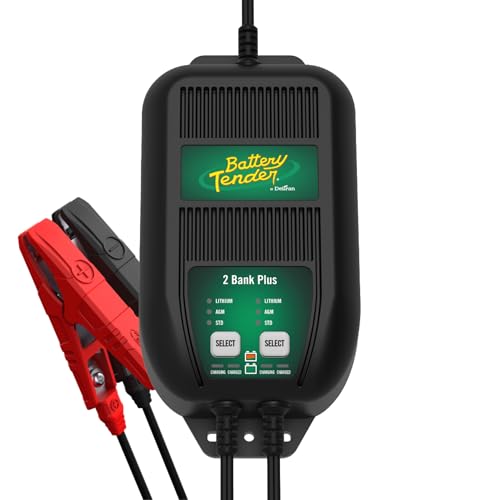
Best for steady, dependable maintenance with a simple 2-bank setup. The Battery Tender Plus delivers 2.5A total (1.25A per bank) with a three-stage charging program and temperature compensation. It is suitable for standard and AGM batteries, with a focus on maintaining battery health rather than rapid recharging. A limitation is the lower amperage, which means slower recovery for deeply discharged or large deep-cycle batteries.
Buying Guide: Key Considerations For Dual-Bank Marine Chargers
- Bank amperage vs. battery size: Larger boats with high current demands benefit from higher per-bank amperage for faster charging.
- Battery chemistries supported: Ensure compatibility with lead-acid, AGM, calcium, and LiFePO4 if using lithium batteries.
- Waterproof and environmental rating: IP68 is ideal for exposed installations; IP67 is common and acceptable in marine settings.
- Charging modes and modes per bank: Independent modes per bank increase flexibility for mixed battery sets.
- Temperature compensation: Prevents overcharging in heat and undercharging in cold marine conditions.
- Force or recovery features: Helpful for waking up deeply discharged batteries to a safe charging voltage.
- Size and mounting: Consider space on the vessel console, battery compartment shape, and ventilation needs.
- Maintenance features: Desulfation, float maintenance, and diagnostic indicators aid long-term battery health.
FAQ
- Q: Do I need a dual-bank charger if I only have two batteries? A: A dual-bank charger allows independent charging for each battery, which can reduce cycle times and ensure balanced charging.
- Q: Can these chargers handle LiFePO4 batteries? A: Yes, several models support both lead-acid and lithium chemistries, but verify per-model specifications.
- Q: What does IP68 rating mean? A: IP68 indicates protection against immersion in water and dust ingress, suitable for harsh marine environments.
- Q: Is higher amperage always better? A: Not always; higher amperage charges faster but requires compatible wiring and battery capacity to avoid unnecessary heat and strain.
- Q: Should I mount chargers inside or outside the cabin? A: Mount according to product guidelines and ventilation needs; waterproof units are better suited for exposed locations.
- Q: Do these chargers maintain batteries when not in use? A: Most have a float/maintenance mode to keep battery voltage stable without overcharging.