Best Marine Handheld Radios for Boating and Coastal Navigation
The best marine handheld radios provide reliable distress signaling, GPS positioning, NOAA weather alerts, and rugged durability for water-based activities. This guide highlights five models well-suited for boaters, kayakers, coast guard crews, and offshore travelers. Each entry explains who it’s best for, why it’s a strong pick, and a practical caveat to consider before purchase. Use the buying guide to compare features like GPS, DSC, battery life, IP ratings, and night/day display to find the right balance for your needs.
| Product | Best For | Key Benefit |
|---|---|---|
| Retevis RM40 Marine Radio | Offshore sailors and MOB emergencies | GPS location sharing and DSC distress with MOB alarm |
| ICOM M94D | Vessel traffic awareness and long battery life | Integrated AIS & DSC, long 10-hour battery, loud audio |
| Uniden MHS338BT | NOAA weather alerts and Bluetooth-ready operations | GPS, IPX8 float, strobe, flashlight, 6 W power |
| COBRA BlueBound 350 Black | Compact, visible floating radio for near/far vessels | High-visibility floating core, 6 W power, Day/Night display |
| Uniden Atlantis 275 | All-at-sea use with large display | Bright LCD, floating, emergency strobe and flashlight |
Retevis RM40 Marine Radio

Features include built-in GPS that updates location in real time, enabling quick rescue and safe navigation. The DSC feature allows preset distress messages, and an MOB alarm shares precise coordinates with nearby vessels. This model is best for watermen who need fast location updates and reliable distress signaling, such as offshore anglers, kayakers, and coastal sailors. A potential limitation is GPS performance in heavily obstructed environments; ensure you have clear view of the sky for optimal GPS refresh rates.
Icom M94D 21 USA VHF Marine Transceiver

This model combines built-in AIS with DSC for fast, precise calls and emergency alerts. It delivers 6 W transmit power and a long-lasting 2400 mAh battery, providing up to around 10 hours of typical use. The loud 1500 mW audio ensures intelligible calls in noisy marinas or engines rooms. Choose this if you want real-time vessel awareness and strong endurance. Limitation to watch: AIS features require some setup and may need compatible display interfaces to view target lists clearly on the go.
Uniden MHS338BT Floating Marine Radio

This rugged handheld floats and includes IPX8 submersion protection, a water-activated emergency strobe, and a flashlight. It offers NOAA weather alerts and a FM radio option, along with a drop-in charging cradle and Li-ion battery. Best for boaters who value quick visibility, emergency signaling, and convenient charging. A potential drawback is that the feature set is broad; some users may find the interface less intuitive without hands-on use or clearer on-device instructions.
COBRA BlueBound 350 Black VHF Radio

The Black variant emphasizes a high-visibility orange floating core, improving retrieval if dropped overboard. It provides 6 W transmit power with options for 1, 3, or 6 W, facilitating efficient power use that aligns with range needs. The Day/Night LCD display helps readability in varying light. This option is best for users who want a compact, clearly visible radio with flexible power settings. Consider that the emphasis on visibility might be less critical in very bright conditions or for users preferring a larger screen interface.
COBRA BlueBound 350 White VHF Radio

Similar to the Black variant, the White version offers 6 W power with a high-visibility floating core and a Day/Night display. It is designed for near and far vessel communication with durable IPX7 waterproofing and USB-C for charging. Best for users who want a lighter color option with the same feature set and a reliable floating design. A limitation is that color-specific accessories or cases may affect visibility in certain lighting conditions.
Uniden Atlantis 275 Handheld VHF
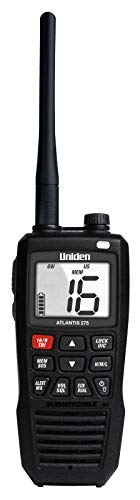
The Atlantis 275 features a large dual-color display and floating IPX8 submersible construction. It packs 6 watts of power and NOAA weather alerts for adverse conditions. It’s ideal for mariners who want a bold, easy-to-read interface and are frequently in wet environments or near shore. A possible drawback is that its display size might limit portability for users who prioritize a ultra-compact radio for crewmembers in tight spaces.
Buying Guide
Key purchase considerations help identify the best fit for your needs:
- GPS and DSC: If quick location sharing and distress signaling are priorities, choose models with built-in GPS and DSC features like the RM40 or ICOM M94D.
- VHF power and battery life: Look for 6 W transmit power for longer range and batteries that support 8–10 hours of typical use, such as the ICOM M94D and Uniden MHS338BT.
- Durability and water resistance: For all-water use, IP ratings (IPX7/IPX8) and floating capability protect against drops and submersion, as seen in Uniden MHS338BT and Atlantis 275.
- Additional features: NOAA weather alerts, FM radio, Bluetooth, strobe lights, and flashlights add situational awareness. Consider which features you will actually use on deck or offshore.
- Display readability: Day/Night display and large LCD screens improve readability in bright sun or poor visibility conditions.
- Portability vs. battery life trade-offs: Smaller, lighter units excel for kayaks and port operation, while larger units often offer longer battery life and more robust interfaces.
- Ease of use: Some models require Smartphone apps or additional setup; if ease of use is critical, favor devices with straightforward menus and clear labeling.
FAQ
- What is DSC and why is it important on handheld VHF radios?
DSC (Digital Selective Calling) allows you to send digital distress and identification messages, enabling faster coordination with nearby vessels and coast guards.
- Should I prioritize floating capability over rugged IP ratings?
Floating capability reduces the risk of losing the radio if dropped; IP ratings protect against water ingress during rough seas. Choose based on your most likely risk scenario.
- How long should a marine handheld radio’s battery last in typical use?
Most capable models provide around 8–10 hours of operation on a full charge, depending on transmit power and features used.
- Is AIS integration essential in a handheld radio?
AIS helps you see nearby vessels and can simplify DSC calls. It’s beneficial for busy waters but not strictly required for casual use.
- What accessories are useful with handheld VHF radios?
Spare batteries, charging cradles, l any safety lanyards, and waterproof cases improve reliability and readiness on water.