Best Digital Fuel Gauges for Boats and More
Answering buyers seeking precise digital fuel gauges, these five selections fit 12V to 24V marine and automotive applications. They are best for boaters needing clear, backlit displays, and dash builders seeking universal compatibility. Each option offers different mounting sizes, backlight styles, and sender compatibility to suit various tanks and receivers. The table below compares key aspects to help you choose quickly.
| Product | Best For | Notes |
|---|---|---|
| 100TECH Boat Fuel Gauge | Rough seas, high-vibration environments | Adjustable 240-33ohm to 0-180ohm ranges; Φ52mm mounting |
| RUPSE Fuel Sender Unit (6.8″) | Sturdy stainless steel sender with backlit display | SAE 5-hole mounting; IP67; easy wiring |
| ZHSYMX 52mm Fuel Level Gauge | Custom dashboards needing multi-range compatibility | 4 signal options; 12V/24V readiness |
| OCHIKI 52mm Boat Fuel Gauge | White LED display, simple installation | 52mm dial; clear LCD with backlight |
| KAOLALI Fuel Gauge Sending Unit | Long-lasting stainless steel sender | 8″ (200mm); corrosion-resistant; SAE 5-hole pattern |
Below are five product sections with concise, comparison-friendly details to help you decide quickly.
100TECH Boat Fuel Gauge For Marine Or Auto

Best for: Vibration-prone vessels and dash builders needing stable readings. This gauge supports multiple sender ranges (240-33ohm, 0-190ohm, 240-30ohm, 0-180ohm, 10-180ohm) and features anti-vibration needle technology with an 8-level fine scale for improved accuracy. The indicated range is E-F, and the device operates on 9-32V DC. Installation diameter is Φ52mm (2-1/16″).
Why selected: Its wide compatibility with common American Standard senders makes it versatile for boats, RVs, yachts, and vehicles. The heavy-duty construction and clear scale help reduce misreadings in rough conditions.
Caution: Verify sender compatibility before purchase to ensure the correct resistance range for your system.
RUPSE Fuel Sender Unit 6.8″ For Boats And Cars
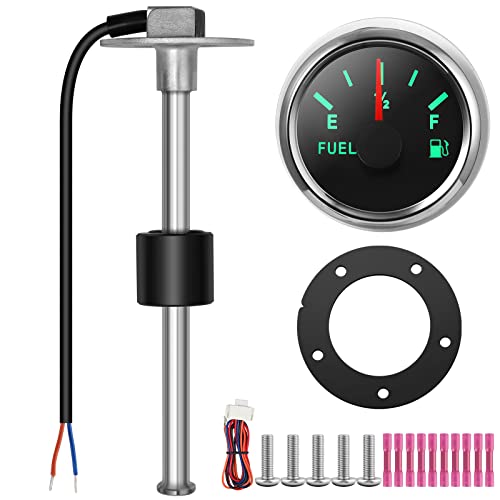
Best for: Builders seeking a robust stainless steel exterior with a long-lasting sensor. This unit uses high-quality reed switches for stable output and supports multiple liquids (gasoline, diesel, water, methanol).
Why selected: The IP67 waterproof rating and anti-fog curved glass help maintain legible readings in marine environments, while the 8 backlight colors improve readability in low-light conditions.
Caution: Confirm your tank’s mounting pattern and wiring compatibility with your dashboard before purchase.
ZHSYMX 52mm Universal Fuel Level Gauge

Best for: Dash projects needing precise 0-190ohm, 98-8ohm, 565-33ohm, or 0-90ohm sender compatibility. The needle is designed for stable readings even on rough seas, aided by anti-vibration technology.
Why selected: Its universal compatibility and adjustable resistance ranges simplify matching with various senders, reducing the need for custom wiring.
Caution: Double-check your sender’s resistance range to ensure full-scale accuracy.
OCHIKI 52mm Waterproof Marine Gauge

Best for: Users needing a high-precision display with white LCD backlighting for daytime and night readability. It uses a 52mm dial and provides clear, readable fuel levels.
Why selected: The LCD dial with adjustable backlight colors and a professional anti-fog curved glass lens offers clear visibility in challenging lighting and wet environments.
Caution: Ensure your installation height and dash spacing accommodate the LCD display size.
KAOLALI Fuel Gauge Sending Unit 8″ (200mm)

Best for: Long-lasting marine senders with corrosion resistance and straightforward installation. The 8″ stainless steel sender offers a stable signal for various fuel types.
Why selected: Its robust construction and straightforward SAE 5-hole mounting pattern make it a strong choice for larger tanks and installations that require a durable sender.
Caution: Verify compatibility with tank dimensions and mounting hole spacing before buying.
Buying Guide
What should you consider when choosing a digital fuel gauge for a boat or vehicle?
- Sender compatibility: Check the resistance range (ohms) your fuel sender uses (common ranges include 240-33, 0-190, 98-8, 0-90).
- Display features: Decide between analog needle with LED backlight or full digital LCD displays. Look for anti-fog glass and clear readability at night or in spray.
- Mounting size and pattern: Most marine gauges use 52mm (2-1/16″) or similar diameters. Confirm your dash cutout and mounting hardware.
- Durability: Choose IP-rated (water resistance) and corrosion-resistant materials for saltwater use. Stainless steel senders last longer in harsh environments.
- Power requirements: Ensure the unit operates within your system’s voltage (commonly 9-32V DC). Verify compatibility with your boat’s battery and electrical setup.
- Wiring and installation: Look for clear wiring diagrams and easily accessible terminals. Some units include gasket seals and mounting screws for quick setup.
FAQ
- What is the typical resistance range for marine fuel senders?
Common ranges include 240-33 ohms, 0-190 ohms, 98-8 ohms, and 0-90 ohms. Always match the gauge to your sender’s resistance specification.
- Do digital gauges display fuel level accurately at sea?
Yes, with anti-vibration needle designs and properly matched senders, readings stay stable even in rough seas.
- Can I install a 52mm gauge in a non-standard dash?
It depends on your dash cutout size. 52mm (2-1/16″) is a common standard, but some dashboards require custom mounting or adaptors.
- Is backlighting essential for daytime use?
Backlighting improves readability at night and in direct sun glare. Look for adjustable color backlights for versatility.
- What maintenance is needed for marine fuel senders?
Periodic inspection for corrosion, clean connections, and ensuring the sender moves freely to avoid sticking readings.