Best Diaphragm Bilge Pumps for Marine Use: Durable, Reversible, and Manual Options
Answering the question of which diaphragm bilge pump to select for a boat, this guide reviews reliable, marine-grade options. Reversible and automatic pumps suit larger bilge and ballast tasks, while manual pumps provide simple, portable drainage. The top picks below serve different buyers: anglers needing quick bilge relief, cruisers seeking automatic ballast control, and DIY boat owners prioritizing portability and ease of installation. A quick summary table follows to compare core specs at a glance.
Summary Table
| Product | Best For | Key Benefit |
|---|---|---|
| SEAFLO Marine 12V Reversible 8.0 GPM | Mid-sized boats needing reversible bilge/ballast | Versatile, self-priming up to 4 ft |
| SEAFLO 06 Series Automatic Submersible | Automatic bilge protection on boats | All-in-one pump with float switch |
| NovelBee 720GPH Manual Diaphragm | Manual transfer and emergency use | Compact, simple hand operation |
| Amarine Made Boat Manual Hand Bilge | Portable, non-electrical pumping | Two-position handle, self-priming |
| Johnson Pumps 10-13350-03 Viking Power | Wastewater or bilge in small systems | Quiet, self-priming diaphragm design |
SEAFLO Marine 12V Reversible 8.0 GPM Pump

What it is A 12V, self-priming, reversible diaphragm pump designed for bilge draining and ballast filling. It uses a rubber/copper impeller and operates up to 4 feet priming. It is thermally protected and features stainless steel shafting for durability.
Best for Boats that need flexible bilge and ballast handling with a single, compact unit.
Why chosen The reversible operation supports multiple tasks without swapping pumps, reducing clutter and installation steps.
Caution/limitation Performance may vary with hose sizing and line head; ensure 3/4″ hose barb matches fittings on your vessel.
SEAFLO 06 Series Automatic Submersible Bilge Pump

What it is An automatic 12V bilge pump with a built-in float switch, 750 GPH flow, and 3/4″ outlet. It includes a snap-off strainer and compact form factor.
Best for Boats needing hands-free bilge protection with automatic cycling based on water level.
Why chosen The integrated float switch reduces manual intervention and helps conserve battery power by cycling only when needed.
Caution/limitation Automatic systems rely on correct float operation; ensure the bilge remains accessible for proper switch signaling.
SEAFLO 720GPH Manual Diaphragm Hand Pump

What it is A manual diaphragm pump with a fixed-position plastic handle, delivering up to 720 GPH. It is designed for water transfer on boats.
Best for Lightweight, portable pumping tasks where electrical power is unavailable or undesired.
Why chosen Simple maintenance and installation make it a reliable auxiliary option for small craft or emergency use.
Caution/limitation Manual operation can be labor-intensive for larger volumes or frequent pumping tasks.
Amarine Made Boat Manual Hand Bilge Pump
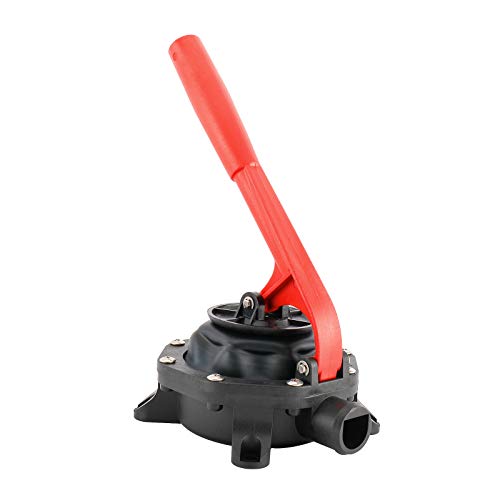
What it is A diaphragm hand pump with two-position handle and self-priming capability, suited for bilge waste transfer and water movement.
Best for Boat owners needing a compact, manually powered transfer pump with straightforward operation.
Why chosen It adds a reliable, non-electric option for emergency bilge management and routine transfers alike.
Caution/limitation Look for hose compatibility (adapter and sealing ring are included, but ensure your hose fits the 1″ID or specified sizing).
Johnson Pumps 10-13350-03 Viking Power 16 Waste Pump

What it is A single-chamber self-priming diaphragm pump intended for wastewater or bilge applications. It offers quiet operation and low pulses due to a rubber mounting bracket.
Best for Smaller boats or systems where a dedicated wastewater/bilge pump is preferred with quiet operation.
Why chosen The unit emphasizes smooth, low-noise operation suitable for living spaces near the bilge area.
Caution/limitation Ensure compatibility with your hull’s space and outlet sizing; check the 16-inch or more length for mounting orientation as required.
Buying Guide
What type should you choose?
Automatic submersible pumps are ideal for boats that require hands-free bilge protection. Manual diaphragm pumps suit emergencies, portability, or where electrical systems are limited. Reversible models provide multi-task versatility for bilge draining and ballast operations.
How to compare flow rates
Measured in GPH or GPM, higher numbers move more water per hour. Consider your typical bilge size, the expected head (vertical lift), and the hose diameter to choose a model with compatible flow and head capacity.
Head pressure and self-priming limits
Some pumps self-prime up to a few feet; others require priming. If your pump cannot be mounted near the waterline, check the self-priming distance and ensure sufficient lift for your installation.
Durability and materials
Look for stainless steel shafts, thermally protected motors, and robust impellers (rubber, aluminum, or plastic). For exposed marine environments, corrosion resistance matters for longevity.
Wiring, power, and installation
Automatic pumps need a power source and a float switch, while manual pumps rely on a hand lever. Check the voltage, amperage, and mounting options (bulkhead or deck) to ensure compatibility with your vessel’s layout.
Maintenance and warranty considerations
Inspect seals, strainers, and hoses regularly. A longer warranty (such as 4 years) can indicate durable construction and confidence in performance under marine conditions.
FAQ
- What is a diaphragm bilge pump? A diaphragm bilge pump uses a flexible diaphragm to move water, often including an impeller in the same housing, suitable for bilge drainage or ballast tasks.
- Do I need an automatic bilge pump? If you want hands-free operation that activates when water rises, an automatic pump with a float switch is recommended.
- Can I use a manual pump on a larger boat? Manual pumps are best for supplementary use or emergency backups on larger boats where primary pumping is electric.
- What hose size should I match? Most pumps use 3/4″ hose connections; verify your fittings and adapters to ensure a proper seal and efficient flow.
- Is a reversible pump better? Reversible pumps offer versatility for bilge draining and ballast filling in one unit, which can simplify installations on smaller vessels.
- What maintenance is required? Regularly check seals, strainers, and hose connections; keep electrical connections dry and inspect mounting for vibration or wear.