Best Depth Gauges for Boats: Top Picks for Safe Navigation
Finding the right depth gauge for a boat depends on your vessel, typical riding conditions, and how you plan to use the instrument. This guide highlights five reliable options, from dash-mounted depth finders to handheld fish finders, so you can choose what’s best for anglers, cruisers, or commercial craft. Whether you need accurate deep-water readings, rugged durability, or simple install-and-use design, these models cover common boating scenarios.
Summary table of selected products:
| Product | Brand | Depth Range | Best For |
|---|---|---|---|
| DepthTrax 2B Boat Mount In Dash Digital Depth Finder | Hawkeye | 2.5–600 ft | In-dash display, fast alarms |
| Hawkeye Boat Depth Sounder DT2B | Generic | Not specified | Compact panel gauge, simple use |
| Digital Boat Depth Finder with Transducer (White Backlight) | EIMSOAH | Up to 100 m | Yachts and mid-size boats |
| ELING 52mm Digital Depth Gauge Indicator | ELING | Up to 100 m | Compact, white backlight |
| Depth Finder with Transducer, Stainless Steel Yacht | Generic | 0–100 m | Rugged, IP67, stainless bezel |
DepthTrax 2B Boat Mount In Dash Digital Depth Finder

The DepthTrax 2B is an in-dash depth finder designed for large displays and fast readings up to 600 feet. Its 200 kHz transducer supports dual mounting options, including transom and through-hull installation. This model features a three-stage warning system with audible alerts, a bright LED indicator, and LCD alarms for immediate depth awareness. It’s best for: boaters who want a large, configurable display and a reliable alarm system for deeper waters. Caution: installation may require level mounting and hull access for through-hull mounting.
Hawkeye Boat Depth Sounder Display Gauge DT2B
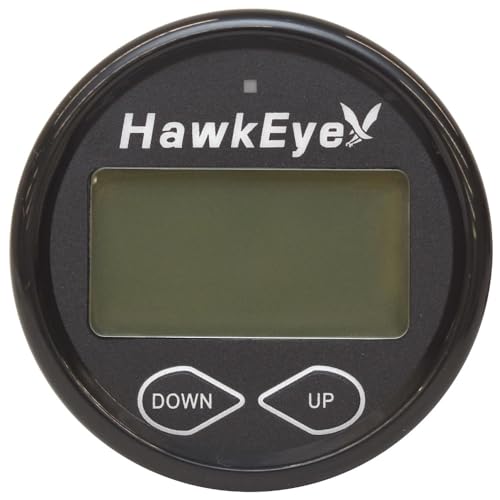
The DT2B is a compact 2-inch black display gauge from Hawkeye. It’s a practical choice for small cockpits or refresh installations where space is limited. Best for: boats needing a simple, low-profile depth readout without advanced alarm features. Limitation: the data presentation is basic, with fewer integration options compared to larger dash units.
Digital Boat Depth Finder With Transducer (White Backlight)

This depth finder with a white backlit display targets yachts and mid-sized boats. It provides depth readings up to 100 meters and is described as easy to install. Best for: boaters who want a straightforward setup with a bright display for visibility in daylight or night operations. Caution: check compatibility with your boat’s transducer requirement and hull material before mounting.
ELING 52mm Digital Depth Gauge Indicator

The ELING depth gauge is a compact 2-inch indicator with white backlight. It’s designed for easy installation and is suitable for yachts, fishing boats, and other vessels where space is at a premium. Best for: owners needing a small, legible gauge that fits tight dashboards. Limitation: depth indication is limited to approximately 100 meters, so not ideal for deep-water navigation.
Depth Finder With Transducer, Stainless Steel
This stainless steel 316L bezel depth finder offers real-time depth data with an IP67 rating for water and dust resistance. It’s best for: boats exposed to harsher environments or cold seas due to its rugged build and anti-fog glass. Caution: ensure the 12V system compatibility and installation fit with your dash layout to avoid power or mounting issues.
Buying Guide
- Depth range and display size: For deep-water boating, prioritize models like the DepthTrax 2B with a broad range and large display. If space is limited, a compact gauge such as the DT2B may suffice.
- Power and installation: Check whether the unit requires through-hull or transom transducers, and confirm the boat’s hull material compatibility. Dash-mounted units often integrate more cleanly on larger vessels.
- Durability and environment: Look for IP ratings, stainless steel bezels, and anti-fog glass for reliability in cold or harsh conditions. For saltwater use, corrosion resistance is essential.
- Alerts and alarms: If frequent shallow or deep-water navigation occurs, choose a model with audible alarms and bright indicators to prevent grounding.
- Ease of use and readability: White backlights and large numerals improve visibility in bright sun and at night. Ensure the interface is intuitive for frequent, on-the-water use.
- Additional features: Some units offer temperature readings, fish-finder capabilities, or contour readouts. Decide whether you need a multi-functional device or a dedicated depth gauge.
FAQ
What does a depth finder measure?
It measures the water depth below the transducer, providing data that helps navigation and safe anchoring.
Do depth finders require hull type compatibility?
Yes. Through-hull transducers work better on solid hulls, while transom-mount or inline transducers suit many boats depending on hull design.
Is a larger display always better?
A larger display improves readability, especially in bright sunlight or rough seas, but it may require more dash space.
Can these devices work on small boats?
Yes. Several compact models are designed for small to mid-sized boats and kayaks, offering essential depth readings and simple installation.
Do depth finders provide depth instantly?
Most models offer near-immediate readings, with startup times varying by device and power setup.
Are depth finders waterproof?
Most are sealed for marine use, with IP ratings or rugged housings to withstand splashes and submersion in typical conditions.