Best Continuous Duty Bilge Blower Options for Reliable Onboard Ventilation
When you need steady, reliable bilge ventilation, choosing a continuous duty blower is essential. This guide covers five top options that balance airflow, durability, and power efficiency for various boat sizes and layouts. Best for engine compartments, galleys, bilges, and compact spaces, these blowers are suited for regular operation without unexpected downtime. The selections emphasize 12V DC models with proven continuous-duty design, suitable for yachts, sailboats, and boats that demand consistent air movement.
| Product | Brand | Airflow | Voltage | Best For |
|---|---|---|---|---|
| Attwood Turbo 4000 Series II In-Line Blower | Attwood | ~4000 CFM equivalent (axial flow) | 12V | Medium to large bilges, engine compartments |
| Jabsco 35770-0094 Flexmount Blower | Jabsco | High-volume air flow | 24V | Heaviest applications, flexible mounting |
| SEAFLO 4” In-Line Marine Bilge Blower SFIB1-270-02 | SEAFLO | 270 CFM | 12V | Quiet, compact spaces, long warranty support |
| Attwood 1733-4 Blower Bilge 3″ | Attwood | High lift 5-blade airflow | 12V | Engine compartments, bilges, heads |
| SEAFLO 3″ In-Line Marine Bilge Blower SFIB1-130-01 | SEAFLO | 130 CFM | 12V | Smaller compartments, galleys, heads |
Attwood Turbo 4000 Series II In-Line Blower
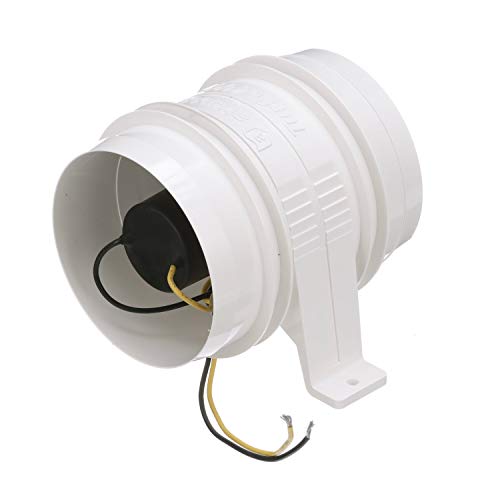
The Attwood Turbo 4000 Series II uses axial flow technology to maximize throughput in compact inline form. It is water resistant and operates on 12V. Best for mid-size bilges and engine compartments where robust airflow is needed without excessive noise. Designed to withstand marine environments with a water-resistant rating, it suits boats requiring steady air movement and reliable duty cycles.
Who it’s best for: boat owners needing strong, continuous airflow in mid-sized bilges or engine rooms who want a durable, water-resistant unit. Why selected: the axial flow innovation provides efficient air transfer with steady performance. Caution: ensure mounting location minimizes vibration transfer to adjacent equipment.
Jabsco Flexmount Blower, Continuous Duty, 4 Inch, 24V

Jabsco’s 35770-0094 Series Flexmount blower is built for continuous duty with a design focus on heavy-use environments. It features a 360-degree adjustable outlet and a compact mount for flexible installation. The 24V model is well-suited for vessels with higher power supply, providing reliable airflow across large spaces like engine rooms or bilges.
Who it’s best for: larger boats or vessels with high airflow needs and 24V systems. Why selected: long motor life and flexible mounting improve installation options. Caution: 24V systems may require appropriate wiring and fuse protection in mixed electrical setups.
SEAFLO 4” In-Line Marine Bilge Air Blower SFIB1-270-02

SEAFLO’s 4” inline blower delivers 270 CFM with ultra-quiet operation and ISO 8846, CE, RoHS certifications. It draws up to 6A, and includes a 4-year warranty. This model is ideal for mid-to-large boats needing strong airflow without excessive noise, suitable for bilge, salon, or cabin ventilation where quiet operation matters.
Who it’s best for: boat owners prioritizing quiet performance with substantial airflow. Why selected: long warranty and compact 4” footprint. Caution: higher current draw means more battery load during peak usage.
Attwood 1733-4 Blower Bilge 3″ Water Resistant

Attwood’s 1733-4 uses a patented inline design with a 5-blade fan to maximize airflow and efficiency in compact spaces. It is water resistant and designed for bilges, galleys, and engine compartments. The blade sweep and pitch boost lift to increase airflow speed for better ventilation performance.
Who it’s best for: smaller to mid-sized spaces where space is at a premium. Why selected: strong airflow in a compact 3″ form factor. Caution: airflow is highly dependent on ducting length and duct integrity; long runs may reduce performance.
SEAFLO 3″ In-Line Marine Bilge Blower SFIB1-130-01

SEAFLO’s 3” inline blower delivers 130 CFM with a 12V setup and low current draw. It features a sealed motor shaft and a durable ABS housing, designed to handle continuous duty in smaller spaces like heads and galleys. The 4-year warranty adds long-term reassurance for routine use.
Who it’s best for: small bilge compartments, galleys, or heads where space is limited but airflow remains critical. Why selected: efficient airflow at a compact size and low power draw. Caution: ensure inlet/outlet clearance remains unobstructed for optimal performance.
Buying Guide: Key Considerations For Continuous Duty Bilge Blowers
- Airflow needs: Measure bilge or space volume to estimate required CFM. Higher CFM improves venting in larger compartments but may increase noise and power draw.
- Voltage and duty cycle: 12V DC units are common for boats; some vessels use 24V systems. Choose models rated for continuous duty to avoid overheating.
- Mounting and ducting: Look for flexible mounting options and compatible 4″ or 3″ ducts. Check inlet/outlet diameters to ensure efficient airflow with minimal leaks.
- Noise level: If cabin comfort matters, prioritize models with lower dB ratings. Ultra-quiet units help maintain sleep and work environments onboard.
- Durability and marine construction: Water resistance, sealed motors, and corrosion-resistant housings extend service life in harsh marine environments.
- Warranty and service: A longer warranty reduces future maintenance risk, especially for vessels in remote locations.
- Power consumption: Consider current draw during continuous operation to avoid excessive battery drain on longer trips.
FAQ
- What is continuous duty for a bilge blower?
Continuous duty means the blower is designed to run for extended periods without overheating or failing, suitable for ongoing ventilation tasks on a boat.
- Which blower is best for a small pontoon bilge?
A compact 3” inline model like the SEAFLO SFIB1-130-01 or Attwood 1733-4 can provide adequate airflow in tight spaces.
- Is a 24V blower necessary for every boat?
No. Many boats use 12V systems; 24V blowers are typically used on vessels with higher electrical capacity or dedicated power setups.
- How do I choose the right CFM?
Estimate the space volume and target air changes per hour. Larger spaces require higher CFM for effective ventilation.
- Are marine blowers noisy?
Some are; look for models marketed as ultra-quiet or with dB ratings below 45 dB for better onboard comfort.
- What maintenance is needed?
Inspect ducting for leaks, clean intake screens, and verify motor seals remain intact to prevent moisture ingress.