Best Coast Guard Approved Fuel Line Options for Marine Use
If you need a reliable fuel line for boats, ships, or marine equipment, these Coast Guard–approved options provide compatibility with gasoline, diesel, and ethanol blends. This guide targets boat owners, marine technicians, and ship operators seeking durable, compliant fuel hoses for fuel transfer, engine feeds, or fuel system maintenance. Below, five top products are evaluated for best用途, installation practicality, and potential limitations. A quick comparison table summarizes key specs to help you choose.
Summary table of chosen products:
| Product | Diameter / Length | Material/Construction | Best For |
|---|---|---|---|
| CULMKARI 3/8″ Marine Fuel Hose Feed Line | 3/8″, 10 ft | NBR inner; NBR+PVC outer; reinforced | General fuel supply on boats and ships |
| EVIL ENERGY 3/8″ Marine Fuel Line Hose | 3/8″, 10 ft | NBR inner; NBR+PVC outer; polyester braid | Versatile fuels; wide temperature range |
| CULMKARI 3/8″ Marine Fuel Hose (5 ft) | 3/8″, 5 ft | NBR inner; NBR+PVC outer | Short fuel runs or tight installations |
| POHIR 3/8″ Marine Fuel Line SAE J1527 | 3/8″, 10 ft | NBR inner; NBR+PVC outer; polyester reinforcement | Standard engine feeds and tanks |
| Continental 1.5″ Fuel Fill/Exhaust Hose | 1.5″ ID, 48″ long | 2-ply synthetic with helix wire | Fuel fill or exhaust routing on larger systems |
CULMKARI 3/8″ Marine Fuel Hose Feed Line (10 Ft)

The 3/8″ ID, 10 ft fuel hose uses an inner NBR layer with a NBR+PVC outer, designed for universal fuel hose applications on boats and marine equipment. The inside diameter is 3/8″ (9.5 mm); the outer diameter is 17 mm, with a minimum bending radius of 80 mm. It supports gasoline, diesel, and similar fuels, offering balanced performance and durability. Best for longer runs on vessels where a flexible, Coast Guard–compliant line is required. Caution: check compatibility with any fuel additives that may affect NBR materials.
Best for: General fuel delivery on boats and marine equipment where a durable, flexible line is needed and a 10 ft length fits the installation.
EVIL ENERGY 3/8″ Marine Fuel Line Hose (10 Ft)

This hose features an NBR inner layer and an NBR+PVC outer layer, reinforced with polyester fiber braid. It has a maximum working pressure of 300 PSI and a burst pressure of 900 PSI, with a temperature range from -20°F to 221°F (-30°C to 105°C). It is compatible with gasoline, diesel, E85, and other fuels, making it versatile for marine engines, outboard motors, and fuel transfer. Best for: high-energy situations where elevated pressure tolerance and broad fuel compatibility are needed. Limitation: ensure the environment does not exceed its temperature range or subject the hose to abrasion-prone areas without protection.
CULMKARI 3/8″ Marine Fuel Hose (5 Ft)
The 3/8″ ID hose is 5 ft long, with the same NBR inner and NBR+PVC outer construction as the longer version. It handles gasoline, diesel, and E85 for marine fueling needs and has a similar 9.5 mm ID and 17 mm OD. Best for: compact installations or replacement runs where a shorter length reduces clutter. Caution: verify the 5 ft length fits the routing path without sharp bends.
POHIR 3/8″ Marine Fuel Line SAE J1527
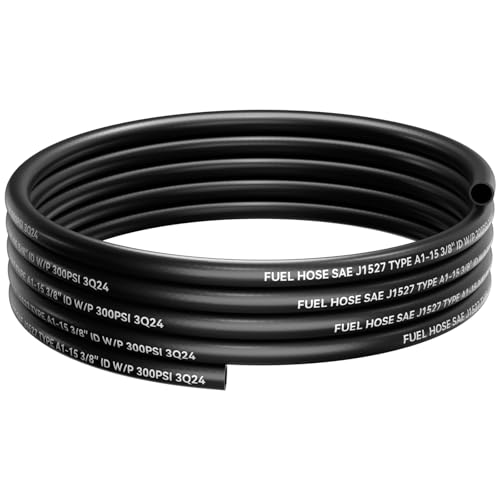
This 3/8″ ID fuel line uses an upgraded flame-retardant NBR inner layer with an NBR+PVC outer layer reinforced by a polyester braid. It has a maximum working pressure of 300 PSI and a burst pressure of 900 PSI. Temperature range spans -22°F to 212°F. It is compatible with gasoline, diesel, and E85, among others, and is suitable for feeding fuel to engines, pumps, filters, or generators on ships or boats. Best for: standard fuel lines in marine systems when fire safety is a priority. Limitation: ensure the line length and routing avoid excessive heat exposure that could affect NBR properties.
MPI 1.5″ USCG Approved Fuel Fill Hose

U.S. Coast Guard–approved, Type 2, 1-1/2″ fuel fill hose with helical wire for extra flexibility. Sold by the foot, making it adaptable for custom fills or large marine fuel systems. Best for: installs requiring a Coast Guard–approved fill hose with flexible routing. Caution: ensure you order the correct length and diameter for your fill neck to avoid mismatches.
Continental 58524 Fuel Fill/Marine Exhaust Hose

Continental’s hose features a 1.5″ inner diameter and 48″ length, designed for gasoline, methanol, ethanol, and diesel in marine applications. It is a 2-ply synthetic hose with a helix wire for durability. Best for: larger vessel fuel fills and venting needs where a stout, flexible hose is required. Limitation: check local regulations on fuel fill routing to ensure compliant installation.
Sierra Marine Fuel Feed Hose (3/8″ x 5′, USCG A-1-15)

U.S. Coast Guard–approved, Type 2 1-1/2″ fuel fill hose with helical wire for flexibility, sold by the foot. It fits a range of marine fuel systems and is suitable for standard engine feeds. Best for: flexible, lightweight fueling lines that can be cut to length. Limitation: confirm compatibility with your specific engine fuel system components when cutting to length.
Buying Guide
What should you consider when choosing a Coast Guard–approved fuel line?
- Fuels supported: Verify compatibility with gasoline, diesel, and ethanol blends you use. Some hoses tolerate E85 better than others.
- Pressure ratings: Look for a hose with a realistic working pressure near your system’s requirements; higher is safer for surge conditions.
- Temperature range: Marine environments can be extreme; select hoses rated for the temperatures you expect.
- Construction: NBR inner with PVC or reinforced outer layers improves chemical resistance and durability; flame retardant levels can matter in certain installations.
- Diameter and length: Ensure ID matches fittings and length fits the routing without sharp bends that could kink or restrict flow.
- Flexibility and routing: Longer hoses should maintain flexibility around corners; consider braided or reinforced designs for rugged paths.
- Coast Guard approvals: USCG type approvals help ensure compliance with safety standards for marine fuel systems.
Frequently Asked Questions
- What does USCG approval mean for a fuel hose?
The hose meets certain safety and performance standards recognized for marine use, improving reliability in fuel systems. - Can I use a fuel hose for diesel and gasoline interchangeably?
Most hoses list compatible fuels, but confirm the specific materials tolerate the blend you use and avoid cross-contamination risks. - How do I choose the right length?
Measure the routing distance, including bends, to avoid excess slack or tension that could cause failure. - Are all 3/8″ hoses the same?
No. Inner material, outer layers, and reinforcement differ; choose based on temperature, pressure, and chemical exposure. - What maintenance is recommended for marine fuel hoses?
Inspect for cracks, swelling, or hardening; replace if signs of wear appear. Keep away from heat sources and verify fittings. - When should I avoid a particular hose?
Avoid hoses with materials not rated for your fuel type or exposure to high heat or abrasion without protective shielding.