Best Closed Cell Marine Spray Foam for Buoyancy and Insulation
Open-cell alternatives don’t always meet the needs of marine projects. The best closed-cell marine spray foams provide buoyancy, insulation, and moisture resistance for boats, docks, and water-friendly structures. This guide highlights top options and clarifies who each product is best for. It helps buyers compare flotation foam for boat flotation, insulation, void filling, or soundproofing in marine settings.
Summary table of selected products for quick reference:
| Product | Density | Best For | Notes |
|---|---|---|---|
| Oycevila 2 Quart Kit | 2 lb | Small boats and repairs | Good flotation and insulation; includes gloves |
| Fiberglass Supply Depot 4 Lb 1 Gallon Kit | 4 lb | Higher buoyancy with larger pours | Versatile for boat and dock applications |
| Sprayman Black Waterfall Foam Sealant | Unknown (black pond foam) | Visible-sealing outdoors | UV resistant and discreet in landscape features |
| Fiberglass Supply Depot 2 Lb 1 Gallon Kit | 2 lb | Void filling under decks | Good buoyancy with easy pouring |
| Fiberglass Supply Depot 6 Lb 1 Gallon Kit | 6 lb | Heavy-duty flotation and insulation | High density, supports larger projects |
Oycevila 2 Quart Kit Marine Flotation Foam

This 2-quart kit provides a closed-cell polyurethane pour foam designed for marine flotation and insulation. It expands to fill voids and creates a buoyant, air-trapping structure that helps keep boats and related fixtures afloat. Best for small boats, fence-line reinforcements near water, and marine repair jobs where lightweight buoyancy is needed.
Who it’s best for: DIY boat owners, small vessel repairs, and coastal fence or post reinforcement near docks. It’s suited for those who require stable flotation with added insulation for compartments like fish boxes or bait wells.
Why chosen: It emphasizes flotation performance and durability under saltwater exposure, while offering insulation benefits to improve temperature stability aboard small craft.
Caution: The kit is relatively small; for larger boats or deeper voids, consider a higher-volume option to ensure complete buoyant coverage.
Fiberglass Supply Depot 4 Lb Density Kit

This 4 lb density two-part closed-cell pour foam is designed for boat and dock flotation, soundproofing, void filling, and insulation. When mixed and poured, it expands to fill cavities and provides buoyancy. It can be laminated over with polyester, epoxy, or vinyl ester resin after curing without melting.
Who it’s best for: Builders and renovators working on larger vessels or docks that require higher buoyancy and structural support, plus additional insulation or soundproofing in storage compartments or engine bays.
Why chosen: The higher density offers stronger flotation potential and compatibility with resin systems, making it a versatile option for more demanding marine projects.
Caution: Higher density foam can be stiffer to work with; ensure proper mixing and safety measures during application in confined spaces.
Sprayman Black Waterfall Foam Sealant
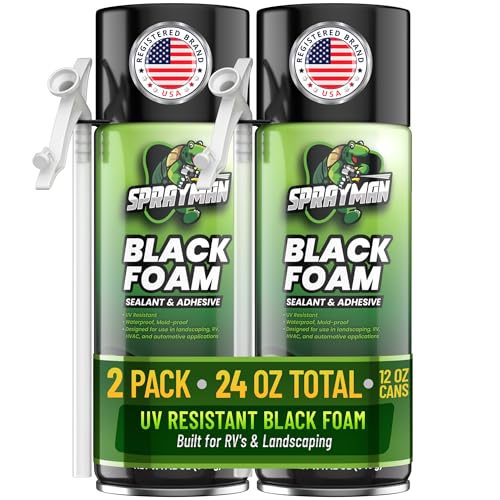
This two-pack polyurethane pond foam sealer is formulated with a natural black finish. It’s designed for outdoor landscape installations, including ponds, waterfalls, and visible exterior repairs where the foam needs to blend with natural surroundings. It’s UV resistant and moisture-tolerant for outdoor conditions.
Who it’s best for: Projects requiring discreet sealing that remains visible yet inconspicuous in outdoor water features or landscapes adjacent to marine environments. It’s better for aesthetic restoration rather than primary vessel flotation.
Why chosen: The black color minimizes visual impact in ponds and landscapes, offering an effective exterior sealant with UV resistance.
Caution: This product is not a primary flotation solution for boats; use it for surface sealing and decorative or exterior applications only.
Fiberglass Supply Depot 2 Lb Density Kit

This 2 lb density two-part polyurethane foam is suitable for boat and dock flotation, void filling under decks, and insulation. The kit includes equal parts and produces a practical amount of buoyancy for non-structural applications, with the option to laminate over with resin after curing.
Who it’s best for: Small to mid-size projects where lightweight buoyancy is needed, such as under decks or inside cavities where a gentle expansion foam is appropriate.
Why chosen: It pairs buoyancy with insulation and ease of use for limited-space applications, making it a flexible option for DIY marine work.
Caution: Suitable for nonstructural uses; larger, load-bearing needs may require higher density foam or additional stabilizers.
Fiberglass Supply Depot 4 Lb Density Kit

This 4 lb density closed-cell pour foam is designed for boat and dock flotation, soundproofing, filling voids, and insulation. It’s compatible with epoxy and vinyl ester resins and does not melt under curing conditions, enabling durable marine builds and repairs.
Who it’s best for: Projects requiring robust buoyancy and higher structural integrity, such as larger boats, marina docks, or storage compartments that demand stable insulation and noise reduction.
Why chosen: It provides reliable buoyancy with strong compatibility for resin laminates, expanding the range of possible marine applications.
Caution: Like other high-density foams, workability and expansion control are important to prevent overfilling or unintended pressure in confined spaces.
Buying Guide: Key Considerations For Closed-Cell Marine Flotation Foam
What density do you need?
Foam density determines buoyancy and stiffness. Lighter-density foams (2 lb) are easier to spray into tight spaces and are suitable for non-structural flotation, void filling, and insulation. Heavier-density foams (4–6 lb) offer greater buoyancy and load-bearing potential, ideal for larger vessels or docks.
What volume will you fill?
Estimate the total void volume of the area to be filled. Choose kits that provide enough material for the space, accounting for expansion and curing. For larger projects, a gallon kit or multiple pails may be more cost-effective and time-saving.
Can resin laminates be used with the foam?
Many marine foams cure compatibly with epoxies and polyester resins. If you plan to overlay or reinforce with resin, confirm that the foam will not melt or deform during curing.
Are there environmental and UV considerations?
Outdoor marine applications benefit from UV-resistant formulations and moisture tolerance. For exposed areas, UV resistance helps maintain long-term performance and appearance.
What about safety and handling?
Use gloves and proper ventilation when handling polyurethane foams. Some kits include gloves or safety instructions; always follow manufacturer guidelines for mixing ratios and curing times.
What is your application style?
Consider whether you need pourable foam for voids, sprayable foam for large areas, or pre-mixed kits for quick repairs. Pourable and two-part systems offer precise control for marine applications.
FAQ: Quick Answers For Buyers
- Is closed-cell marine foam suitable for boat flotation? Yes. It provides buoyancy by trapping air within a closed-cell matrix and is widely used for flotation in small boats and marine structures.
- Can I laminate foam with resin after curing? Often yes. Many 2 lb and higher-density foams are compatible with polyester, epoxy, or vinyl ester resins after curing.
- What density should I choose for dock flotation? Higher densities (4–6 lb) offer greater buoyancy and durability for docks and larger vessels; 2 lb is typically enough for smaller projects.
- Are there safety concerns when applying marine foam? Use gloves, ensure proper ventilation, and follow mixing instructions to avoid skin contact and inhalation risks during application.
- Will UV exposure affect the foam’s performance? UV-resistant formulations help maintain performance and prevent degradation in outdoor marine environments.
- What is the best option for void filling under decks? A 2 lb or 4 lb density kit is commonly used, depending on the required buoyancy and available space for pouring.