Best Cheap Kayak Fish Finder for Budget-Friendly Angling
Looking for an affordable kayak fish finder that still delivers useful depth, fish location, and bottom structure data? This guide highlights five reliable options suited for budget-conscious paddlers. Each model targets different needs—handheld portability, wireless operation, or easy mounting—so you can pick the one that fits your kayak setup and fishing style. Below, you’ll find who each product is best for, why it was selected, and clear pros and limitations to help you decide.
Summary of Recommended Products
| Product | Best For | Key Advantage |
|---|---|---|
| Yoocylii Handheld Fish Finder | Budget kayak anglers who want portability | Compact with depth, fish size, and weed/rocks bottom readouts |
| Humminbird PiranhaMAX 4 | New or casual anglers needing dual beam detail | Dual beam sonar for detail and coverage |
| LUCKY Kayak Portable Fish Finder Transducer Wireless MT-202 | Wired/wireless versatility for transferable setups | Long sensing distance and clear LCD readouts |
| Venterior Portable Rechargeable Fish Finder | Color display with easy sun readability | Wireless sensor and readable display in daylight/night |
| WINDFRD Kayak Fish Finder Mount | Easy mounting with flexible positioning | Universal track mounting and adjustable arm |
Yoocylii Handheld Fish Finder For Kayaks

The Yoocylii handheld unit provides core depth data and a basic fish-location readout suitable for budget-minded kayak anglers. It shows water depth, approximate fish location, and fish size (small/medium/big). Bottom details include weeds, sand, and rocks. It operates on 4 AAA batteries, offering several hours of use, and is portable enough to wear with a neck strap. Best for: anglers who want a compact, inexpensive option for shallow to mid-depth water and easy transport on and off the kayak. Limitation: battery life may require frequent replacements on long trips.
Humminbird PiranhaMAX 4 Fish Finder

The Humminbird PiranhaMAX 4 offers dual-beam sonar for detailed viewing and broader coverage. The two-beam option helps users balance detail with situational awareness of surrounding structures. A tilt-and-swivel mount allows quick adjustment of the viewing angle, useful when paddling on varying water conditions. Best for: anglers who want a compact, budget-friendly display with reliable dual-beam sonar. Limitation: lacks more advanced networking features found on higher-end models.
LUCKY Kayak Portable Fish Finder Transducer Wireless MT-202

The MT-202 model uses a wireless transducer to remove hull-wiring constraints, offering a long operation distance and a 3.5-inch horizontal LCD display. It provides fish depth, fish location relative to structure, and a history-scrolling readout to track movement. Best for: paddlers who want easier installation and flexible placement on kayaks, boats, or shore setups. Limitation: wireless systems can occasionally be sensitive to interference or battery life constraints in extended trips.
LUCKY Portable Wired Kayak Fish Finder MT-202
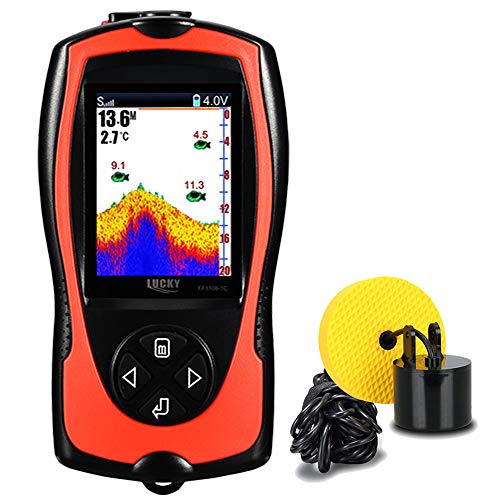
This wired model features a compact 2.4-inch TFT color LCD that displays underwater contour, water depth, water temperature, and fish size. It supports both transducer and simulation modes, and offers a 26-foot operating distance with up to 328-foot depth detection. Best for: budget users who want a straightforward, color-display unit that is easy to operate in varying light. Limitation: wired setups require a transducer line that may limit mounting options on some kayaks.
EDSRDPLT Universal Kayak Fish Finder Mount

The EDSRDPLT mount kit provides an all-in-one solution for kayaks, SUPs, and small boats. It includes a 1.5-inch ball head, track base, and a telescoping transducer arm, compatible with many Garmin, Lowrance, and Humminbird models. Best for: anglers who want a no-tools, quick-install mounting option to position their fish finder and transducer on a single rail system. Limitation: compatibility may vary with certain display sizes or track configurations.
Venterior Portable Rechargeable Fish Finder

The Venterior unit uses a wireless sensor to measure depth, temperature, fish size, and bottom contour. A color LCD with two background options improves readability in bright sun or at night, and a 262-foot sensor range supports a wide operating area. Best for: paddlers who want a compact, battery-powered system with color display and flexible mounting. Limitation: sensor durability and battery life can vary with harsh outdoor use.
Buying Guide: Key Considerations For Choosing A Cheap Kayak Fish Finder
How do you pick the right model when shopping on a budget? Consider these practical factors to align features with your kayak setup and fishing goals.
- Display clarity and size: A larger, readable screen helps in bright daylight and rough water. If the unit is color-capable, compare backlight options for day and night use.
- Transducer type and mounting: Consider whether you prefer a wired, wireless, or handheld arrangement. Mounting options should fit your kayak’s track system or hull design.
- Depth and beam: Look for meaningful depth ranges (e.g., 3 ft to 328 ft) and beam angle (e.g., 45°, 90°) to balance coverage and detail in targeted waters.
- Power and battery life: Budget models vary in battery type and endurance. For longer trips, consider readily available batteries and charging options.
- Portability vs. functionality: Handheld and compact units excel for portability, while mounted systems offer more stability and continuous readings during moves.
- Water conditions: If you fish in saltwater or brackish water, ensure components are corrosion-resistant and suitable for salt exposure.
- Ease of use: Simple menus and fast setup reduce complexity on the water, especially for beginners.
Frequently Asked Questions
- What is a kayak fish finder and why should I consider one?
A kayak fish finder helps you locate depth, fish activity, and bottom structure. It is useful for improving fishing efficiency on compact watercraft.
- Are wireless fish finders better for kayaks?
Wireless models reduce wiring on the deck, offering flexible mounting. They can be more convenient but may require battery management and occasional interference checks.
- What depth range should I look for on a budget unit?
Most budget options offer practical depth readings from a few feet down to around 100 meters, which covers shallow lakes and nearshore coastal waters.
- Do I need a mount if I buy a handheld unit?
If you want steady readings while moving, a mount is helpful. For occasional use or portability, a handheld device with a neck strap can suffice.
- Can these units work in saltwater?
Yes, many models support freshwater and saltwater use, but check corrosion resistance and sensor compatibility for salt environments.