Best Body Filler for Fiberglass Boats: Top Repair Picks
If you need a reliable body filler for fiberglass boats, use a fiberglass-reinforced putty that delivers strength, adhesion, and durability to hull repairs. This guide highlights five top options, explains who each is best for, and clarifies when to choose one over another. Ideal buyers include DIY boat owners, professional marine technicians, and hobbyists repairing holes, dents, or chips on fiberglass surfaces.
| Product | Best For | Key Benefit |
|---|---|---|
| 3M Bondo Short Strand Fiberglass Reinforced Filler | Small holes and dent repairs | Twice the strength of regular body filler |
| J-B Weld Quart Fiberglass Short-Strained Filler | Waterproof repairs up to ½ inch | Short-strand reinforcement for durability |
| TotalBoat Polyester Structural Repair Putty (Quart) | High-strength structural filling | Premium polyester resin with long strand fibers |
| 3M Bondo-Hair Long Strand Fiberglass Reinforced Filler | Holes up to 1 inch | Long fiberglass strands for extra strength |
| Evercoat Body Shop Pro-Grade Reinforced Filler | Rust spots, dents, and seams | Short strand reinforcing fibers for durability |
3M Bondo Short Strand Fiberglass Reinforced Filler

Brand: Bondo. This filler features fiberglass strands that make it stronger than standard body filler and is designed to cover holes up to ½ inch without backing strips. It serves well as a foundation for hole and dent repairs, rust-out repairs, and general structural restoration on fiberglass surfaces.
Best for: Small holes and dent repairs on fiberglass boats where extra strength is needed without backing materials.
Why selected: The short-strand reinforcement provides a robust base for repairs that will endure marine conditions, while its ease of use suits both DIYers and professionals.
Limitation: Not ideal for large structural gaps beyond ½ inch without additional backing or patching.
J-B Weld Quart Fiberglass Short-Strained Filler

Brand: J-B Weld. This two-component fiberglass putty combines short-strand reinforcement with waterproof performance, suitable for cracks up to ½ inch on various substrates including fiberglass, composites, metal, and concrete.
Best for: Waterproof repairs on fiberglass, composites, and metal surfaces where moisture resistance is critical.
Why selected: The two-component system offers reliable curing and improved strength, making it a solid choice for structural repairs exposed to water.
Limitation: Working time depends on temperature; plan accordingly to finish in a single session in marine environments.
TotalBoat Polyester Structural Repair Putty (Quart)

Brand: TotalBoat. This pre-thickened, long-strand fiber reinforced polyester putty is designed for high-strength structural filling, bonding, and radius forming. Suitable for fiberglass, wood, metal, and core materials, it’s good above or below waterline.
Best for: Structural bonding and bulkhead fillets on boats; versatile for hull repairs and deck work.
Why selected: The combination of premium polyester resin and long glass fibers yields strength, elasticity, and good adhesion for complex repairs.
Limitation: Requires MEKP catalyst and curing time; working time can vary with temperature, so plan ahead for sand-and-finish stages.
3M Bondo-Hair Long Strand Filler (Quart)

Brand: 3M. This long-strand fiberglass reinforced filler delivers twice the strength of standard body filler and can rebuild missing pieces or fill holes up to 1 inch wide without backing strips.
Best for: Larger holes or missing patches in fiberglass, with an easy path to rebuild sections without backing materials.
Why selected: The extended fiberglass strands increase durability for more demanding patches on boat hulls and deck areas.
Limitation: Larger repairs may require careful shaping and sanding to achieve a smooth finish; area prep is essential for best adhesion.
Evercoat Body Shop Pro-Grade Reinforced Filler
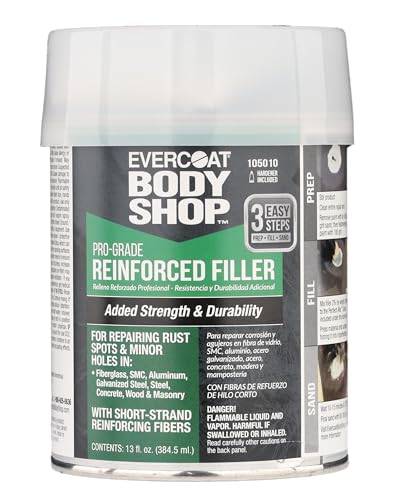
Brand: EVERCOAT Body Shop. This reinforced filler uses short strand fibers to deliver durability for dents in fiberglass, steel, aluminum, concrete, wood, and masonry surfaces. It includes a hardener for a convenient, ready-to-use mix.
Best for: General-purpose repairs on a variety of marine surfaces, including rust spots on metal and damage on fiberglass.
Why selected: Versatility across materials and ease of use make it a reliable all-around option for mixed-material repairs on boats.
Limitation: On deeper repairs, layering and proper curing between applications are important to prevent sagging or incomplete fill.
Buying Guide: Key Considerations For Marine Fillers
- Material compatibility: Choose fillers designed for fiberglass, with options for metal or wood if mixed substrates are present.
- Reinforcement type: Short strands offer strength for structural repairs; long strands add extra durability for larger patches.
- Water exposure: For underwater or always-wet areas, use waterproof or marine-grade formulations.
- Working time: Temperature affects cure time; plan for clamping, shaping, and sanding within the working window.
- Application method: Some putties require catalysts or hardeners; follow mixing ratios precisely to achieve proper cure.
- Finish quality: Sandability and paint compatibility influence the final appearance; prioritize products that sand smoothly and hold primer well.
- Repair size: For small holes, short-strand fillers often suffice; for large patches, long-strand reinforced or multi-layer repairs may be needed.
- Safety and cleanup: Work in a well-ventilated area and use protective gear; clean tools promptly to prevent curing in the container.
FAQs
- What is the difference between short-strand and long-strand fiberglass fillers?
Short-strand fillers provide good overall strength for small to medium repairs, while long-strand fillers offer higher durability for larger patches and structural work. - Can I use these fillers above and below the waterline?
Yes. Many marine-grade fillers are formulated for both above- and below-waterline repairs, but follow product instructions for curing and sealing. - Do I need a backing material for larger holes?
For holes larger than ½ inch, backing strips or cloth can improve adhesion and prevent sag during curing. - How do I know which filler is best for rust repairs?
Look for reinforced fillers designed for metal and rust spots; some products explicitly target rust areas on steel or aluminum surfaces. - Is there a difference between marine fillers and regular body fillers?
Marine fillers are formulated for exposure to sun, saltwater, and temperature changes; they typically cure to a tougher, more water-resistant finish. - How long does curing take?
Cure times vary by product and temperature; follow the manufacturer’s guidance for working time and full cure before finishing.