Best Boat Trailer Jacks for Easy Lifts and Safe Trailers
Answer: A heavy-duty bolt-on or swivel trailer jack with a wide lift range and dual wheels is ideal for boat trailers, RVs, and utility trailers. This guide highlights five strong options that balance load capacity, height range, and ease of use. Best for heavy front-end stability, best for low-profile tongues, best for quick dialing and mobility, best for cordless drill compatibility, and best for corrosion resistance. The right jack helps stabilize and level your trailer on uneven surfaces, protects the hitch, and reduces setup time for solo operators.
Summary of chosen products:
| Product | Capacity | Key Benefit | Best For |
|---|---|---|---|
| YOMILINK 2000 lbs Trailer Jack (Silver) | 2000 lbs | Dual wheels, wide height range, durable build | Heavy trailers, need stability |
| VEVOR Trailer Jack with Wheel | 1000 lbs | Easy installation, foldable, corrosion-resistant | Light to mid-weight trailers |
| Torin 1000 lbs Trailer Jack | 1000 lbs | Bolt-on design, reliable crank | Standard utility/boat trailers |
| FZZD 2000lbs Trailer Jack with Wheel | 2000 lbs | Ergonomic grip, wide lift range | Wide tongues and uneven ground |
| Kohree 2000 lbs Trailer Jack | 2000 lbs | Cordless drill compatibility, dual wheels | Convenient electric assist |
YOMILINK 2000 lbs Trailer Jack (Silver)

Capacity and range: 2000 lbs with a 25.5″ to 37.8″ lift, accommodating 3″ to 5″ trailer tongues. Best for heavy-duty trailers or boats with tall tongues. The dual-wheel design improves stability on soft ground.
Best for: Operators needing robust stability on uneven surfaces and frequent heavy-duty use. This jack is chosen for its high capacity and corrosion-resistant construction due to galvanized tubes and powder finish.
Caution: Bolting or welding to the tongue is required for mounting; ensure proper installation to maintain stability.
VEVOR Trailer Jack with Wheel

Capacity: 1000 lbs. Lift range from 12.8″ to 23″ with a single wheel and ergonomic handle. Best for mid-weight trailers and RVs, offering easy bolt-on installation and foldable design for ground clearance.
Best for: Trailer owners who want a balance of light weight, quick installation, and storage-friendly folding. Better for lower-profile trailers where ground clearance matters.
Caution: The single wheel design may require more effort on soft ground compared to dual-wheel models.
Torin 1000 lbs Trailer Jack with Wheel

Capacity and design: 1000 lbs, 10″ to 20.5″ adjustable, bolt-on tongue jack with a zinc-painted finish for corrosion resistance. A wind handle provides fast, smooth cranking for quick adjustments.
Best for: Users with standard utility or boat trailers who need a reliable, economical solution. Choose this if you want a traditional bolt-on jack with straightforward operation.
Caution: Check tongue dimensions to ensure compatibility; limited to 3″–5″ tongues like many bolt-on jacks.
YOMILINK 2000 lbs Trailer Jack (Black)
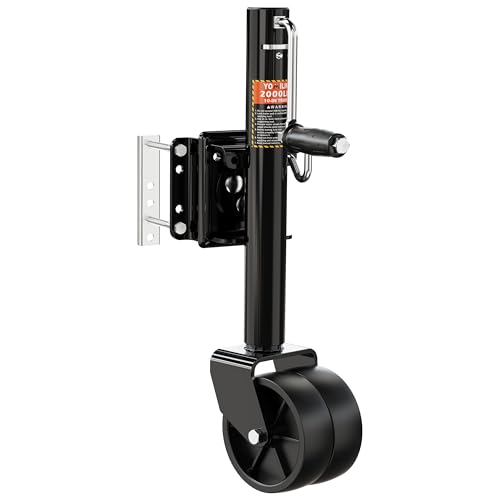
Capacity: 2000 lbs with a 25.5″–37.8″ lift range and 3″–5″ tongue fit. Features corrosion-resistant construction and a heavy-duty carbon steel build with galvanized inner and outer tubes.
Best for: Those needing identical capacity to the silver version but preferring a black finish and dual wheel setup for stability. Use when heavy-duty performance is a priority.
Caution: As with other bolt-on jacks, verify mounting hardware compatibility with your trailer frame before installation.
FZZD 2000lbs Trailer Jack with Wheel

Lift range and capacity: 25.5″ to 37.8″ with 2000 lbs capacity. The ergonomic grip provides easier control of lifting and lowering, especially on uneven surfaces, and the dual-wheel design supports smoother movement.
Best for: Trailer setups where long tongue heights and stable handling on bumpy ground are needed. Good for campers and larger boats with tall tongues.
Caution: The description emphasizes weight handling; ensure proper mounting and keep wheels on stable ground during operation.
Buying Guide
What capacity do I need?
Choose a jack with at least 1000 lbs for mid-weight trailers and 2000 lbs for heavy boats or larger campers. Higher capacity improves stability during lifting and reduces strain on the jack and tongue.
What lift height matters?
Evaluate the typical height difference between your trailer and the ground. A range around 12″–37″ covers most lakeside and road-use scenarios. A wider range helps on uneven ground or when parking on slopes.
Dual wheels vs single wheel
Dual wheels offer better stability on soft or uneven ground, while a single wheel keeps weight and cost down. For boats on sand or mud, prioritize dual-wheel designs.
Mounting method
Bolt-on jacks provide robust installation but require on-frame modification or proper brackets. Weld-on options can be permanent but demand more skill. Ensure compatibility with your trailer tongue dimensions (usually 3″–5″).
Materials and corrosion resistance
Look for powder-coated steel or galvanized tubes to withstand road salt, water exposure, and humidity. This extends the life of the jack in marine environments.
Ease of use and maintenance
Wind handles and ergonomic grips reduce effort. Some models offer foldable or swing-back designs to clear the ground when not in use. Regularly lubricate moving parts to extend life.
Cordless drill compatibility (optional)
Jacks like Kohree 2000 lbs offer drill compatibility, enabling faster lifts with a common 20–24V drill. This is helpful for frequent set-ups or solo operators.
Best practice tips
- Always chock wheels before lifting the trailer.
- Lower the trailer onto a solid support before disconnecting the tow vehicle.
- Inspect mounting bolts and replace any worn hardware.
FAQ
- What is a good ballast for a boat trailer jack? A jack with 1000–2000 lbs capacity provides reliable support for most boat trailers and RVs, with 2000 lbs recommended for tall tongues or heavy trailers.
- Can I install a trailer jack myself? Yes, most bolt-on jacks are designed for DIY installation using standard tools, but ensure you have the correct mounting hardware and follow the manufacturer’s instructions.
- Do I need dual wheels on a trailer jack? Dual wheels improve stability on soft ground and uneven surfaces, making them preferable for beach or mud settings.
- What maintenance is needed for trailer jacks? Regularly lubricate cranks and moving joints, inspect bolts, and clean off dirt and corrosion to extend life.
- Are cordless-jack options worth it? Cordless-drill compatible jacks offer speed and ease, especially for frequent setup, but consider battery and drill compatibility with your tools.
- Is there a universal tongue size I should measure? Most jacks fit 3″–5″ tongues; measure your trailer’s tongue width to confirm compatibility before purchase.