Best Boat Trailer Light Wiring Solutions for Safe Towing
When wiring boat trailer lights, reliability, corrosion resistance, and easy installation top the list. This guide highlights five top options ideal for re-wiring or upgrading trailer lighting on boats, utility trailers, and RVs. Each product is chosen for durability, color-coded wiring, and suitability for marine or outdoor conditions. This overview helps buyers pick the right kit for their trailer width and wiring needs.
Summary of selected products
| Product | Best For | Length / Reach | Key Benefit |
|---|---|---|---|
| 25Ft Trailer Wiring Harness Kit | Beginners and quick installs | 25 ft | Color-coded 5-wire Y-shaped harness for simple branching |
| ATQYZLM 22FT 4 Pin 5 Wire Harness | All-weather, long reach trailers | 22 ft | Foil-coated, corrosion-resistant, easy forked design |
| Oyviny 4 Pin 5 Wire Harness | Two-side taillight rewiring | 22 ft | Wishbone design; color-coded; nylon protection |
| VINAUO 35FT Wiring Harness | Long trailers needing more reach | 35 ft | Wishbone design; color-coded; corrosion-resistant |
| WALSIO 26FT Wiring Harness | Moderate-wide trailers | 26 ft | 18 AWG copper; braided nylon protection; waterproof plug |
25Ft Trailer Wiring Harness Kit With 5 Wires

The FZSFVAQ 25Ft Trailer Wiring Harness uses a Y-shaped connector to branch from multiple trailer sides, making installation faster for single-axle or dual-axle trailers. It features clearly labeled five wires for brake lights, turn signals, and running lights, helping even beginners wire confidently. The thick PVC coating and black nylon mesh add durability in outdoor and marine environments, with a waterproof/dustproof plug cover for environmental protection.
Best for: New trailers or replacement installs where quick, straightforward wiring is desired. Caution: Ensure the wiring length matches your trailer length to avoid excess slack or tension on the plug area.
ATQYZLM 22Ft 4 Pin 5 Wire Harness

ATQYZLM’s 22-foot 4-pin, 5-wire harness emphasizes robust, all-weather performance. The thick PVC insulation and 18 AWG pure copper conductors provide solid conductivity while a nylon net tube shields the wires. Its forked design eliminates most splicing steps, and color-coded labels plus a guide simplify the wiring process.
Best for: Heavier or longer trailers that require simple, splice-free installation and long reach. Caution: May be overkill for very short trailers under 80 inches wide where shorter harnesses are sufficient.
Oyviny 4 Pin 5 Wire Harness, 22Ft

Oyviny’s 22-foot 4-pin 5-wire harness uses a wishbone (Y) connector suitable for rewiring both sides of taillights without extensive splicing. It includes color-coded wires for brake, turn, and tail lights, and a black nylon net tube for durability, ensuring long service life in outdoor conditions.
Best for: Rewiring dual-sided taillights with minimal splicing. Caution: Check existing connector compatibility to ensure a seamless match with your trailer setup.
VINAUO 35Ft Wiring Harness
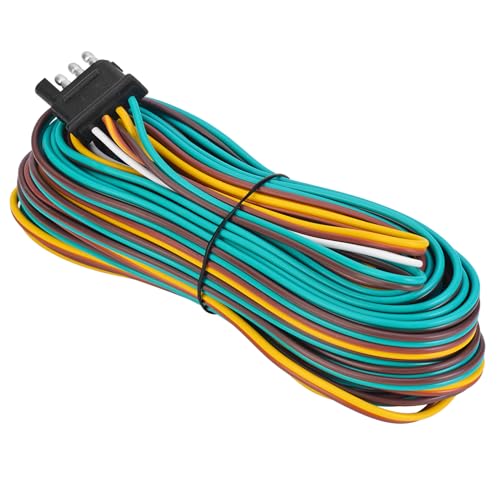
VINAUO’s 35-foot length provides ample reach for longer trailers. The 4-wire, color-coded wishbone design facilitates quick, safe connections with a 42-inch ground wire. The outer PVC jacket and corrosion-resistant materials help maintain performance near water or salt exposure.
Best for: Long trailers or installations requiring extended wiring runs. Caution: The longer length may be excessive for compact trailers where a shorter kit suffices.
LIMICAR 25ft Wishbone Harness

LIMICAR offers a 21-foot (listed as 25 ft total length with extension) 4-flat 5-wire harness designed to fit trailers up to 80 inches wide. It uses a wishbone design and 18-gauge details to minimize corrosion. The design supports easy installation by running wires down each trailer side, reducing the need for splicing.
Best for: Trailers of standard widths needing a straightforward, extendable harness. Caution: The 21–25 ft range may require additional length on very wide or irregular trailer frames.
Buying Guide: Key Considerations For Boat Trailer Wiring
- Trailer width and length: Choose length to comfortably reach from the vehicle to lights without strain. Longer kits work well for wide or long trailers, while shorter kits suit compact boats and utility trailers.
- Wire gauge and material: Look for 18 AWG copper conductors or better, with PVC insulation and protective nylon sleeves for outdoor, saltwater, or damp environments.
- Wiring design: Wishbone/Y-shaped designs simplify routing to both taillights; forked designs avoid splicing. Ensure the color-coding matches your vehicle’s wiring plan.
- Weather and water exposure: Marine-grade or IP-rated components reduce corrosion risk and prolong life in harsh elements.
- Ease of installation: Forked or color-coded harnesses are preferable for DIY installations. Include a guide or labeling to reduce mistakes.
- Compatibility: Confirm connector types match existing trailer or vehicle sockets; verify that the length and number of wires align with required connections (brake, tail, turn signals, and ground).
- Durability: Look for waterproof/dustproof plugs, braided nylon protection, and robust outer jackets to withstand road debris and salt spray.
Frequently Asked Questions
- What is the difference between a 4-pin and a 5-wire trailer harness?
– A 4-pin harness typically carries power for tail lights and ground, while a 5-wire adds separate wires for brake and turn signals, enabling more complex lighting configurations. - Do I need a marine-rated trailer wiring kit for boat trailers?
– Marine-rated or weatherproof kits are recommended for boat trailers due to exposure to water, salt, and humidity, which can accelerate corrosion. - Is a longer wiring harness always better?
– Not always. Choose a length that provides ample clearance and slack without excess bulk. Too long a harness can snag or fray during travel. - Should I splice wires or use a forked/yielding harness?
– Forked/yielding harness designs reduce the need to splice, lowering the risk of poor connections and simplifying installation for DIYers. - Can I mix harness brands on a single trailer?
– Mixing brands is possible but ensure compatibility of wire color-coding and connector types to prevent miswiring of brake/turn signals. - What maintenance helps trailer wiring last longer?
– Periodically inspect connectors for corrosion, keep plugs clean and dry, and apply dielectric grease to reduce moisture intrusion.