Best Boat Trailer Lift Jacks for Easy Lifting and Secure Trailers
Answering the need for reliable boat trailer lift jacks, this guide highlights five solid options aligned with common trailer sizes and mounting methods. Suitable buyers include DIY enthusiasts, rig owners, and anyone seeking smoother, safer tongue lifting. The selected models emphasize durability, ease of installation, and corrosion resistance. Use the quick comparison table to compare lift capacity, travel range, and mounting style at a glance.
| Product | Lift Capacity | Lift Range | Mounting | |
|---|---|---|---|---|
| Torin 1000 lbs Trailer Jack | 1000 lbs | 10.5″ to 20.5″ | Bolt-on, 3″–5″ tongue | Small to mid-size trailers |
| YOMILINK 2000 lbs Trailer Jack | 2000 lbs | 25.5″ to 37.8″ | Bolt-on or weld | Heavier trailers, long tongues |
| VEVOR Trailer Jack 1000 lbs | 1000 lbs | 12.8″ to 23″ | Bolts to tongue; swivels up | Versatile trailer heights |
| MAXXHAUL 1000 lbs Swing Back | 1000 lbs | — | Bolt-on, swivels | Compact, simple swap-out |
| TOWKING 2000 lbs Upgraded | 2000 lbs | 12″ retracted to 22″ extended | Bolt-on | Medium to large trailers |
Notes: All products listed are designed to stabilize and raise trailer tongues. Replacement wheels, cranking hardware, and corrosion resistance are common features. When choosing, consider tongue thickness, mounting method, and whether you need wheel assistance or a purely stationary jack.
Torin 1000 lbs Trailer Jack

The Torin model provides a 1,000-pound lift capacity with a bolt-on design for tongues measuring 3″ to 5″. It features a 10″ to 20.5″ height range and a corrosion-resistant zinc finish. The wind handle enables fast, smooth cranking for quick setup. Best for smaller to mid-sized trailers or RVs where a light-to-moderate load needs reliable support. Limitation: a single wheel may require more careful positioning on soft terrain.
YOMILINK 2000 lbs Trailer Jack

The YOMILINK jack offers a robust 2,000-pound capacity with a long lift range from 25.5″ to 37.8″, suited for tall or long-travel tongues. It supports bolt-on or welded mounting, with a wind handle for smooth cranking. Made from heavy-duty carbon steel with corrosion-resistant tubes. This option is best for heavier trailers and boats with tall tongues, especially when you need extended travel. Caution: ensure proper weld or bolt alignment for secure mounting.
VEVOR Trailer Jack with Wheel

VEVOR provides 1,000 pounds of lifting power with a 12.8″ to 23″ lift range and a single wheel setup. The jack is bolted to the tongue and can swivel for storage, reducing ground clearance concerns. It uses alloy steel with inner and outer tubes for rigidity and corrosion resistance. Best for owners needing a compact, reliable jack that remains out of the way when not in use. Limitation: single wheel can be less stable on uneven surfaces.
MAXXHAUL 10″ Lift Swing Back

MAXXHAUL offers a 1,000-pound lift with a swing-back design for towing convenience. It features a bolt-on installation and a durable steel construction with a protective finish for outdoor use. This option is ideal for small-to-medium trailers that require a straightforward, durable jack that can be rotated to clear the trailer or stored against the tongue. Limitation: if you frequently use very tall tongues, check the lift range to ensure full extension fits your needs.
TOWKING 2000 lbs Upgraded
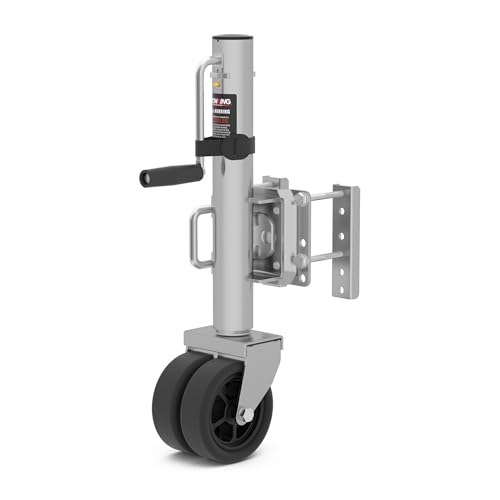
The TOWKING jack provides a 2,000-pound capacity with a 12″ retracted and 22″ extended height. It features an upgraded PP wheel and reinforced spoke axle for smoother operation under heavier loads. Best for medium-to-large trailers that require substantial lifting power and stable performance. Caution: ensure the wheel assembly is properly lubricated for long-term performance.
Buying Guide: Key Considerations For Boat Trailer Jacks
- Lift capacity: Match the jack capacity to the trailer tongue weight. Choose 1.5–2x your expected load for safety.
- Mounting method: Bolt-on is common, but welding can offer extra security on some builds. Verify tongue thickness compatibility.
- Lift range: Consider both lowest and highest heights needed to clear the ground and reach the desired tongue height.
- Wheel design: A single wheel is lighter; dual wheels offer more stability on uneven terrain. Wheel material affects durability on saltwater environments.
- Corrosion resistance: Look for zinc or galvanized finishes and alloy steel for outdoor exposure near water.
- Storage and maneuverability: Swivel-down or swing-back designs save ground clearance during towing and storage.
- Installation ease: Models with clear instructions, included hardware, and simple mounting save setup time.
Frequently Asked Questions
- What is the typical lift capacity needed for a boat trailer tongue jack?
– Most small-to-mid trailers use 1000 lbs, while larger or heavier boats may require 2000 lbs or more. - Should I bolt or weld my trailer jack to the tongue?
– Bolting is common and reversible; welding provides a secure, permanent mount, often used for larger trailers. - What is the advantage of a swing-back design?
– It reduces ground clearance issues and keeps the jack out of the way during towing. - How important is corrosion resistance for trailer jacks?
– Essential for longevity, especially in saltwater environments or frequent exposure to moisture. - Can I use a trailer jack on uneven terrain?
– Some jacks include wider wheels or dual-wheel configurations for improved stability; ensure the terrain matches the jack’s design. - Is a higher lift range always better?
– Not always; choose a range that fits your trailer height and storage space to avoid overextension or under-extension.