Best Boat Fuel Sending Units for Accurate Tank Readouts and Easy Installation
Answering common buyer needs, this guide highlights reliable boat fuel tank sending units that fit a wide range of depths and tank types. These selections are best for boaters, RV enthusiasts, and automotive users who need accurate fuel or water level readings without complex wiring. Each entry includes mounting compatibility, measured range, and installation notes to help you pick the right sender for your tank depth and gauge. A quick comparison table is included to summarize core specs at a glance.
| Product | Tank Depth Range | Output | Best For |
|---|---|---|---|
| Marine Fuel Sending Unit, CLLOMAGY (6-12 in) | 6-12 inches | 33-240 ohms | Small to mid-size tanks; tight spaces |
| Marine Fuel Tank Sending Unit, CLLOMAGY (4-28 in) | 4-28 inches | 33-240 ohms | Versatile depths; deeper tanks |
| RUPSE Fuel Sender Unit (8″ / 200mm) | 8 inches | 240-33 ohms | Medium tanks with stainless build |
| Rupse Fuel Sender Unit (6″ / 150mm) | 6 inches | 240-33 ohms | Compact boats and vehicles |
| Seweder Fuel Tank Sending Unit (11″ / 280mm) | 11 inches | 240-33 ohms | Long tanks; broad applications |
Marine Fuel Sending Unit, 6-12″ Depth

The CLLOMAGY Marine Fuel Sending Unit is designed as a direct replacement for broken boat fuel sending units in marine tanks, with compatibility for 6–12 inch depths. It reads fuel and water level information in gasoline systems and RV or truck applications. It is described as flexible and adjustable, cuttable to tank depth and operable in tight spaces by rotating and re-tightening after alignment. This unit is best for boaters needing a quick, adjustable retrofit in mid-sized tanks. A potential limitation is the need to confirm exact tank depth to avoid over- or under-rotation during installation.
Marine Fuel Tank Sending Unit, 4-28″ Depth

This CLLOMAGY unit covers a broad 4–28 inch depth range and uses the same 33–240 ohm output as standard gauges. It is suitable for boats, RVs, cars, and trucks with various tank depths. It is best for owners upgrading older, deeper tanks or those who anticipate future depth needs. A caution: verify compatibility with existing dash gauges and mounting patterns to ensure a precise fit.
RUPSE Fuel Sender Unit, 8″ (200mm)
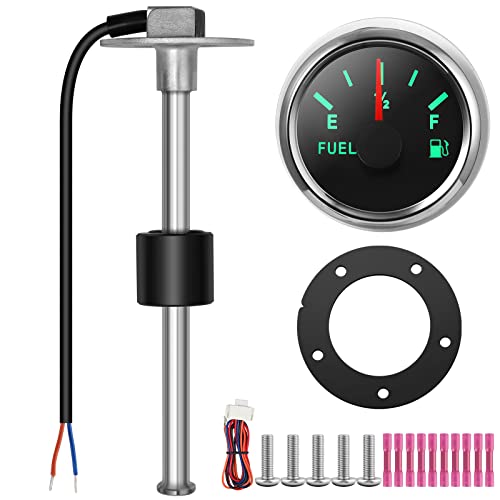
RUPSE’s 8″ stainless steel fuel sender combines high-precision reed switches with corrosion-resistant construction for reliable long life. It supports 240-33 ohm gauges and features eight backlight colors for legibility in various lighting conditions. The SAE 5-hole mounting and included gasket ensure sealing and oil resistance. It is best for medium tanks in boats or RVs where durability and clear display are priorities. Limitation: installation requires proper mounting alignment to achieve full-scale readings.
Rupse Fuel Sender Unit, 6″ (150mm)

The 6″ Rupse sender offers corrosion-resistant stainless steel construction with reed switches and IP67-rated waterproofing. It uses 240-33 ohm output and includes eight backlight colors for easy reading in sun or low light. With SAE 5-hole mounting and a gasket, it provides straightforward installation. Best for compact or smaller tanks where precise readings and quick wiring are needed. A caveat is ensuring the 6″ depth matches your tank’s actual distance from the gauge.
Seweder Fuel Tank Sending Unit, 11″ Depth

Seweder’s unit is calibrated for 240-33 ohms output and is designed for long tanks up to 11 inches depth. It uses 316 stainless steel for durability and a reed switch mechanism for stable readings. It supports multiple vehicle types (boat, auto, trucks, buses, marine) and is suitable for use with both fuel and water level gauges. Choose this if you need a robust, longer-depth sender for a wide range of applications. Limitation: verify that your current gauge supports the 240-33 ohm range if you are substituting an older unit.
Buying Guide: Key Considerations For Choosing A Boat Fuel Sending Unit
- Tank depth compatibility: Match the tank depth to the sender’s operating range (e.g., 6-12″, 4-28″, or 11″). If in doubt, choose a unit with a broader depth range.
- Output compatibility: Ensure the sender’s electrical output (commonly 33-240 ohms) matches your dash gauge for accurate readings.
- Material and durability: Stainless steel bodies and reed-switch sensors offer corrosion resistance and longer life in marine environments.
- Installation basics: Look for SAE 5-hole mounting patterns and included gaskets for easy, leak-free installation.
- Backlighting and readability: Units with backlit gauges improve visibility in bright sun or night conditions.
- Flexibility and adjustability: Some models allow cutting or rotation to fit non-standard tank depths or tight spaces.
- Fuel vs water sensing: Confirm whether the unit is intended for fuel, water, or multi-use readings to avoid measurement inaccuracies.
Frequently Asked Questions
- What does the 240-33 ohm rating mean? The rating describes the electrical resistance range corresponding to empty (240 ohms) to full (33 ohms) on the gauge.
- Can I install a sender in any fuel tank? Not all tanks match every depth or pattern. Verify depth, mounting pattern, and seals before installation.
- Are stainless steel senders more durable? Yes, they resist corrosion better in marine environments, extending service life.
- Do all senders require wiring diagrams? Yes. Wiring diagrams help ensure correct wiring and accurate readings, especially for multi-gauge dashboards.
- What is the advantage of backlit gauges? Backlighting improves readability in bright sun or low light, reducing misreadings.
- Can I replace only the sender without changing the gauge? If the new sender matches the gauge’s output range and mounting pattern, replacement is often possible.