Best Boat Bow Tie Down Solutions for Safe Towing and Loading
Answering the need for secure, reliable boat bow tie downs, this guide highlights options suited to different towing and loading situations. The top picks include heavy-duty chains, quick-release straps, and retractable bow ties designed to resist corrosion and handle marine conditions. Choose based on boat size, trailer setup, and preferred installation style. This overview helps beyond brand names by explaining what makes each option strong, and who will benefit most from it.
| Product | Best For |
|---|---|
| Tie Down Store Tie Down Safety Chain | Heavy-duty towing with quick setup; ideal for traditional bow eye and winch stand systems |
| BoatBuckle Pro Series Kwik-Lok Straps | Simple, one-hand adjustments for varied trailer frames; best for frequent hook-and-go use |
| BoatBuckle F14220 G2 Retractable Bow Tie-Down | Saltwater or brackish environments; preferred for retractable, low-profile needs |
| BoatBuckle Kwik-Lok Bow Tie-Down Straps with Loop End | Universal frame compatibility; straightforward loop-end hookup for quick installs |
| STAR BRITE Tie Down Bow | Durable webbing with rapid quick-release; good for frequent securing and release cycles |
Tie Down Store Tie Down Safety Chain

This heavy-duty 3/16 inch proof coil steel chain, combined with a 3/8 inch zinc-plated S-Hook and wire latch, keeps the boat securely attached to the bow stand. It is designed for long-lasting marine performance in both saltwater and freshwater environments. Best for buyers who prioritize a traditional chain connection that does not rely on straps. A potential limitation is that install effort can be higher if the bow eye or winch stand configuration varies from standard setups.
BoatBuckle Pro Series Kwik-Lok Bow Tie-Down Straps with Loop End
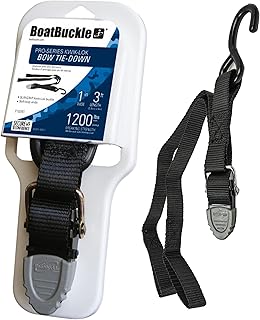
These 1″x36″ straps deliver a 1,200 lbs break strength with a 400 lbs safe working load. The SUR-Grip Kwik-Lok buckle enables one-handed adjustment, making them a practical choice for boats on trailer frames with limited access. Best for regular trailer users who want a reliable, quick-adjust solution. Limitation: high-strength straps may require careful storage to prevent UV degradation over time.
BoatBuckle F14220 G2 Retractable Bow Tie-Down

Designed for brackish or saltwater environments with anti-corrosive construction, this retractable bow tie-down features a standard S-hook to protect the boat’s finish. It is best for sailors who need a low-profile, easy-to-stow solution on trailers where space is at a premium. Limitation: retractable mechanisms can require periodic maintenance to ensure smooth operation in marine salt and debris conditions.
BoatBuckle Kwik-Lok Bow Tie-Down Straps with Loop End

This 1″x3′ strap set uses a Kwik-Lok buckle with a quick-release latch, enabling one-handed adjustment. It pairs with universal trailer frames and offers a 1,200 lbs break strength with a 400 lbs safe working load. Best for users who need a flexible, easy-to-hook bow strap with reliable tension. Caution: ensure loop-end length comfortably reaches the I-beam or center tongue to avoid slack during travel.
STAR BRITE Tie Down Bow 1″ x 36″

STAR BRITE offers high-quality polypropylene webbing with heavy-duty components and a quick-release buckle for fast securing and release. It supports up to 1,200 lb rated capacity with a 400 lb safe working load, making it versatile for a broad range of trailer configurations. Best for users who value quick operation and reliable load management. Limitation: polypropylene may elongate slightly under constant tension in extreme heat or direct sun over time.
Buying Guide
Key considerations when choosing a boat bow tie-down system:
- Load ratings: Determine the safe working load (SWL) and break strength to match boat weight and trailer use. Higher loads are beneficial for faster highway speeds and rough terrain.
- Material and corrosion resistance: Marine-grade steel, zinc plating, and stainless components improve longevity in saltwater and humid environments.
- Installation style: Chains, straps, and retractable systems have distinct installation needs. Consider bow eye, winch stand compatibility, and whether quick-release features add real value for your routine.
- Ease of use: One-handed adjustments, quick-release mechanisms, and loop-end versatility reduce setup time and errors during loading and unloading.
- Fit and compatibility: Universal trailer frames versus specialized frames affect which product will install without adapters or modifications.
- Storage and durability: Retractable and strap-based systems vary in bulk and maintenance requirements. Protect components from sun exposure and abrasion when not in use.
FAQ
- What is a bow tie-down and why is it important?
A bow tie-down secures the bow area of a boat to the trailer, preventing movement during towing and launching. It helps protect the boat finish and protects against load shifts during travel. - When should I choose straps over a chain?
Straps are quicker to install and adjust, and they avoid metal-on-metal wear on the bow eye. Chains offer a traditional, rugged connection and may be preferred for certain bow eye designs. - Are retractable bow tie-downs more expensive?
Retractable systems typically cost more upfront but save space and reduce snag potential on the trailer. - How do I determine the correct load rating?
Match the SWL to your boat’s weight and trailer dynamics, including highway speeds and potential sea conditions you expect to encounter. - Can I mix different bow-down types on one trailer?
You can mix types if each meets the required load ratings and installation compatibility, but consistency tends to simplify usage and maintenance. - Do these devices require maintenance?
Yes. Inspect corrosion protection, latches, and buckle mechanisms regularly, especially after exposure to saltwater or bilge water.