Best Boat Battery Charger Inverter Solutions for 12V Systems
Whether you’re outfitting a small fishing boat or a full‑scale marine vessel, having a reliable boat battery charger is essential. This guide focuses on 12V onboard charging solutions that work well with lead‑acid, AGM, and LiFePO4 batteries, helping you pick the right bank count and amperage for your setup. The featured models suit different buyers: casual weekend cruisers, serious anglers, and boat owners who need 24/7 maintenance and dead‑battery recovery. The table below highlights the five products selected for clear comparison.
| Product | Banks / Total Amps | Best For | Key Benefit |
|---|---|---|---|
| NOCO Genius GEN5X2 | 2 banks, 10A total (5A per bank) | Multi‑battery boats with varied battery types | Independent bank charging with flexible modes |
| SOARFLY 3 Bank Marine Charger | 3 banks, 30A total (10A each) | Boats needing simultaneous multi‑battery care | Independent mode per battery, 3 types supported |
| FirstPower Pro 2 Bank 5X2 | 2 banks, 10A total (5A per bank) | All‑around boats with 12V systems | IP68 waterproof, 24/7 charging capability |
| NOCO Genius GEN5X1 | 1 bank, 5A | Compact systems or space‑limited boats | Smallest NOCO option with full modes |
| NOCO Genius GEN5X3 | 3 banks, 15A total (5A per bank) | Medium to larger boats with multiple batteries | Three independent charging channels |
NOCO Genius GEN5X2: 2‑Bank, 10A Onboard Battery Charger

Best for boats with two battery banks requiring independent charging. The GEN5X2 delivers 5A per bank and supports 12V lead‑acid and lithium systems. It includes temperature compensation and overcharge protection for safer maintenance. This unit is compact for its power and robust for marine environments. Choose this if you operate a mid‑sized vessel with separate starting and deep‑cycle batteries and want precise per‑bank control.
Limitations: While flexible, it charges two banks only, so a boat with more than two batteries may need an additional charger or a larger bank system.
SOARFLY 3 Bank Marine Charger, 12V 30A

This three‑bank charger is best for boats that require charging of three separate batteries or battery banks. It delivers 10A per bank and supports 12V SLA/AGM, Li‑ion, and calcium batteries. Each battery can be controlled independently, which helps with customized charging strategies. It’s a strong pick for anglers or larger kayaks with more complex electrical setups.
Caution: The three‑bank setup may be more complex to wire for first‑time installers; ensure your mounting and wiring meet marine compliance standards.
FirstPower Pro 2 Bank 5X2: 12V Waterproof Onboard Charger

Best for boats seeking rugged, all‑weather reliability with 24/7 charging. This 2‑bank, 5A per bank charger is IP68 waterproof and supports SLA/AGM, LiFePO4, calcium, and deep‑cycle batteries. Independent mode per bank provides flexibility for mixed battery types on a compact platform.
Limitation: While robust, the 2‑bank design may be insufficient for boats with three or more batteries needing separate monitoring.
NOCO Genius GEN5X1: 1 Bank, 5A Charger
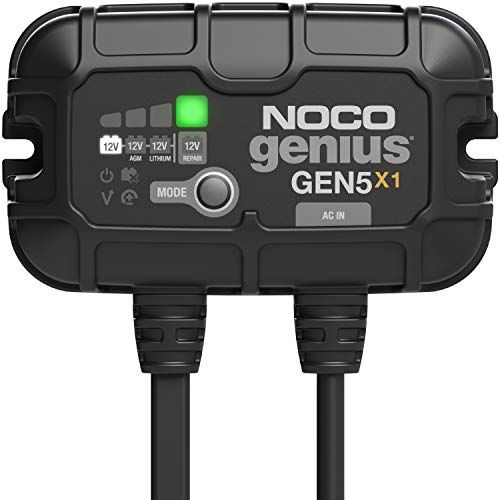
Best for small vessels or tight installations with a single battery. The GEN5X1 offers a full range of charging modes for 12V lead‑acid and Li‑ion batteries, with temperature compensation for optimal performance. It’s a compact, efficient solution for boats with a single battery bank or limited space.
Recommendation: Choose this if space is at a premium and you only need to maintain one battery bank reliably.
NOCO Genius GEN5X3: 3 Bank, 15A Onboard Charger
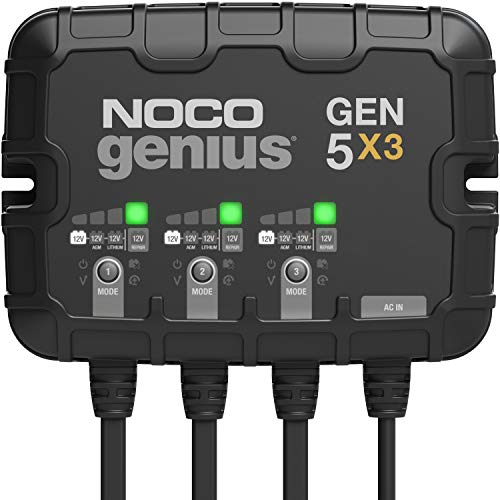
The GEN5X3 is designed for medium to larger boats with multiple batteries. It provides 5A per bank across three independent channels, suitable for mixed battery chemistries. This model supports lead‑acid and lithium systems with temperature compensation and overcharge protection. It’s a balanced choice when you need more than two banks without stepping up to a larger system.
Best for: Boats with three distinct batteries needing separate, precise charge control. Limitation: More complex wiring and space requirements than a two‑bank unit.
Buying Guide: Key Considerations for Boat Battery Chargers
What battery types will you charge? Most marine chargers support lead‑acid, AGM, gel, calcium, and LiFePO4. Verify compatibility with your battery types before buying.
How many banks do you need? The number of banks determines how many batteries you can independently charge. More banks offer flexibility but require more installation space and wiring.
Do you need temperature compensation? Chargers with temperature sensors adjust charging based on ambient temperature, preventing overcharge in heat and undercharge in cold conditions.
Is waterproofing or IP rating important? For open‑top or splashy environments, IP68 or similar waterproofing helps protect electronics in harsh marine conditions.
What about charging modes? Look for 12V, 12V AGM, 12V Li‑ion, and a Repair/Desulfation mode if you have older or deeply discharged batteries that need a boost.
Installation considerations: Some models are designed for direct mounting under hatches or near the battery; others are more portable. Ensure mounting brackets and wiring routes meet marine safety standards.
Frequently Asked Questions
- What is the advantage of a multi‑bank charger on a boat? It allows independent charging of each battery, preventing cross‑charging issues and preserving battery life.
- Can these chargers handle LiFePO4 batteries? Yes, most models listed support LiFePO4 along with lead‑acid variants.
- Should I get a charger with temperature compensation? Yes, it helps optimize charging across varying temperatures, increasing battery longevity.
- Is waterproofing necessary for inland boats? For enclosed or dry storage, basic waterproofing may suffice, but exposed installations benefit from higher IP ratings.
- Do I need 24/7 float charging? If your vessel sits unused for long periods, a maintainer/float mode helps keep batteries topped up without overcharging.