Best Battery Selector Switches for Boats
The best battery selector switches for boats let you isolate, combine, or switch between battery banks with confidence. These options are ideal for boat owners who want reliable starting power, independent charging, and safer storage. This guide highlights five top picks designed for 12–48V systems, noting who each is best for and why it stands out. A quick buyer table is provided below to help you compare at a glance.
Quick comparison table
| Product | Best For | Voltage Range | Position Options |
|---|---|---|---|
| Seachoice Battery Select Switch | Two or more batteries, simple isolation | 12-50V | Dual |
| Blue Sea 4-Position Mini Selector | Compact spaces, emergency combine | Up to 32V | 4-Position |
| RED WOLF 1-2-Both-Off | Flexible battery management, heavy use | 12-48V | 4-Position |
| Blue Sea e-Series 4-Position | Engine room mounting, compact install | Up to 32V | 4-Position |
| Nilight 90015A | Durable for harsh environments | 12-48V | 4-Position |
Seachoice Battery Select Switch, Disconnect Isolator Cutoff

The Seachoice option is designed for systems with two or more batteries and voltages up to 50V. It permits selection between batteries for starting, charging, or operation in parallel. It is UL listed, ignition protected, and CE approved, which can reassure buyers seeking standard compliance. Best for boaters who want a straightforward, reliable way to switch between batteries without a complex setup.
Best for: Small to mid-sized boats needing a simple, dependable switch between two battery banks.
Limitation: This unit emphasizes basic selection rather than advanced multi-battery management features. Consider additional protection if you require frequent or complex battery balancing.
Blue Sea Systems 4-Position Mini Selector

This compact unit supports installation in tight spaces and offers three mounting methods for flexible placement. It includes an emergency combine feature to draw power from both batteries during engine starting or essential radio use, which helps maintain critical systems when one battery is low. Best for boats with limited cockpit or cabinet space and a need for reliable emergency power.
Best for: Tight installations where space is at a premium and you still want an emergency combine option.
Caution: While compact, verify clearance around mounting surfaces to ensure proper heat dissipation and wiring clearance in your install area.
RED WOLF 1-2-Both-Off Battery Switch

This 12–48V heavy-duty switch offers 200A continuous and 300A intermittent rating, with a 1-2-Both-Off 4-position function for flexible control. It supports a maximum power busbar of 250A under certain conditions and emphasizes isolation for maintenance or preventing parasitic drain. Best for high-demand maritime setups that require strong isolation and versatile battery linking capabilities.
Best for: Heavier electrical loads where robust isolation and multiple configuration options are needed.
Limitation: The current rating can depend on temperature and humidity; plan for heat management in hot engine rooms or sun-exposed panels.
Blue Sea Systems e-Series 4-Position Battery Switch
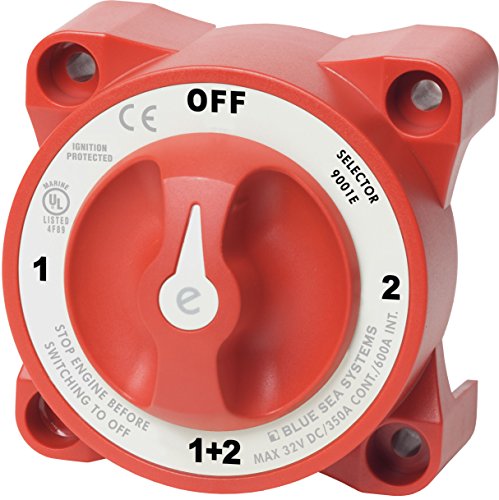
The e-Series 4-Position switch is designed for compact installation, with multiple mounting options and an ignition-protected build suitable for engine rooms in gasoline-powered boats. It offers standard four-position operation to isolate or combine battery banks as needed. Best for boats where engine-room protection and space-saving design are priorities.
Best for: Boats with constrained spaces and a need for ignition-protected components.
Caution: Ensure compatibility with your boat’s wiring gauge and panel design to avoid overloading adjacent components.
RVMARINEPAT Battery Disconnect Switch

This 12V-48V, 300A heavy-duty switch offers four-position control (1-Both-2-Off) for versatile battery management. It features a make-before-break design to avoid power loss during switching and includes mounting screws for straightforward installation. Best for boaters seeking uninterrupted power switching and a defensive off position to prevent parasitic drain.
Best for: Users who prioritize uninterrupted power during transitions and a total off option for storage.
Limitation: Cables must be compatible with the terminal sizes up to 2/0 AWG; verify cable availability and routing on your vessel.
Nilight 90015A Battery Switch

Nilight’s 90015A unit is a heavy-duty, waterproof switch designed for DC 12–48V systems. It emphasizes isolating and securing the electrical system, with 4-position operation for flexible battery management. Best for boats exposed to wet environments or needing a rugged, water-resistant solution.
Best for: Harsh marine conditions where water resistance is a top priority.
Limitation: Ensure the waterproof rating matches your exact mounting location and that the terminals are accessible for maintenance.
Malictele 300A 4-Position Battery Switch

Malictele offers a 300A, 12–48V 4-position switch with a 1-Both-2-Off configuration and a robust ABS housing with tinned copper studs. The unit supports switching between separate battery banks and the combined output to loads, with a make-before-break design to prevent power interruption. Best for users who need reliable, sturdy construction and straightforward installation.
Best for: Boats requiring strong plastic housing and solid electrical separation with easy installation.
Limitation: Check the mounting space and cable routing to ensure the knob and terminals do not interfere with other hardware.
Attwood 14230-3 Single Pole 4-Way Selector

Attwood’s single-pole 4-way selector is versatile for DC systems from 6 to 32 volts. It is rated for 300 amps continuous at 6 volts and 150 amps at 12 volts, and includes an automatic alternator field circuit disconnect to protect electronics on boats. Best for owners seeking broad voltage compatibility and built-in surge protection.
Best for: Boats with diverse electrical setups needing versatile voltage support and added circuitry protection.
Limitation: Higher continuous current is specified at lower voltages; confirm your actual system’s operating voltage to avoid overloads.
Buying Guide
Key considerations when choosing a boat battery selector switch:
- Voltage range and current rating: Match the switch to your boat’s battery bank voltage (most are 12–48V) and anticipated load. Higher amperage is advantageous for powering starters and heavy electronics.
- Number of positions: Four-position switches (1, 2, Both, Off) offer flexible control for maintenance, starting, and emergency use. Two-position units are simpler but less versatile.
- Make-before-break vs break-before-make: Make-before-break helps avoid temporary power loss during switching, while break-before-make ensures complete isolation when needed. Choose based on critical load profiles.
- Mounting space and installation: Compact designs help in tight engine rooms or panels. Check mounting options (surface, rear, flush) to fit your boat’s layout.
- Protection features: Ignition protection, waterproof housing, and surge or field-disconnect features safeguard electronics in marine environments.
- Professional considerations: If you frequently operate multiple electronic loads, a switch with an emergency combine or automatic alternator disconnect can improve reliability and safety.
FAQ
- What is a battery selector switch for boats used for?
It allows you to switch between batteries, combine banks for extra power, or isolate batteries to prevent drain, especially during storage or maintenance.
- What does make-before-break mean in this context?
It means the new connection is made before the old one is broken, reducing the risk of power drop to critical devices during switching.
- How many batteries can these switches typically manage?
Most four-position models support two battery banks and a combined Both option, but always verify the product specs for your chosen unit.
- Are marine battery switches ignition protected?
Many models are designed to be ignition protected, which helps reduce ignition risks in engine compartments.
- Can I install these switches myself?
Installation ranges from simple surface mounting to rear-panel mounting. Follow the manufacturer’s wiring diagrams and, if unsure, consult a marine electrician.