Best Battery Chargers for Boats: Reliable Onboard Power for All Marine Needs
Answering the question for boat owners: the best battery chargers for boats are compact, multi-bank units that can safely charge and maintain 12V and 24V marine batteries, including lead-acid, AGM, LiFePO4, and deep-cycle types. This guide spotlights top options designed for harsh marine environments, with clear notes on who benefits most from each model. Ideal buyers range from weekend sailors needing reliable maintenance to hardcore offshore skippers requiring advanced protection and flexible charging modes.
| Product | Bank Count | Total Amps | Best For | Key Limitation |
|---|---|---|---|---|
| NOCO Genius GEN5X3 | 3 | 15A | Boats with multiple battery banks and LiFePO4 or lead-acid | Higher budget; requires mounting space |
| NOCO Genius GEN5X2 | 2 | 10A | Smaller boats needing reliable dual-bank charging | Limited to two banks |
| FirstPower Pro 2 Bank 5X2 | 2 | 10A | Rugged, IP68-rated charger for wet environments | Brand less known than NOCO |
| NOCO Genius GEN5X1 | 1 | 5A | Compact boats or cramped bilge spaces | Single-bank only |
| NEXPEAK NC201 | 1 | 10A | Versatile 12V/24V charging with repair mode | Some complexity in modes |
NOCO Genius GEN5X2: 2-Bank, 10A Onboard Charger
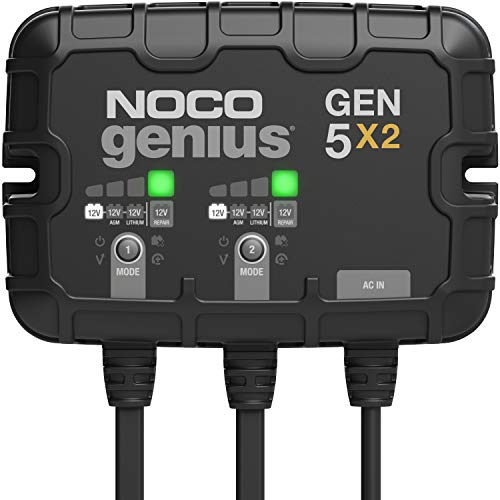
This two-bank charger delivers 10 amps total with 5 amps per bank. It supports 12V lead-acid and lithium batteries, including AGM and LiFePO4, and offers modes for 12V, 12V AGM, 12V Lithium, and a Repair Mode. Best for boats with multiple battery setups that need independent, flexible charging and temperature-aware protection. Choose this if you operate a mid-sized craft with both starting and house batteries and want robust overcharge protection. A potential limitation is the need for adequate mounting space and a higher price point than single-bank models.
Who it’s best for: boaters with two separate battery banks (starter and house) who value independent regulation and precise modes per bank. Also suitable for anglers or cruisers who maintain LiFePO4 systems in harsh marine conditions.
Why selected: its compact design, proven NOCO protection features, and multi-mode selection provide reliable compatibility across battery chemistries while preserving battery life through smart temperature compensation.
Caution: Ensure the charger is correctly wired to each bank to prevent crossbank confusion and verify your battery types before selecting modes.
Smart 2 Bank Marine Battery Charger, 10A

This 2-bank unit provides 10A total (5A per bank) and is built for 12V batteries used in marine and boat systems. It automatically switches to float charging when full and supports 12V SLA/ AGM, 12V Lithium, and 12V Calcium. It can independently set modes per bank, making it versatile for mixed battery chemistries on a single vessel. Best for boats that need both maintenance and charging while underway or in storage. A caveat is that some users may find the mode selection steps require a moment to familiarize themselves with the interface.
Who it’s best for: owners with two batteries of different chemistries or a system that alternates between use and storage. It’s also suitable for boats that require dead-battery revival with dedicated mode access.
Why selected: the independent bank control and automatic mode switching provide a strong balance of convenience and protection for a mid-sized boat portfolio.
Caution: Activation of dead-battery recovery may require holding a button for several seconds; plan charging in calm, safe conditions.
NOCO Genius GEN5X3: 3-Bank, 15A Charger
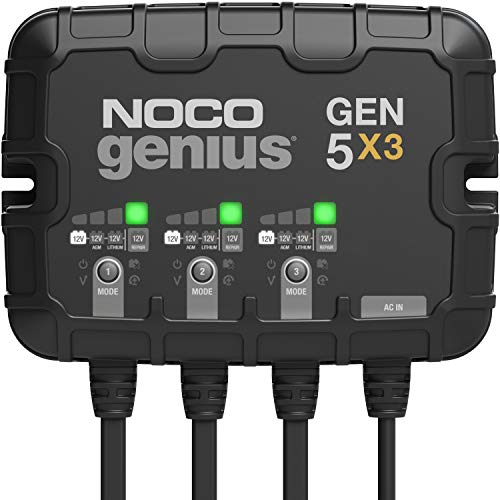
The GEN5X3 offers three banks with a combined 15 amps total, 5 amps per bank. It features selectable charging modes for 12V, 12V AGM, 12V Lithium, and a 12V Repair Mode, enabling precise maintenance for lead-acid and lithium batteries across multiple boats or offshore setups. Best for larger vessels with multiple households or engine batteries and when you need robust protection against overcharge and temperature fluctuations. A limitation is its higher price compared to 2-bank or single-bank options.
Who it’s best for: skippers with several battery sources (starter, house, and deep-cycle) who require reliable, independent charging across banks and strong environmental resilience.
Why selected: this model maximizes onboard flexibility for complex electrical systems while maintaining safety through temperature compensation and overcharge protection.
Caution: Ensure your panel space can accommodate the larger chassis and mount the unit securely to avoid vibration issues at sea.
FirstPower Pro 2 Bank 5X2

This 2-bank charger offers 10A total (5A per bank) with IP68 waterproof protection, making it suitable for exposed installations and spray-prone environments. It supports 12V SLA/ AGM, 12V Lithium, and 12V Calcium modes, and can charge two batteries simultaneously with independent mode selection. Best for rugged coastal boats or vessels stored in wet conditions. A potential limitation is that FirstPower Pro is less widely recognized than NOCO, which may influence user confidence for some buyers.
Who it’s best for: boats that operate in saltwater or require reliable waterproof-grade components and 24/7 on-board charging capability.
Why selected: IP68 rating, independent bank control, and compatibility with multiple chemistries make it a practical, durable option for demanding marine use.
Caution: Confirm mode settings before plugging in to avoid charging an incompatible battery type.
NEXPEAK NC201 10-Amp Battery Charger

The NC201 delivers 10A in a 12V/24V design with 7-stage charging, including a repair mode and temperature compensation. It supports a wide range of batteries: automotive, marine, deep-cycle, AGM, GEL, and LiFePO4. Best for boaters who want a versatile charger with a dedicated repair function and a broader voltage range. A limitation is that the interface and mode switching may require a learning curve for some users.
Who it’s best for: boat owners seeking a flexible charger that can adapt to different battery chemistries and voltages, including LiFePO4 marine packs.
Why selected: the combination of 12V/24V support, multiple chemistries, and a repair mode makes it a strong all-around choice for mixed electrical systems on boats.
Buying Guide: What to Look For in a Boat Battery Charger
- Bank configuration and total amperage: More banks offer better management of separate batteries (starter, house, deep-cycle). A higher total amperage speeds up charging but requires appropriate electrical capacity on the boat.
- Battery chemistry support: Ensure compatibility with lead-acid, AGM, calcium, and LiFePO4. LiFePO4 capability is increasingly common and beneficial for longer battery life.
- Charging modes and protections: Look for modes per bank, temperature compensation, overcharge protection, and short-circuit protection. A Repair or Desulfation mode can extend battery life for older packs.
- Waterproofing and durability: For exposed bilge or deck installations, IP68 or equivalent protection helps resist spray and salt exposure.
- Maintenance features: Float charging, automatic mode switching, and dead-battery recovery can reduce maintenance time and prevent voltage sag during storage.
- Ease of use and installation: Consider whether you prefer a compact unit for tight spaces or a larger chassis with more banks. Verify mounting compatibility with existing panels and wiring.
Frequently Asked Questions
- What is the difference between a single-bank and multi-bank charger for boats?
– A single-bank charger handles one battery, while multi-bank units charge several batteries independently, which is ideal for boats with separate starting and house batteries. - Can marine chargers charge LiFePO4 batteries?
– Yes, many modern marine chargers support LiFePO4 as well as lead-acid chemistries, but always confirm mode compatibility for each battery type. - Is 10A enough for a boat with two batteries?
– For two 12V batteries, 10A total (5A per bank) is common and suitable for moderate charging needs; if you have high-usage or deep-cycle packs, higher amperage may be beneficial. - Do I need a charger with temperature compensation?
– Temperature compensation helps prevent overcharging in hot weather and undercharging in cold, improving battery longevity in variable marine climates. - What maintenance mode should I use?
– Use float or maintenance modes when the boat is idle for extended periods to keep batteries topped up without overcharging. - Can a charger revive a dead battery?
– Some chargers include a repair/desulfation mode that can help revive sulfated or slightly discharged batteries, but completely dead (0V) cells may not recover.