Best Automatic Charging Relay for Marine Boats: Top Picks for Reliable Dual-Battery Power
Answering the need for reliable power separation and charging on boats, these automatic charging relays (ACRs) are designed to manage dual-battery systems efficiently. They help ensure the starting battery remains ready while allowing auxiliary loads to draw from the alternator when needed. The best picks here suit boat owners who demand dependable isolation, simple installation, and compatibility with 12/24V marine electrical setups. The following selections emphasize durability, ease of use, and clear indications of who benefits most. A quick product table is provided below for a fast comparison.
| Product | Best For | Key Benefit | Voltage Compatibility |
|---|---|---|---|
| Blue Sea Systems 7611 AUTO CHARGE RELAY | Mid-size boats with 12/24V systems | Automatic charging with continuous 120A rating | 12/24V DC |
| Blue Sea Systems 7610 SI-ACR | Engine cranking protection with isolated loads | Hermetically sealed contacts; reliable isolation | 12/24V DC |
| VEVOR Split Charge Relay Kit | Do-it-yourself boat setups | All-in-one kit for dual battery isolation | 12V |
| Nilight 12V 140AMP Dual Battery Isolator | Rugged marine/off-road use | IP66 waterproof, VSR logic for dual charging | 12V |
| Blue Sea Systems Add-A-Battery Kit 120A | Expand existing systems on boats | Integrated relay and dual circuit management | 12/24V DC |
Blue Sea 7611 Auto Charge Relay 120A

The Blue Sea Systems 7611 is a 120A continuous-relay designed for 12/24V DC systems. It automatically senses charging voltage and connects or isolates batteries accordingly. This unit is best for boats needing a robust, single-relay solution to link the alternator with the house or starting battery during charging and separate them during rest.
- Best for: Boats needing a straightforward, high-current auto-charge relay for 12/24V systems.
- Why selected: High continuous rating and marine-grade design suit mid-size vessels.
Caution: Ensure wiring gauge supports 120A and confirm compatible fuse protection to prevent accidental overcurrent.
Blue Sea 7610 SI-ACR 120A
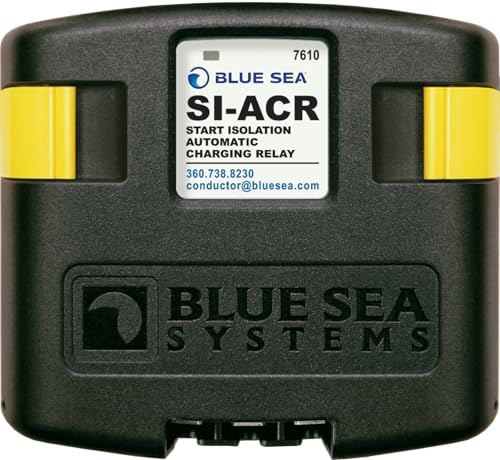
This model features automatic charging with a focus on protecting sensitive electronics by temporarily isolating house loads from the engine circuit during cranking. It also uses hermetically sealed contacts, making it a strong choice for boats where reliability and weather exposure are critical.
- Best for: Boats needing engine-crank protection and clean isolation during starting.
- Why selected: Sealed contacts reduce the risk of corrosion in harsh marine environments.
Caution: The installation requires careful routing to preserve the isolation function and prevent nuisance disconnects.
VEVOR Split Charge Relay Kit

The VEVOR kit provides a complete dual-battery isolator solution with a 140A voltage-sensing relay. It is designed for RVs, boats, and vehicles, delivering automatic charging for two batteries from a single alternator and isolating them when the system is off.
- Best for: DIYers needing a complete, install-ready dual-battery isolator kit.
- Why selected: Easy-to-follow accessories and instructions simplify mounting and wiring.
Caution: Physical durability depends on mounting location; protect from direct impact and moisture exposure.
Blue Sea Systems Add-A-Battery Kit 120A

The Add-A-Battery Kit integrates an automatic charging relay with a dual-circuit system, allowing the starter and house banks to be managed independently while maintaining essential emergency parallel capability.
- Best for: Boats expanding power distribution without a full new electrical system.
- Why selected: Combines relaying and dual-circuit control in a compact setup for marine use.
Caution: The combined system should be sized to your total electrical load to avoid overloads on the main alternator.
UCkasayfy Dual Battery Isolator Kit 12V 140A

This VSR kit provides 140A isolation with IP67 waterproof rating. It monitors voltage to ensure the primary battery stays charged, with voltage display to check status. Suitable for boats, RVs, and trailers requiring robust battery separation.
- Best for: Marine setups needing water resistance and voltage visibility.
- Why selected: Strong protection and clear monitoring support for battery health.
Caution: Verify that the included wiring and seals are compatible with your vessel’s expected exposure to splashes or spray.
Buying Guide
What should you consider when choosing an automatic charging relay for marine use?
- Voltage and current rating: Ensure the relay supports your boat’s system voltage (12/24V) and the continuous current required by your loads. Higher amperage is beneficial for larger boats or heavy electrical usage.
- Isolation and protection: Look for relays that isolate house circuits from starting circuits during crank and provide protection for sensitive electronics.
- Durability and sealing: For marine environments, hermetically sealed contacts or IP-rated housings help resist moisture, salt, and vibration.
- Ease of installation: Kits with complete wiring, instructions, and mounting hardware reduce installation time and error.
- System expansion: If you plan to add batteries or circuits later, consider an Add-A-Battery or dual-circuit option to simplify upgrades.
- Monitoring features: Some models offer voltage sensing, displays, or easy fault indication, aiding maintenance checks on the water.
Frequently Asked Questions
- What is an automatic charging relay and why is it used on boats?
- Can I install a dual battery isolator myself?
- What voltage should I use for my boat’s ACR?
- What maintenance does an ACR require?
- Is an IP-rated isolator necessary for all boats?
An automatic charging relay connects the starting and auxiliary batteries during charging and isolates them at rest, ensuring the engine can start reliably while providing power for house loads when the engine runs.
Yes, many kits are designed for do-it-yourself installation, but following the manufacturer’s wiring diagram and marine-rated components is essential for safety and reliability.
Most marine systems use 12V or 24V. Choose a relay rated for your system voltage and current to ensure proper operation and longevity.
Regular checks of battery voltages, connections, and fuse protections are advised. Inspect seals and mounting for signs of moisture or vibration wear.
For boats exposed to spray, humidity, and salt, an IP-rated or waterproof seal helps extend the life of the relay and reduces corrosion risk.