Best Anchors for 22-Foot Boats: Safe, Reliable Mooring Options
The best anchor for a 22-foot boat balances holding power, corrosion resistance, and ease of use. This guide highlights five anchors well-suited for boats in the 12–22 ft range, including pontoons, small fishing craft, and deck boats. Each pick targets different bottom types and conditions, helping you decide who should choose which design. The buyer’s choice depends on bottom material, water type, and portability needs. Below, a quick summary table helps compare core specs and intended usage at a glance.
| Product | Best For | Weight | Includes | |
|---|---|---|---|---|
| JY PERFORMANCE 8 lb Fluke Anchor Kit | Budget-friendly lake days and light offshore use | 8 lb | Chain, rope, shackles | Sand, mud |
| Seachoice River Anchor, 20 Lbs | Varied bottoms with strong holding power | 20 lb | Galvanized shackle | Multiple |
| MARINE SYSTEM Anchor Kit, 10 lb | Salt and freshwater versatility, small boats | 10 lb | Chain, rope | All |
| Extreme Max 19 lb Cube Anchor | Immediate set and adjustable positioning | 19 lb | N/A | Wind/current changes |
| TUNORD 8 lb Fluke Anchor Kit | Compact kit for pontoons and dinghies | 8 lb | Chain, rope, shackles | Sand, mud |
JY PERFORMANCE 8 lb Fluke Anchor Kit

Best for budget-conscious boaters who anchor in calm to moderate conditions. This all-in-one kit includes an 8 lb galvanized fluke anchor, 6.5 ft chain, two D-ring shackles, and 100 ft of nylon rope. The fluke design digs into sand or mud and the weighted chain enhances grip, helping stabilize boats in light to moderate currents and light winds. Ideal for 12–22 ft pontoons and small fishing craft. Caution: not ideal for heavy seas or very rocky bottoms where larger anchors may be required.
Seachoice River Anchor, 20 Lbs

Best for a wide range of bottom types, including mud and sand, with a strong holding power. This cast-iron anchor features a one-piece design with a large eyelet and includes a galvanized anchor shackle. Its simple design makes it reliable for medium-sized vessels in both freshwater and saltwater. Choose this if you want solid, straightforward performance in varied conditions. Limitation: heavier to lift and transport compared with smaller kits.
MARINE SYSTEM Anchor Kit Fluke Anchor Set
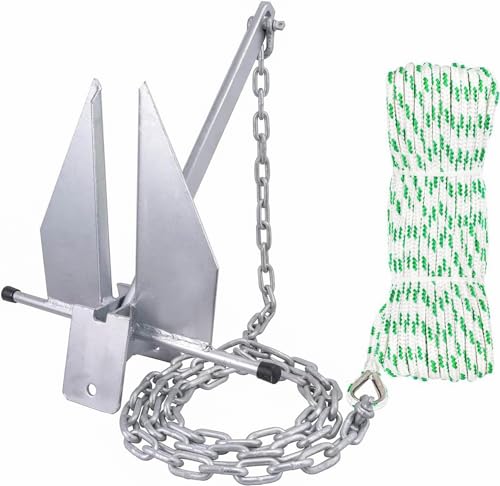
Best for versatile use on boats from 16–26 ft in salt or freshwater. The 10 lb hot-dipped galvanized fluke anchor is paired with 6.5 ft of chain and a 3/8″ nylon rope, designed for corrosion resistance and long-term durability. The kit’s balanced weight supports stable holding in typical water conditions for small to midsize craft. Use this if you want a reliable mid-weight option with marine-grade rope and chain. Caution: heavier than compact kits, harder to stow on very small boats.
Extreme Max 19 lb Cube Anchor

Best for quick sets and reliable holding in changing wind or current. The cube anchor’s box style design sets quickly and can be adjusted to align with the river or sea bottom. It folds for compact in-boat storage when not in use. This anchor is well-suited for 12–22 ft boats that encounter frequent current shifts or wind. Limitation: its square profile may require more space in crowded anchor compartments.
TUNORD Boat Anchor Kit Fluke Anchor

Best for compact, easy-to-carry setups ideal for pontoons and dinghies. This 8 lb fluke anchor kit includes 3/8″ nylon anchor rope, a marine-grade stainless steel thimble, and two hot-dipped galvanized shackles. It is well-suited for 12–22 ft boats and provides a balanced hold in sandy or muddy bottoms. Choose this if you need an economical, travel-friendly option. Limitation: lighter weight may reduce holding power in strong currents or heavier wind.
Buying Guide
- Bottom material matters: Fluke anchors excel in sand and mud, while anchors with heavier ballast can perform better in rocky or weed-covered bottoms.
- Boat size and weight: For 12–22 ft boats, 8–10 lb fluke anchors are common; larger craft may require 15–20 lb equivalents.
- Rope and chain length: A longer rope improves scope, reducing pull on the anchor; a longer chain adds weight and improves setting in soft bottoms.
- Material and corrosion: Hot-dipped galvanized steel resists rust longer; stainless options exist but add cost.
- Portability: Smaller kits are easier to store on boats with limited space but may sacrifice some holding power in rough conditions.
- All-in-one kits vs. modular: All-in-one kits are convenient for new boaters; modular setups allow upgrading rope, chain, or anchor separately as needs evolve.
FAQ
- What size anchor is best for a 22-foot bowrider?
An 8–10 lb fluke anchor is a common starting point for many 12–22 ft vessels, depending on bottom type and weather risk. - Should I choose a cube anchor or a fluke anchor?
Cube anchors offer quick holding in shifting winds, while fluke anchors generally perform well in sand or mud and are easier to reset. - Is a longer anchor rope important?
Yes, a longer rope provides better scope and helps the anchor bite more effectively in tidal or windy conditions. - Do I need a galvanized chain with my anchor?
A short chain improves weight distribution and reduces rope wear, especially in rocky or sandy bottoms. - Can I mix anchors for different conditions?
Yes; having a lighter anchor for calm days and a heavier option for rougher water offers flexibility. - What maintenance is required for galvanized anchors?
Rinse with fresh water after saltwater use and dry before storage to minimize rust and preserve performance.