Best 650 CCA Marine Battery Guide for Boats and More
Answer: For boat engines and other marine starters, a 650 CCA marine battery is a solid balance of cold-cranking power and durability. This guide highlights five top options and who they’re best for, so you can pick a model that fits your vessel, climate, and maintenance preferences. The selections emphasize dual-purpose and starter-focused designs to cover both engine starts and accessory power. Use the table below to compare core details at a glance.
| Product | Main Strength | |
|---|---|---|
| Litime 12V 20Ah Marine Starting Lithium Battery | 650-800 CCA range; low-temp protection | |
| WEIZE BCI Group 31M Dual Purpose AGM Battery | Dual purpose; high cycle life | |
| Weize Platinum AGM Battery BCI Group 35 | 650 CCA; solid AGM reliability | |
| OPTIMA D34M Bluetop | 750 CCA; SpiralCell tech | |
| UPLUS BCI Group 27M Dual Purpose Marine Battery | 800 CCA; space-saving dual purpose |
Litime 12V 20Ah Marine Starting Lithium Battery

The Litime model provides 650-800 CCA cranking power with low-temperature protection. It is designed for marine engines and some lawn equipment, offering over 5000 cycles and strong moisture resistance in harsh marine environments. It does not support Yamaha outboards or certain vehicle starters, so verify compatibility with your engine before purchase.
Best for: Smaller to mid-size boats and lawn equipment that require reliable cold-start capability in cool or salt-air conditions.
Caution: Not suitable for all outboard brands; confirm engine compatibility to avoid fitment issues.
WEIZE BCI Group 31M Dual Purpose AGM Battery

This AGM dual-purpose battery combines strong starting power with deep-cycle capacity. It features low internal resistance and high output, delivering reliable power for marine and RV use. Quick charging capability is highlighted, with guidance on charging currents and duration.
Best for: Boats or RVs that need a single battery to handle both starting and longer-running electronics, especially where space is limited.
Caution: Follow recommended charging parameters to maximize cycle life; improper charging can reduce performance.
Weize Platinum AGM Battery BCI Group 35

This 12V AGM battery offers 650 CCA with a 55Ah capacity and robust resistance to heat and cold. It includes clear dimensions and terminal positioning to help with fitment decisions. AGM construction supports longer cycle life compared with flooded designs, and it’s compatible with hot or cold environments when installed properly.
Best for: Vehicles and vessels that require a high-reliability AGM battery with steady starting power and resilience in extreme temperatures.
Caution: Verify dimensions and terminal positions to ensure a proper fit in your battery compartment.
OPTIMA D34M Bluetop Dual Purpose AGM Battery

OPTIMA’s D34M Bluetop uses SpiralCell technology, delivering 750 CCA and 55 Ah. Its dual-purpose design supports starting and deep cycle needs, with maintenance-free sealed construction and an adaptable mounting profile. It’s known for robust starting power in demanding weather conditions.
Best for: Boats and RVs that demand strong cold-start performance plus dependable deep cycling for onboard electronics.
Caution: Heavier battery with a higher profile; ensure physical fit and mounting clearances before installation.
UPLUS BCI Group 27M Dual Purpose Marine Battery
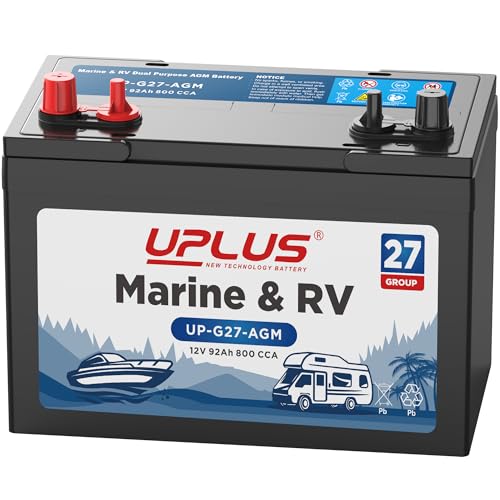
This dual-purpose marine battery delivers 800 CCA and 92Ah, designed to cover both starting needs and deeper-cycle demands. It emphasizes a space-saving design that reduces the need for a second battery by combining functions, which is helpful on smaller boats.
Best for: Boats with limited space that still require reliable engine starts and electronics power throughout the trip.
Caution: Confirm the battery compartment dimensions before ordering to ensure it fits your boat’s layout.
Buying Guide
What matters most for 650 CCA marine batteries?
- Intended use: Start power vs. dual-purpose. Choose a model that prioritizes starting power if you have a small boat, or a dual-purpose design if you need both start and deep-cycle capability.
- Battery type: AGM and lithium have different maintenance needs, lifespans, and charging requirements. AGM is maintenance-free and robust in heat, while lithium offers high cycle life and light weight but different charging needs.
- Cold-weather performance: Look for explicit CCA ratings and low-temperature protection features to ensure reliable starts in cold water or winter storage.
- Fit and compatibility: Check dimensions, terminals, and mounting orientation. Some models have left/right terminal configurations or taller profiles that affect mounting space.
- Charging guidance: Many batteries specify charging voltage and current; following these ensures longevity and performance.
- Durability: Salt spray and moisture resistance are important for marine use. Some models advertise enhanced moisture resistance and protective features.
FAQ
- Q: What does 650 CCA mean for marine batteries?
A: Cold-cranking amps measure the battery’s ability to start an engine in cold conditions. Higher CCA helps in cold weather marine starts. - Q: Is an AGM battery better than a flooded lead-acid for boats?
A: AGM batteries are sealed, maintenance-free, and more resistant to vibration, making them common choices for boats. They also handle deeper discharges better than many flooded designs. - Q: Can I use a dual-purpose battery for both starting and running electronics?
A: Yes, dual-purpose batteries provide cranking power and deep-cycle capability, but ensure the capacity and size fit your boat’s electrical load and space. - Q: How important is battery size and terminal position?
A: Very important. Incorrect sizing or terminal orientation can prevent installation and reliable connections. Always verify fit before purchase. - Q: Should I use a specific charging method for 650 CCA batteries?
A: Follow the manufacturer’s charging recommendations. Using the wrong voltage or excessive current can shorten life and reduce performance. - Q: What maintenance is needed for marine batteries?
Most modern AGM and lithium batteries are maintenance-free, but inspecting connections and terminals for corrosion and ensuring proper mounting remains important.