Best 36V Lithium Battery Chargers for Marine Use and Beyond
Direct answer for buyers: these 36V lithium battery chargers are designed to fast-charge LiFePO4 systems on boats, trolling motors, golf carts, and RVs with strong waterproofing and smart protections. This guide highlights five top options and indicates who each charger serves best. Whether you need marine-grade IP65/IP66 protection, wake-up 0V activation, or compact dual-bank capabilities, there’s a suitable choice for you. The following table compares key specs to help you decide quickly.
| Product | Brand | Voltage / Current | Waterproofing | Best For |
|---|---|---|---|---|
| LiTime 36V 25A LiFePO4 Charger (IP65) | Litime | 36V / 25A | IP65 | Harsh outdoor marine environments, trolling motors, golf carts |
| DC HOUSE 36V 25A Lithium Charger | DC HOUSE | 36V / 25A | Waterproof; cooling fan | Busy docks, boats, RVs needing fast top-ups |
| EPOWREY 25AMP 36V Charger | EPOWREY | 36V / 25A | General waterproofing; portable | Onboard golf carts, boats, solar setups |
| LiTime 36V (43.8V) 15A Charger | Litime | 36V / 15A | IP66 | Maritime use, RVs, smaller or slower-charge needs |
| Dyness 36V 25A LiFePO4 Charger | Dyness | 36V / 25A | IP67 | High-demand golf carts, RVs, trolling motors |
LiTime 36V 25A LiFePO4 Charger (IP65)

This charger delivers fast and stable charging for 36V LiFePO4 batteries, with 25A output and 43.8V maximum charging. It is designed for 38.4V systems and optimized for marine, trolling motor, golf cart, and RV uses. It features an IP65 marine-grade waterproof housing to withstand dust and moisture on docks or open water, and a smart 3-stage charging process (Pre-Charge, CC, CV) to protect battery lifespan. Best for: outdoor marine setups and high-usage trolling motors where weather exposure is common. Caution: ensure proper venting if used in enclosed compartments to avoid heat buildup.
DC HOUSE 36V 25A Lithium Battery Charger
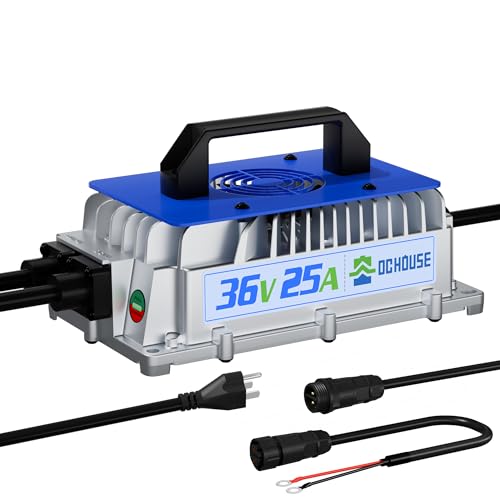
The DC HOUSE charger is built for faster top-ups with 25A current and 43.8V maximum voltage. It emphasizes efficiency (≥93%) and includes a cooling fan for heat management, making it suitable for boats, golf carts, forklifts, and other 36V LiFePO4 applications. It also features multiple protections (over-voltage, over-current, overheating, short-circuit, reverse polarity) and a 0V wake-up function. Best for: users needing a compact, robust charger with broad device compatibility. Limitation: some users may need a dedicated mounting option to fit tight spaces on smaller vessels.
EPOWREY 25AMP Lithium Golf Cart Charger

EPOWREY’s 25A charger supports 43.8V (38.4V) LiFePO4 batteries and is designed for golf carts, boats, RVs, and solar setups. It includes ring terminals for onboard mounting and features over-voltage, over-current, overheating, short-circuit, and reverse polarity protections. Best for: mounted or semi-permanent installations with straightforward wiring. Caution: ensure compatibility with your battery’s BMS wake-up requirements to avoid unneeded wake-up cycles.
LiTime 36V (43.8V) 15A Charger
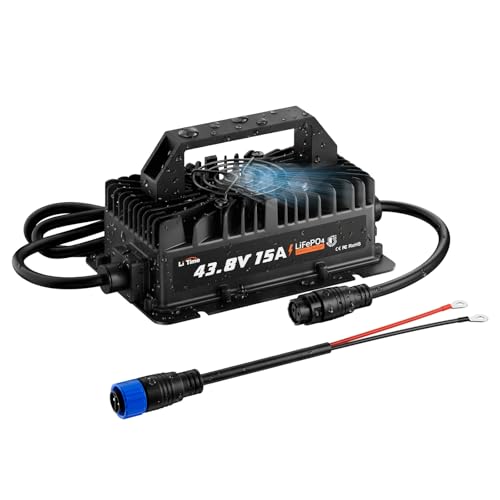
This IP66-rated LiTime charger supports 0V wake-up and a robust 15A output for faster charging of 36V LiFePO4 systems, including marine, RV, golf cart, and trolling motor uses. Its rugged aluminum housing adds durability in exposed environments, and the unit provides comprehensive safety protections. Best for: users needing reliable, weatherproof charging with wake-up capability. Limitation: 15A is slower than 25A options when charging large 36V packs.
Dyness 36V 25A LiFePO4 Charger

Dyness offers a 25A charger with 43.8V maximum voltage and IP67 waterproofing for demanding marine or RV use. It promises fast charging (≥93% efficiency) and includes 0V wake-up, over-voltage, over-current, short-circuit, and over-temperature protections. Best for: high-usage golf carts or boats where reliability and ruggedness matter. Caution: ensure the charger’s voltage and BMS settings align with your battery’s requirements to avoid mis-timed wake-up cycles.
Buying Guide
What 36V LiFePO4 charging features matter?
Key features include maximum charging voltage (43.8V), charging current (e.g., 15A, 25A), 0V wake-up to re-activate discharged cells, and protection suites (over-voltage, over-current, over-temperature, short-circuit). For marine use, IP ratings (IP65, IP66, IP67) indicate resistance to water, dust, and spray. A built-in cooling fan helps maintain performance during extended charging on deck or in a vehicle bay.
Which charger is best for my setup?
- Best overall marine endurance: LiTime 25A IP65 charger—robust, weatherproof, fast enough for frequent use.
- Best for tight spaces: DC HOUSE 25A—compact with protection features and a wake-up function.
- Best for portable or easily mounted systems: EPOWREY 25A—ring terminals enable quick onboard installation.
- Best wake-up and dual-use capability: LiTime 15A IP66—wake-up feature with comprehensive safety protections.
- Best high-demand golf carts and RVs: Dyness 25A IP67—highest protection for rugged outdoor environments.
Safety and maintenance considerations
- Choose a charger with multi-protection features and a proper voltage range for LiFePO4 chemistry.
- For exposed locations, prefer IP67 or IP66 housings and consider a charger with a cooling mechanism.
- Verify compatibility with your battery management system (BMS) and wake-up requirements to avoid charging interruptions.
Installation tips
- Mount chargers with adequate ventilation and avoid enclosing them in tight spaces without airflow.
- Run proper cable sizing for 25A–25A+ charging to minimize voltage drop.
- Keep connectors dry when used near water or on wet docks; use moisture-rated enclosures where needed.
FAQ
- Q: Do these chargers work with all 36V LiFePO4 batteries? A: They are designed for LiFePO4 chemistry and 36V systems; verify the BMS compatibility and wake-up mode before use.
- Q: What is 0V wake-up? A: A function that reactivates deeply discharged LiFePO4 cells so the charger can begin charging safely.
- Q: Are IP65/66/67 ratings necessary for marine use? A: Yes, higher IP ratings offer better protection against water, dust, and spray in docking or boating environments.
- Q: Can I mount these chargers on a golf cart or boat hull? A: Many models support onboard mounting, but follow the manufacturer’s mounting guidelines and use provided hardware.
- Q: Is 25A always better than 15A? A: Higher current reduces charging time for large batteries but may require compatible wiring and circuit protection.
- Q: Do these chargers include cooling or ventilation? A: Several models include cooling fans or rugged housings to maintain performance during long charges.