Best 300 Watt Marine Amp Options for Boat Audio Upgrades
The best 300 watt marine amp options provide reliable power, waterproof reliability, and clear sound for boats, jet skis, and other watercraft. This guide targets buyers seeking durable multi-channel or mono marine amplification around the 300-watt mark. The top picks cover 2-channel, 4-channel, and monoblock designs, helping you optimize bass, midrange, and overall volume without overtaxing your boat’s electrical system. Ideal buyers include anglers upgrading cabin speakers, owners adding subwoofers, and anyone needing compact, marine-grade amps for outdoor conditions.
Summary of selected products:
| Product | Channels | Max Power | Best For |
|---|---|---|---|
| Pyle Hydra Marine Amplifier PLMRMP1A | 2 | 400 W | Compact 2-channel setups with RCA input |
| Rockford Fosgate M2-300X4 | 4 | 300 W RMS | Marine 4-channel versatility |
| KENWOOD KAC-M5001 | Monoblock | 600 W max / 300 W RMS @ 2Ω | Deep bass for subwoofers |
| Pyle Hydra PLMRA400 | 4 | 400 W | 4-channel marine power with RCA inputs |
| Skar Audio RP-800.1DM | Monoblock | 800 W peak / 800 W RMS @ 1Ω | High-output mono marine amp |
Pyle Hydra Marine Amplifier PLMRMP1A — 400 Watt 2-Channel

Reference features indicate a two-channel marine amplifier suitable for powering a pair of speakers with RCA stereo inputs. It includes a 3.5mm-to-RCA adapter and a remote for volume control, along with protection circuitry and a soft turn-on/off to safeguard the electrical system. This model is best for buyers seeking a compact, easy-to-wire 2-channel solution for small boats or pontoon setups. Caution: 400 W rating is total, so allocate headroom for wiring and speaker impedance to avoid overheating in harsh marine environments.
Rockford Fosgate M2-300X4 Marine 300-Watt 4-Channel

This Element Ready 4-channel amplifier delivers 300 W RMS when configured across channels and supports 2Ω or 4Ω loads. Built for marine environments, it features UV-resistant protection, a conformal coated board, stainless mounting hardware, and marine-grade terminal connections. Best for boaters needing clean, flexible four-channel power with sturdy, ocean-friendly construction. Limitation: primary use is four channels; if you only need stereo power, a 2-channel option may be more compact.
KENWOOD KAC-M5001 Compact Mono Marine Amplifier

Kenwood’s compact monoblock delivers up to 600 W max and 300 W RMS at 2 Ω, pairing well with subwoofers on boats, pontoons, and outdoor audio systems. It features IP67/IP66 waterproof and dustproof protection, a rugged chassis, and level control. This model is best for buyers prioritizing strong bass response in marine environments. A potential limitation is the form factor; it’s a single-channel amp, so stereo expansion would require additional equipment.
Pyle Hydra PLMRA400 — 400 Watt 4-Channel

This 4-channel marine amplifier provides 400 W total, with RCA inputs and a heavy-duty aluminum heatsink for protection against thermal overload. It includes LED indicators and short protection for reliability in damp marine environments. Best for buyers who want a balanced 4-channel option with straightforward RCA integration. Limitation: higher wattage is spread across four channels, so individual channel power is lower than a dedicated high-wamp 2-channel unit.
Skar Audio RP-800.1DM 800 W Mono Marine Amp
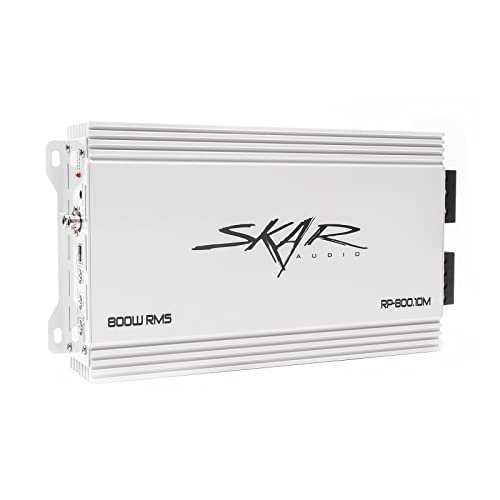
The RP-800.1DM is a high-output mono amplifier designed for marine use, offering peak power up to 1,200 W and 800 W RMS at 1 Ω. Fully marinized with waterproof coating and rust-proof hardware, it’s ideal for users adding a dedicated subwoofer with maximum splash resistance. Choose this if you need heavy subwoofer drive in harsh marine conditions. Limitation: higher power requires careful electrical installation to manage heat and battery load.
Buying Guide
Key considerations for choosing a 300-watt marine amp
- Channel configuration: If you need stereo speakers, a 2-channel or 4-channel amp with multiple channels provides flexibility. For subwoofers, a monoblock can deliver deeper bass with stable current.
- Power output and impedance: Check RMS ratings at your speaker impedance (typically 2 Ω or 4 Ω). Higher power is beneficial for larger boats or louder environments, but ensure your wiring and alternator can handle it.
- Marine-grade protection: Look for water and dust resistance (IP ratings) and corrosion-resistant components. Marine environments demand robust sealing and conformal coatings.
- Inputs and compatibility: RCA inputs are common; some models offer high-level inputs for receivers lacking RCA outputs. Consider the availability of a remote or gain control for fine-tuning.
- Size and mounting: Measure space on your dash or behind seating. Some amps are compact mono units while others are multi-channel with larger heatsinks.
- Cooling and protection: Heatsinks and thermal protection prevent overheating. Soft start/turn-on helps protect electrical systems during engine start.
- Installation considerations: Ensure proper grounding, wire gauge, and fuse protection to avoid parasitic drainage or shorts in a marine setting.
FAQ
- What’s the difference between a 2-channel and 4-channel marine amp?
2-channel amps power two speakers, while 4-channel amps power four speakers or two pairs; configuration affects how you wire speakers and where you install the amp. - Is IP-rated protection necessary for marine amps?
Yes. IP67/IP66 and similar ratings indicate resistance to water and dust, which is important for boats exposed to spray and humidity. - Should I choose a mono block or a stereo amp for bass-heavy setups?
For subwoofers, a mono block provides stable, high-current power suitable for bass. For full-range speakers, a stereo or multi-channel amp is preferable. - Do marine amps require different wiring compared to car amps?
Generally yes. Marine amps may require corrosion-resistant terminals and specific grounding practices to withstand the marine environment. - What maintenance helps longevity in marine amps?
Keep connections clean, check fuses, ensure proper mounting with ventilation, and protect wiring from salt spray and moisture.