Best 3 Inch Bilge Blower Options for Maritime Ventilation
When shopping for a 3 inch bilge blower, the goal is to find a compact, 12V marine fan that can deliver reliable airflow in tight spaces like bilges, engine compartments, and heads. The following selections are among the most relevant models for American boaters, offering different airflow ratings, energy draws, and build qualities. This guide helps buyers choose based on space, airflow needs, and power considerations.
| Product | Airflow | Approximate Draw | Best For |
|---|---|---|---|
| Attwood 1733-4 Blower Bilge 3″ | High air flow with 5-blade design | Not specified in listing | |
| Yaegoo Marine 3″ Inline Bilge Air Blower | 130 CFM | Low current draw (2.5A) | |
| SEAFLO 3″ In-Line Bilge Blower SFIB1-130-01 | 130 CFM | 2.5A max | |
| SEAFLO 3″ In-Line Bilge Blower SFIB1-145-03 | 145 CFM | 3.0A max | |
| Hon&Guan Boat Blower Fan 3″ | 130 CFM, 7-blade design | 10,000 RPM motor |
Summary: The provided 3 inch bilge blowers cover a range from compact, low-draw options to higher airflow units suitable for larger bilge spaces. Use the table above to quickly compare airflow and amp draw, then read product sections for specific suitability to your boat’s layout and electrical capacity.
Attwood 1733-4 Blower Bilge 3″

Features indicate a high airflow design with a 5-blade fan and inline architecture. This model is best for boaters who need strong ventilation in cramped spaces such as engine compartments, bilges, or galleys. The blade sweep and pitch aim to maximize lift and speed, delivering efficient air movement in challenging conditions.
Best for: Boat owners who prioritize maximum airflow in tight areas and can accommodate a higher lift blade design. A possible limitation is that exact amperage and warranty details are not listed in this summary, so verify electrical compatibility before installation.
Yaegoo 3″ Inline Bilge Air Blower

Specifications describe a 12V DC operation with 2.5A current draw and 130 CFM airflow. It includes a 3″ outlet hose and emphasizes low power consumption for steady ventilation in engine compartments, galleys, bilges, and heads.
Best for: Boaters needing a reliable, moderate-airflow blower with economical power use. Caution: exact noise level is not specified; consider placement to minimize cabin noise impact.
SEAFLO 3″ In-Line Bilge Blower SFIB1-130-01

Model SFIB1-130-01 delivers 130 CFM at 12V with a 2.5A draw. The unit is ISO 8846, CE, and RoHS certified and includes integrated mounting feet for flexible installation. The listing highlights reliability for bilges, heads, and galleys with a focus on long-term durability.
Best for: Users who value certifications and a balanced performance-to-draw ratio for multiple small spaces. Limitation: 130 CFM may be modest for larger bilge areas; pair with other ventilation if needed.
Hon&Guan 3 Inch Boat Blower

This 3″ inline blower uses a 7-blade design and claims up to 10,000 RPM with 130 CFM airflow. It emphasizes marine-grade durability with IP44 protection and higher heat resistance, suited for engine rooms and bilges in harsher environments.
Best for: Boaters facing tougher marine conditions who need brisk airflow without complex installation. Caution: high RPM may increase noise; verify mounting and vibration considerations in tight spaces.
Pactrade Marine Turbo Inline Bilge Blower

Designed for high output in a compact inline form, this 12V blower features 5 blades and a 140 CFM airflow with a 3A draw. It notes a corrosion-resistant motor housing and front/rear shaft seals, suitable for engine compartments, bilges, galleys, and heads.
Best for: Owners needing higher airflow in a small footprint with an emphasis on durability. Limitation: construction details are broad; ensure compatibility with existing ducting and mounting allowances.
SAILINGFLO 3″ In-line Bilge Blower
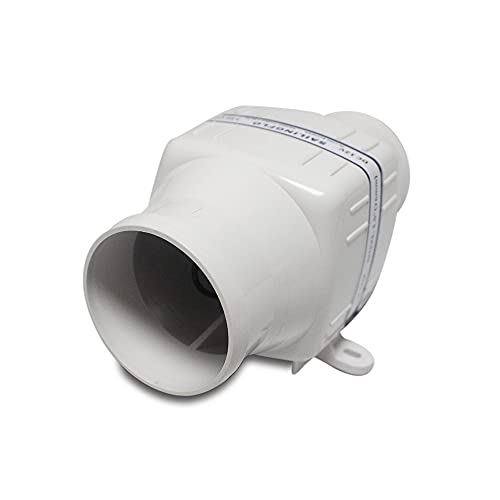
Equipped with four blades and a 3″ outlet hose, this unit emphasizes minimal current draw with high-volume airflow at 12V and 2.5A. It offers vertical or horizontal installation thanks to built-in mounting feet, making it versatile for compact spaces.
Best for: Installers seeking flexible mounting and efficient airflow in tight bilges or engine rooms. Limitation: 4-blade design may be slightly less efficient than 5-blade variants in some layouts; compare to 5-blade options if airflow is the priority.
Buying Guide: 3 Inch Bilge Blowers — What To Consider
- Airflow vs. space: Larger bilge compartments benefit from higher CFM ratings (130–145 CFM). In smaller spaces, 120–130 CFM models are often sufficient.
- Power draw: Most marine blowers run on 12V with draws ranging from about 2.5A to 3.0A. Ensure alternator/battery capacity can handle continuous operation if vents are used long periods.
- Motor and blade design: 5-blade designs generally provide smoother airflow and higher efficiency than fewer blades. 7-blade configurations offer strong airflow but may influence noise.
- Durability and materials: Look for ABS housing, corrosion resistance, and IP/CE/RoHS certifications for prolonged marine exposure.
- Mounting and installation: Units with built-in mounting feet offer easier vertical/horizontal installation. Check for compatibility with your ducting (3″ hoses) and available space in the bilge or engine bay.
- Certifications: ISO 8846, CE, and RoHS certifications indicate compliance with marine electrical and safety standards.
Frequently Asked Questions
- What does CFM mean for a bilge blower?
– CFM stands for cubic feet per minute and measures the volume of air moved. Higher CFM means more airflow in a given space, which can improve ventilation and moisture removal. - Is a higher amperage blower better?
– Not necessarily. Higher CFM with higher current draw can drain the battery quicker. Match blower capacity to the space and electrical capacity available. - Do 3 inch blowers fit standard ducting?
– Most 3″ blowers use standard 3″ ducts, but always verify the connector size and hose compatibility before purchase. - Should I choose a 4-blade or 5-blade model?
– 5-blade and 7-blade designs often provide better efficiency and airflow, but noise and space constraints should be considered. - Are marine blowers weather-resistant?
– Many models feature marine-grade housings and IP or ISO certifications, but confirm resistance ratings for the expected exposure in your boat’s environment. - Do I need a professional for installation?
– Installation can be straightforward for some models with simple mounting, but ensure proper wiring, fusing, and sealing to prevent moisture intrusion.