Best 24 Series Marine Battery Options for Boats and RVs in 2026
Looking for a reliable 24 Series marine battery that balances starting power with deep-cycle endurance? This guide highlights five top picks that fit most boats and RVs, with clear guidance on who each is best for and why. The selections cover AGM, deep-cycle, and dual-purpose designs to match different cruising, trolling, and electronics needs. A quick buyer’s table follows to help compare core specs at a glance.
| Product | Type | Best For | Key Benefit |
|---|---|---|---|
| Interstate Batteries Marine/RV Battery 12V 70Ah 750CCA (24M-AGM) | AGM Dual-Purpose | Boat and RV owners needing reliable starting and trolling power | 2x-3x longer life than conventional AGM |
| UPLUS 24M Dual Purpose Marine Battery, 12V 79Ah | AGM Dual-Purpose | Compact systems with combined starting and deep cycling | Space-saving design, 550CCA |
| GRNOE Group 24 LiFePO4 Battery 12V 100Ah | LiFePO4 Deep Cycle | Lightweight, long life for off-grid and extended trips | Up to 15,000 cycles, scalable configuration |
| Mighty Max Battery MM-G24M, 12V 90Ah | AGM Dual-Purpose | Marine and RV use requiring strong starting and deep cycling | 550 CCA, 700 CA, rugged marine-grade design |
| WEIZE Dual Purpose AGM Battery BCI Group 24M, 12V 90Ah | AGM Dual-Purpose | Balanced starting power and deep-cycle capacity | 2x longer cycle life than traditional flooded batteries |
Interstate Batteries Marine/RV Battery 24M-AGM

Type and capacity: 12V, 70Ah, 750CCA. This dual-purpose AGM battery is designed for both starting the motor and powering trolling motors and accessories. The design emphasizes endurance with thick plates for repeated discharges and recharges, aiming to deliver extended life compared to traditional AGM options.
Best for: Boat owners who need a single battery to handle engine starts and auxiliary electronics without carrying a separate deep-cycle unit. Also suitable for RVs that require dependable cranking power and moderate deep-cycle performance.
Why chosen: It combines dual functionality (start and deep-cycle power) in one unit, backed by a focus on rugged construction and extended life. The 70Ah capacity supports multiple applications on mid-sized vessels or RVs.
Caution: Deep-cycle demand can shorten cycles if frequently discharged to very low levels without proper charging. Verify your electrical system can accommodate its 70Ah capacity and startup load.
UPLUS 24M Dual Purpose Marine Battery

Type and capacity: 12V, 79Ah, 550CCA. This dual-purpose unit combines starter power with deep-cycle capability in a compact form, designed to free up space in crowded electrical compartments.
Best for: Small to mid-size boats or RV installations where space efficiency is critical but reliable engine starting and electronics support are still needed.
Why chosen: The dual-purpose design minimizes the need for separate batteries, simplifying wiring and installation. It delivers robust starting power (550CCA) while offering adequate deep-cycle performance for electronics and trolling functions.
Caution: Before purchasing, confirm your compartment dimensions to ensure the 10.24″ x 6.61″ x 9.17″ footprint fits properly, and verify compatibility with engines up to higher horsepower ranges.
GRNOE Group 24 LiFePO4 Battery 12V 100Ah

Type and capacity: 12.8V, 100Ah LiFePO4 with 100A BMS. Lightweight, modular energy solution designed for long life and high reliability in harsh marine and RV environments.
Best for: Enthusiasts seeking a long-lasting, light alternative to lead-acid for RVs, boats, solar setups, and off-grid systems. Ideal for power-hungry electronics and trolling motors over many seasons.
Why chosen: LiFePO4 chemistry offers significantly longer life (up to 15,000 cycles at 60% DoD) and a built-in BMS for protection against overcharge and short circuits, while staying notably lighter than conventional batteries.
Caution: Higher upfront cost than lead-acid options may be offset by longevity; ensure compatible charging profiles and BMS expectations with existing charging equipment.
Mighty Max Battery MM-G24M 12V 90Ah
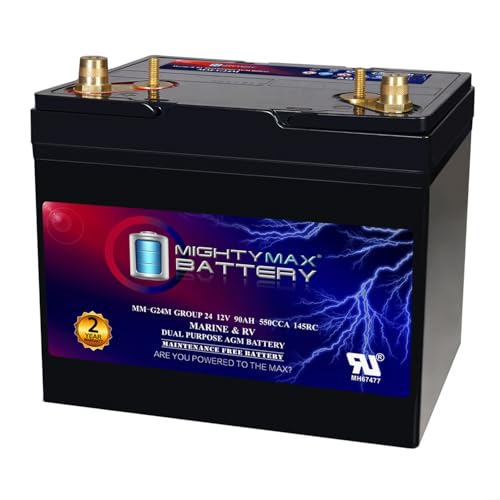
Type and capacity: 12V, 90Ah, AGM. Dual-purpose design with substantial cranking power and deep-cycle endurance for extended outings and electronics loads.
Best for: Mariners and RVers who need solid engine starting capability (550 CCA) while maintaining power to accessories for longer trips.
Why chosen: It provides strong starting performance and a solid 90Ah deep-cycle capability for longer equipment run times, in a marine-grade AGM format.
Caution: This model relies on proper maintenance-free sealing; avoid deep discharges that routinely approach the lower voltage limit to maximize life.
WEIZE Dual Purpose AGM Battery BCI Group 24M

Type and capacity: 12V, 90Ah, 550CCA. A balanced dual-purpose AGM battery with reliable starting power and deep-cycle performance.
Best for: Boat owners who want straightforward, maintenance-free operation with a single battery serving both starts and daily loads.
Why chosen: WEIZE emphasizes quick charging and long cycle life, offering a practical blend of performance and ease of use in many 24M applications.
Caution: Ensure your charging system supports AGM charging profiles and avoid prolonged high-rate charging beyond manufacturer guidelines to maximize lifespan.
Buying Guide: 24 Series Marine Battery Essentials
- Battery chemistry matters. AGM batteries offer spill-proof, maintenance-free operation with solid cranking power. LiFePO4 delivers longer life and lighter weight but may require different charging equipment.
- Dual-purpose vs. dedicated. Dual-purpose batteries handle starting and deep cycling, reducing the number of batteries needed. Dedicated deep-cycle units excel at running electronics for extended periods but don’t always start engines as quickly.
- Cranking vs. capacity (CCA vs. Ah). Higher CCA helps with cold starts in marine environments; higher Amp-hour (Ah) ratings support longer run times for lights, pumps, and electronics.
- Physical fit and compatibility. Check group size (24M), dimensions, and your boat or RV compartment space. Some units are larger or deeper than others and need extra clearance.
- Weight considerations. LiFePO4 is typically much lighter than lead-acid, which can matter for trailer and vessel handling, but charging systems may differ.
- Charging and protection. A built-in BMS is beneficial for LiFePO4, while AGM units rely on proper charging voltages and conditioner compatibility to maximize life.
- Cycle life expectations. If you frequently discharge batteries deeply, LiFePO4 or premium AGM units with high cycle counts offer better long-term value.
- Warranty and availability. Consider manufacturer support and replacement policies, plus the ease of finding replacements in your region.
FAQ
- What is the main difference between 24M AGM and LiFePO4 options? AGM is lead-acid-based, maintenance-free with good starting power, while LiFePO4 offers longer life and lighter weight but may require different charging equipment.
- Is a dual-purpose battery better than buying separate starting and deep-cycle batteries? For many boats and RVs, yes, it saves space and simplifies wiring, but dedicated systems can optimize performance for high-demand loads.
- How do I know if a 24M battery fits my compartment? Check exact measurements (L x W x H) against your battery tray or compartment dimensions and ensure clearance for connectors and ventilation where applicable.
- Should I prioritize higher CCA or higher Ah for my boat? If you sail in cold climates or rely on quick engine starts, prioritize CCA. If you run electronics for long periods, prioritize Ah for capacity.
- Do I need a separate charger for LiFePO4? Yes. LiFePO4 requires charging profiles compatible with lithium chemistry, whereas many AGM chargers are designed for lead-acid.
- What maintenance is required for AGM batteries? AGM batteries are maintenance-free, but ensure terminals are clean, connections are tight, and charging is within recommended voltages to maximize life.