Best 20 Amp Marine Battery Charger Options for Onboard Power and Performance
If you need reliable 20 amp performance for keeping multiple marine batteries in peak condition, these onboard chargers are designed for boats, pontoons, and watercraft that demand consistent charging across 12V systems. This guide highlights top 20A total-output models, explains who they’re best for, and helps you compare features like multi-bank support, protection, and water resistance. Ideal buyers include sailors, anglers, and captains who run dual- or triple-battery setups and require fast, safe charging in harsh marine environments.
| Product | Bank Count | Total Output | |
|---|---|---|---|
| NOCO Genius GENPRO10X2 | 2 | 20A | Best all-around for rugged marine use |
| ProMariner 44021 ProSport HD | 3 | 20A | Best for multiple battery banks and smart distribution |
| ProMariner 44020 ProSport HD | 2 | 20A | Better for two-battery installations |
| anegine 2 Bank Marine Charger | 2 | 20A | Best value with force mode for deep-cycle recovery |
| MVMOD 2 Bank Marine Charger | 2 | 20A | Best for flexible mode selection per bank |
NOCO Genius GENPRO10X2: 2-Bank, 20A Onboard Charger

NOCO’s GENPRO10X2 delivers 20 amps total across two independently controlled banks, with 10 amps per bank. It is designed for the harshest marine environments and is noted for being smaller yet more powerful than earlier GEN2 models. The unit supports multiple charging modes, including 12V, 12V AGM, 12V Lithium, and a 12V Repair Mode, making it suitable for a wide range of lead-acid and lithium-ion batteries. Best for boaters who need reliable dual-bank charging with advanced protection and temperature compensation. A potential limitation is the lack of a single-bank mode if you only need to charge one battery at a time, though its independent banks mitigate this for most dual-battery setups.
ProMariner 44021 ProSport HD: 20 Amp, 3 Bank

The ProSport HD 44021 adds a 3-bank design to a 20A-capacity system, using Microprocessor and software-controlled charging for fast, precise charging. Its Distributed-On-Demand Technology makes efficient use of available amps by allocating them to any subset of batteries as needed. This model is well-suited for boats with three 12V batteries or a mix of starting and deep-cycle packs. It’s best for crews who value flexible, smart charging across several banks. A possible drawback is the added complexity of a three-bank system if you only need two banks.
ProMariner 44020 ProSport HD: 2 Bank

This 20A dual-bank ProSport HD model from ProMariner focuses on fast, precise charging for two 12V batteries. It uses ProMar Digital Technology for accurate control and a Distributed-On-Demand approach to allocate charging power efficiently. It’s ideal for boats with two batteries or a dedicated deep-cycle and starting pair. A limitation to note is that it doesn’t offer a third bank, which can be a constraint on larger battery configurations.
2 Bank Marine Charger By Anegine
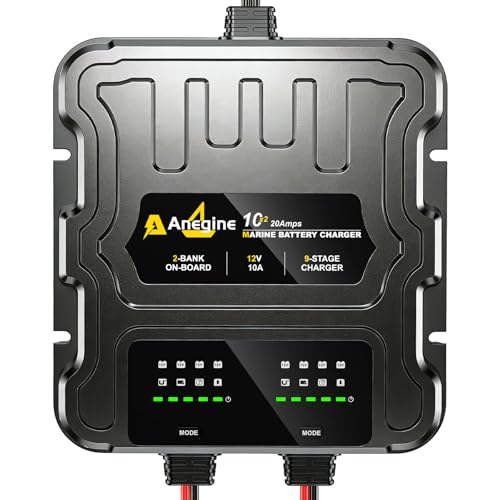
This 2-bank model provides up to 10A per bank for a combined 20A output with IP68 waterproofing. It supports lead-acid, AGM, Gel, LiFePO4, and Lithium batteries, including marine, boat, and deep-cycle configurations. Best for boaters who need resistance to water exposure and independent bank control. It offers Force Mode to revive deeply discharged or idle batteries, but it may not justify its use if you only need basic charging without battery revival features.
MVMOD 2 Bank Marine Battery Charger

The MVMOD charger offers two independently controlled banks with 10A per bank, totaling 20A. It supports 12V batteries across Lead-Acid (SLA/AGM/Calcium) and Lithium chemistries, and it includes IP68 waterproofing for marine use. It’s a solid pick for vessels that require per-bank mode selection and the ability to revive slightly aged batteries via dedicated mode. A consideration is that the product design emphasizes configurable modes over ultra-slim form factors, which may affect installation space on compact boats.
Buying Guide: Key Purchase Considerations
- Bank configuration: If you have two batteries, a 2-bank charger is typically ideal. For boats with three batteries, a 3-bank model can simplify wiring and monitoring.
- Output per bank: Look for models offering at least 5-10A per bank; total 20A is common for dual-bank chargers. Higher per-bank values speed charging for large or deep-cycle batteries.
- Battery chemistry support: Ensure compatibility with your battery types (Lead-Acid, AGM, Gel, LiFePO4, Lithium). Independent bank control helps optimize charging for mixed chemistries.
- Waterproofing and ruggedness: IP ratings (IP68, IP67) indicate submersion tolerance and durability in saltwater environments. Marine-grade construction reduces corrosion risk.
- Protection features: Overcharge protection, reverse polarity protection, temperature compensation, and dead-battery recovery modes extend battery life and prevent damage.
- Repair and revive capabilities: Some units offer forced-charge or Repair modes to revive deeply discharged or idle batteries, though performance varies by chemistry.
- Installation and compatibility: Check dimensions and mounting options to fit your boat’s space. Dual- or triple-bank units may require more wiring planning but simplify on-board management.
Frequently Asked Questions
- What is a 20A marine battery charger best for? It’s ideal for boats with two to three 12V batteries requiring balanced, fast charging and independent bank monitoring.
- Can I use a 20A charger on lithium batteries? Yes, if the model explicitly supports lithium or LiFePO4 chemistry and has the correct charging profile for lithium chemistries.
- Is IP68 waterproofing necessary? For exposed on-water installations, IP68 rating helps withstand prolonged submersion and saltwater exposure.
- Should I choose a 3-bank charger or two 2-bank chargers? A 3-bank charger simplifies wiring for three batteries and ensures simultaneous charging across all banks; two 2-bank units can offer redundancy but require more wiring and space.
- What does “force mode” do? Force mode helps revive deeply discharged or idle batteries by initiating charging even if the battery voltage is very low.
- Are these chargers easy to upgrade later? Many models allow parallel or modular expansion, but always verify compatibility with your boat’s electrical system and space constraints.