Best 2 Part Boat Foam Kits for Flotation, Insulation, and Voids
This guide highlights top 2 part boat foam kits designed for flotation, insulation, and void filling. It targets boaters, DIY marine enthusiasts, and fabricators seeking reliable, non-structural applications. Each pick offers a different density and kit size to fit decks, hull cavities, or dock projects. The selections emphasize closed-cell formulations to resist water absorption and support buoyancy. Read on to compare which foam best fits your vessel type and project scale. The summary table below helps you quickly skim the core differences before diving into each product detail.
| Product | Density | Kit Size | Best For |
|---|---|---|---|
| TotalBoat 2 Lb Density Expanding Foam Kit | 2 lb | 2 gallon kit | Small to mid-size boats, quick buoyancy patches |
| Fiberglass Supply Depot 4 Lb Density Expanding Pour Foam | 4 lb | 1 gallon kit | Higher strength flotation, structural feel under decks |
| Fiberglass Supply Depot 2 Lb Density Expanding Pour Foam (1 Gal Kit) | 2 lb | 1 gallon kit | Lightweight buoyancy, void filling in nonstructural areas |
| TotalBoat 6 Lb Density Expanding Foam Kit | 6 lb | 2 gallon kit | Rigid, high-density flotation and casting/repair work |
| Fiberglass Supply Depot 2 Lb Density Expanding Pour Foam (2 Gal Kit) | 2 lb | 2 gallon kit | Larger-volume buoyancy in nonstructural applications |
TotalBoat 2 Lb Density Expanding Foam Kit

Best for lightweight, nonstructural buoyancy and insulation in small to mid-size boats. The kit uses a 1:1 mix, expands quickly, and cures in about five minutes at typical workshop temperatures. It is 94% closed cell, which limits water absorption and resists damage from oil or solvents. Once cured, it accepts coatings such as polyester or epoxy. Best for rapid patching and layer-building under decks. A potential limitation is its 2 lb density, which may provide lower structural support compared with higher-density options.
- Lightweight 2 lb density for buoyancy and insulation
- 1:1 mix, quick cure
- High closed-cell content for water resistance
- Suitable for nonstructural applications
Fiberglass Supply Depot 4 Lb Density Expanding Pour Foam

Best for higher strength flotation and under-deck reinforcement. This 4 lb density foam provides more rigidity and buoyancy per cubic foot than lighter options. It’s a single 1 gallon kit with a two-part formulation that expands and can be laminated with common resins after curing. Choose this if you need stronger support or plan to carve or shape the foam for a precise fit. Caution: higher density means less expansion and more careful placement is required to avoid overfill.
- 4 lb density for increased rigidity
- Laminate with epoxy, polyester, or vinyl ester
- 1 gallon kit; good for larger voids
- Better for structural-looking flotation under decks
Fiberglass Supply Depot 2 Lb Density Expanding Pour Foam (1 Gal Kit)

Best for lightweight buoyancy and void filling in nonstructural areas. The 2 lb density is well-suited for filling cavities under decks or inside hollow sections where buoyancy is needed without adding heavy mass. It expands adequately to fill irregular spaces and can be laminated after curing. Limitation: lower density means less rigid support when compared with higher-density foams.
- 2 lb density for light-duty flotation
- 1 gallon kit with balanced expansion
- Good for void filling and insulation in noncritical areas
- Carvable and paintable after cure
TotalBoat 6 Lb Density Expanding Foam Kit
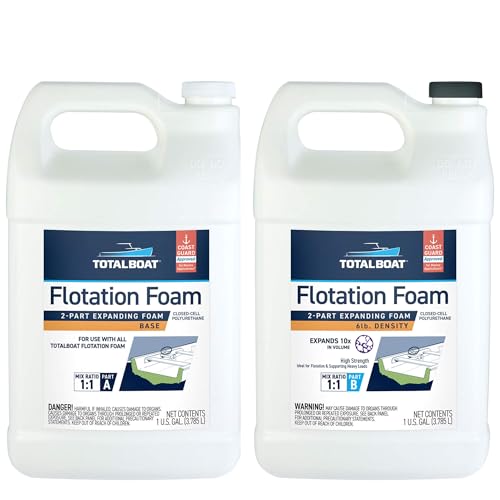
Best for high-density, rigid flotation and structural-like applications. The 6 lb density yields a very firm foam suitable for casting, carving, or added bulk in flotation zones where more support is needed. It cures to a closed-cell foam compatible with resins and can be painted. Caution: higher density reduces expansion; plan accordingly to avoid overfilling tight spaces.
- 6 lb density for rigid, high-strength flotation
- 2 gallon kit; strong, durable output
- Open for casting, carving, and reinforcement
- Better for larger flotation sections or decorative shapes
Fiberglass Supply Depot 2 Lb Density Expanding Pour Foam (2 Gal Kit)

Best for large-volume buoyancy in nonstructural applications. This 2 gallon kit provides more material for bigger projects while maintaining a 2 lb density for lightness and ease of handling. It expands to fill cavities under decks or within hull sections where buoyancy is necessary but heavy mass is not. Limitation: expansion may vary with ambient temperature and mixing accuracy.
- 2 lb density for easier handling and expansion
- 2 gallon kit for bigger projects
- Good option when large voids require buoyancy
- Can be laminated with resins after curing
Buying Guide: Key Points Before Buying
What density should you choose?
- Low density (2 lb): light, good for void filling, quick patches, nonstructural use.
- Medium density (4 lb): balanced buoyancy and rigidity for under-deck areas.
- High density (6 lb): rigid, strong flotation and castable applications but less expansion.
How much volume do you need?
- Calculate cavity volume in cubic feet and multiply by desired foam density to estimate pounds of foam needed.
- Most kits’ cubic-foot yields are listed in product features; use as reference for planning.
What about curing and coatings?
- Most foams cure quickly and accept coatings like polyester, epoxy, or vinyl ester resins after curing.
- Open cells may absorb water; 94% closed-cell foam is generally preferred for marine buoyancy and moisture resistance.
Safety and handling
- Work in a well-ventilated area and wear gloves; some foams can irritate skin or lungs if inhaled as fibers or dust.
- Mix ratios must be precise for predictable expansion and cure; avoid over-filling cavities to prevent squeeze-out.
FAQ
- Q: Are these foams suitable for structural boat repairs?
A: They are designed for nonstructural flotation, insulation, and void filling. For structural repairs, consult a marine engineer and consider higher-strength materials and proper bonding. - Q: Will the foam float a damaged hull?
A: In many cases, a properly applied flotation foam can provide buoyancy in voids, but it should not be used as a sole or primary flotation method for compromised hulls. - Q: Can I paint or coat the foam?
A: Yes, most foams cure to a surface that can be laminated or painted with compatible resins or coatings. - Q: How do I choose between 2 lb and 6 lb density?
A: Use 2 lb for lightweight buoyancy and void filling; 6 lb for rigid, high-density flotation and casting needs. Consider space, required rigidity, and expansion tolerance. - Q: Do these foams resist gasoline and oil?
A: Many are designed to resist exposure to fuels and solvents once cured, but verify compatibility with your specific application and resin system.