Best 2.5 HP Outboard Motors: Compact Power for Small Boats
These 2.5 hp outboard motors are compact, affordable propulsion options for small boats, kayaks, inflatables, and dinghies. This guide highlights five practical models, focusing on ease of start, cooling performance, fuel capacity, and suitability for specific uses such as fishing, leisurely cruising, or quick commutes on lakes and calm rivers. Each product is evaluated for who it’s best for and why it’s a solid pick in its category. A quick purchasing table follows to help you compare at a glance.
| Product | Best For |
|---|---|
| 52CC 2.3 HP Outboard Motor | Budget-friendly starter for small boats |
| 2 Stroke 3.5HP Outboard Motor | Lightweight propulsion for inflatable boats and kayaks |
| 52CC Short Shaft 2.5 HP | Small boats under 9.8 ft needing quick cooling |
| 4 Stroke Small Outboard Motor 4 HP | Versatile power for canoes, kayaks, and dinghies |
| 52CC Outboard Motor 2.5 HP | Inflatable and portable craft with external tank view |
52CC 2.3 HP Outboard Motor

Best for tight budgets and short-duration use. This 2-stroke, 2.3 horsepower engine reaches speeds up to 8500 rpm, enabling quick starts and fast runs. It offers a 40-70 minute runtime with adequate oil, and its CDI ignition plus hand-pull starter provide straightforward operation. The housing features heat-dissipating cooling holes to prevent overheating during extended use. This option suits buyers who need a light, simple motor for small boats or aquaculture tasks where quick spurts of speed are beneficial.
Who it’s best for: casual anglers, aquaculture operators, and hobbyists seeking an affordable, compact propulsion solution. Caution: as a 2-stroke, fuel economy and oil mix are important; expect higher fuel consumption than 4-stroke models.
2 Stroke 3.5HP Outboard Motor

Best for lightweight propulsion with higher thrust needs. This 3.5 hp motor delivers up to 5000 rpm, suitable for small boats, rubber or inflatable craft. It uses a streamlined three-blade propeller to reduce drag and improve efficiency. Its transport-friendly weight and compact design make it ideal for short trips or backwater exploration. Fuel efficiency is aided by a carburetor design, and safety features include CDI ignition and overheat protection.
Choose this if you want more power than entry-level models without significantly increasing weight. Limitations: slightly lower RPM ceiling than higher-performance outboards; best for calm waters and short-range activities.
52CC Short Shaft 2.5 HP

Best for small boats under 9.8 ft needing efficient heat management. This 2.5-horsepower two-stroke motor reaches up to 8500 rpm, with a quick oil-and-fuel fill for a 40-70 minute runtime. It emphasizes good heat dissipation via a housing cooling design and uses a lightweight build with a 0.26 gal external fuel tank for easy fuel monitoring. It suits users who value fast cooling and straightforward operation for short trips.
Best for: small, close-range outings where clear fuel viewing helps plan runs. Caution: short shaft length may limit stern clearance on larger boats.
4 Stroke Small Outboard Motor 4 HP

Best for versatile, all-around use. This 4-stroke, air-cooled 4 HP motor provides robust power and is designed for both saltwater and freshwater. It features enhanced air cooling, a larger 1.75 L fuel tank, and a 360° steering system for easy maneuvers. The constant velocity handle supports precise fishing or navigation, making it a strong choice for larger small boats and longer sessions.
Choose this if you regularly cruise longer distances or need dependable, steady power across varied water conditions. Limitation: may be heavier and less maneuverable than smaller 2.5 hp models on very tiny crafts.
52CC Outboard Motor 2.5 HP
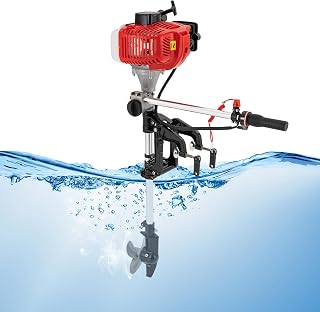
Best for inflatable or portable craft needing a balance of power and visibility. This two-stroke 2.5 hp motor delivers up to 6500 rpm with quick-start CDI ignition and a sound reduction system for a quieter operation. The external 0.32 gal fuel tank provides a clear view of remaining fuel, aiding timely refueling. The design emphasizes ease of use and portability for short trips and leisurely rides.
Consider this if you want a compact motor with a practical fuel-view feature. Limitation: lower RPM ceiling compared to higher-end models, so speeds may be more modest on larger craft.
Buying Guide
What to consider when choosing a 2.5 hp outboard motor:
- Boat size and shaft length: Short shaft models fit smaller, lighter crafts; longer shaft variants suit deeper water or larger dinghies.
- Power needs and RPM range: Higher RPMs deliver quicker starts but may consume more fuel; match to typical water conditions and load.
- Fuel type and efficiency: Two-stroke engines are lighter and cheaper but generally use more fuel; four-stroke options offer cleaner operation and smoother idle.
- Cooling method: Air cooling reduces maintenance but may require more frequent checks in hot environments; effective cooling lowers failure risk during longer runs.
- Ignition system: CDI ignition provides reliable starts; ensure the model offers an accessible pull-start or electric start if you prefer.
- Fuel capacity and monitoring: External fuel tanks with clear sightlines help plan runs and minimize accidental runs dry.
- Portability and mounting: Consider weight, handle design, and compatibility with your boat’s transom and mounting hardware.
Frequently Asked Questions
- What bow length do I need for a 2.5 hp outboard?
– Most 2.5 hp units are designed for small boats under around 9–10 ft; check your boat’s transom height and motor mount compatibility. - Are two-stroke engines harder to maintain than four-stroke?
– Two-stroke engines are typically lighter and simpler but may require more frequent oil mixing and careful fuel management; four-stroke engines tend to run cleaner and longer between services. - How do I choose between a short shaft and long shaft motor?
– Short shafts fit smaller boats with shallow water; long shafts extend deeper for better propeller clearance and reduced cavitation on larger or deeper hulls. - Is an external fuel tank necessary?
– External tanks provide clear fuel level visibility and easier refueling; many users prefer them for longer trips or when monitoring fuel consumption. - Can I use a 2.5 hp motor on a kayak or inflatable?
– Yes, many 2.5 hp models are suitable for kayaks and inflatables, depending on weight limits and mounting compatibility. - Do these motors require special license or certifications?
– Most consumer outboard motors do not require special licenses; local regulations may apply for watercraft operation.