Best Guest Battery Selector Switches for Boats and RVs
Finding the right guest battery selector switch helps manage multiple battery banks safely and efficiently. This guide highlights five Guest and related marine battery selector options, ideal for boaters and RV owners who need reliable, durable switching between batteries for starting, charging, or essential loads. The selections focus on universal mounting, amperage capacity, and practical features like AFD, copper sweep contacts, and easy cable routing. The buyer types most likely to benefit include: boaters needing quick battery isolation, RV users requiring seamless power switching, and system builders seeking compact, durable switches for limited spaces.
| Product | Continuous Amps | Momentary Amps | Mounting | Notes |
|---|---|---|---|---|
| Guest 2111A Battery Selector Switch | 230 | 345 | Universal | Without AFD; copper sweep contacts |
| Guest 2110A Universal Mount | 230 | 345 | Universal | With AFD; copper sweep contacts |
| Guest 2101 Cruiser Series | 230 | 345 | Surface | 6V–36V systems; polycarbonate case |
| Seachoice Battery Select Switch | Not stated | Not stated | Dual | UL listed; ignition protected |
| Blue Sea 4-Position Mini Selector | 6007 m‑Series | Not stated | Compact | Emergency combine feature |
Guest 2111A Battery Selector Switch, Universal Mount without AFD
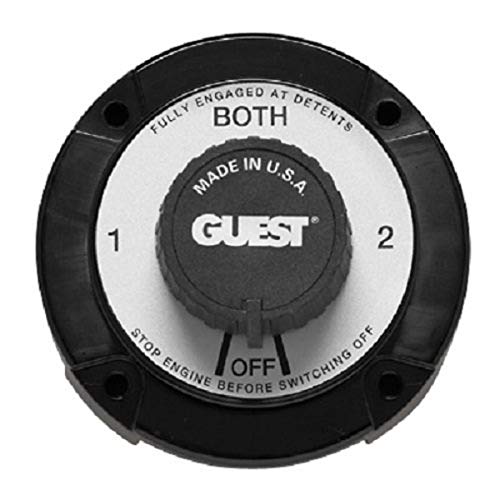
The Guest 2111A is a universal mount selector switch designed for straightforward battery control without AFD. It supports continuous operation up to 230 amps and momentary bursts up to 345 amps. Longer stud lengths aid cable routing and assembly, making this model suitable for installations with tight or cluttered engine compartments. It uses heavy-duty copper sweep contacts for positive circuit control, which helps ensure reliable switching between battery banks. Best for boaters and RV setups that require a robust, simple switch without alternator field disconnect features.
Who it’s best for: boat owners and mobile users who need a dependable, no-frills selector switch for multiple battery banks in compact spaces. Limitation: absence of AFD means no automatic field disconnect when isolating circuits, which may be a consideration for alternator wiring in complex systems.
Guest 2110A Universal Mount Marine Battery Selector Switch with AFD

This model adds an Alternator Field Disconnect (AFD) feature while maintaining a universal mounting approach. It supports 230 continuous amps and 345 amps in momentary operation. Longer studs improve cable routing, and copper sweep contacts provide reliable circuit switching. Choose this if your installation includes an alternator and you need a field disconnect function to prevent parasitic battery drain during engine off periods.
Best for: vessels or setups with alternators where AFD is advantageous to protect charging options. Caution: AFD adds complexity; ensure wiring matches the device’s disconnect behavior to avoid miswiring during maintenance.
Guest 2101 Cruiser Series Marine Battery Selector Switch

The Guest 2101 Cruiser Series is a surface-mounted selector switch designed for 6V, 12V, 24V, or 36V systems, offering 230 continuous amps and 345 momentary amps. It features a polycarbonate housing for durability in marine environments. Best for boats or RVs with tighter spaces where a surface mount unit is preferred. Limitation: the lack of an AFD means no automatic field disconnect, which may be a consideration in modern alternator setups.
Who it’s for: users needing a compact, surface-mount switch compatible with multiple voltage systems. Choose this if you want a simple, robust option that fits shallow mounting areas and avoids deeper equipment bays.
Guest Boat Battery Selector Switch 2112A | 2-Position 6-32V 230A

This 2-position, 6-32V switch provides up to 230A continuous and 345A intermittent capacity in a red plastic housing. It is designed for straightforward battery bank switching in compact spaces. Best for basic dual-battery setups where a simple on/off or alternate configuration is sufficient. Limitation: plastic housing may be less rugged in some high-vibration environments compared with metal-bodied units.
Seachoice Battery Select Switch, Disconnect Isolator

Seachoice offers a dual-battery selector that allows starting, charging, or running loads in parallel. It is suitable for systems under 50V and is UL listed, ignition protected, and CE approved. Best for users who need a certified, dual-battery switching solution that complies with standard marine electrical safety norms. Consideration: the product description emphasizes two or more batteries; ensure your installation aligns with the intended parallel configuration.
Blue Sea Systems 4-Position Mini Selector Battery Switch
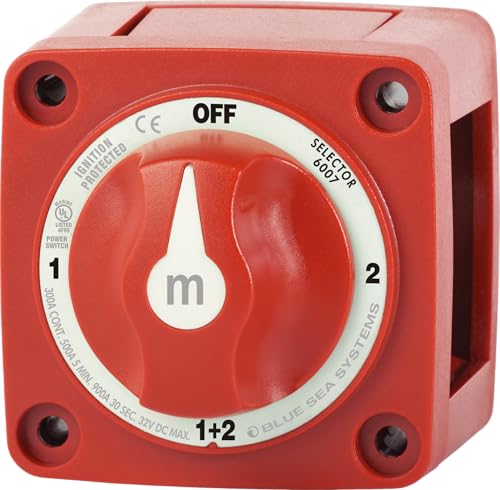
The Blue Sea Systems 4-Position Mini Selector features a compact design for tight spaces and an Emergency Combine function to draw power from both batteries during engine starts or essential radio use. It supports three mounting methods: surface, flush, or rear installation. Best for installations prioritizing space efficiency and emergency power availability. Limitation: the 4-Position setup may be more than needed for simple two-battery systems, requiring careful wiring and labeling to avoid confusion.
Buying Guide
What amperage level do I need?
Look for continuous amperage in the 230A range for general marine or RV starter and accessory loads. If you plan to crank an engine with a larger electrical load or have high-power accessories, consider higher momentary ratings (345A) to handle brief surges without contact wear.
Is AFD important for my setup?
Alternator Field Disconnect (AFD) helps isolate the alternator from the battery bank, reducing parasitic drain when the engine is off. Choose a model with AFD if your system includes an alternator or plan to disconnect the field during maintenance or storage.
What mounting style should I choose?
Universal or surface mounting offers flexibility in tight spaces, while compact designs help fit panels with limited depth. If space is a major constraint, choose a compact or 4-Position mini unit.
What materials affect durability?
Copper sweep contacts improve reliability and positive circuit control. Polycarbonate housings offer resistance to impact and exposure. In wet environments, consider sealed or ignition-protected units to reduce corrosion risk and fire hazard.
Two common configurations: Isolating vs. combining
Isolating switches separate battery banks for independent use. Combining switches allow simultaneous powering of all loads from multiple batteries. If you frequently start engines and run critical electronics, a combination or emergency combine feature can be advantageous.
What about certifications and safety?
UL listed, ignition protected, and CE approvals indicate compliance with safety standards. Ensure the model you choose has appropriate certifications for your region and installation type.
FAQ
- What is a battery selector switch used for?
It lets you choose which battery bank powers your loads or engine and can isolate or combine banks as needed.
- Do I need AFD on a marine switching panel?
AFD is useful when you have an alternator; it helps prevent unintended drain and protects charging circuits during shutdown.
- Can I install a selector switch in a tight space?
Yes, many models are designed for universal or compact mounting, with several mounting options to fit shallow panels.
- What amperage should I select for a dual-battery boat system?
Look for at least 230A continuous with a 345A momentary rating to handle startup surges and accessory loads.
- Is a plastic housing as durable as metal?
Plastic can be lighter and corrosion-resistant, but metal housings may offer greater ruggedness in high-vibration environments.
- Are these switches certified for marine use?
Many options carry UL or CE marks and ignition protection, which supports safer marine installations.