Best 100 Amp Marine Battery Chargers for Power on the Water
Finding a reliable 100 amp marine battery charger helps ensure rapid, safe charging for boats, RVs, and off-grid systems. This guide highlights select 100A models and a few near-100A options to compare performance, safety, and compatibility. Best for professionals needing fast charging or boaters with large battery banks, these chargers balance power with protection. The table below summarizes core details for quick comparison.
| Product | Bank Count | Max Output | Best For | |
|---|---|---|---|---|
| Victron Energy Centaur 12-Volt 100 amp 3 Bank | 3 | 100 A | Large 12V setups, global use | Temperature-based output reduction under extreme heat |
| PowerMax PMBC 100 Amp 12V Charger | 1 | 100 A | RV, boat, and off-grid booster power | No continuous high-load operation beyond 24 hours without caution |
| Schumacher DSR Pro INC100 | 1 | 100 A | Professional-grade ECU reprogram and high-demand use | May require careful voltage selection for certain ECU procedures |
| NOCO Genius GEN5X3 | 3 | 15 A | Compact, multi-bank maintenance for mixed chemistries | Not a 100A charger, but a versatile marine option |
| SOARFLY 3 Bank Marine Battery Charger | 3 | 30 A | Multiple batteries with 10 A per bank | Lower total output than 100A units |
Note: The table above focuses on relevance to 100 amp capability and practical marine applications. Detailed product sections follow with precise features and suitability for different buyers.
Victron Energy Centaur 12-Volt 100 Amp 3 Bank Battery Charger

The Victron Centaur is a 12-volt charger with three banks and a total output of 100 amps. It features auto-ranging input (90–265 VAC, 50/60 Hz), allowing global use, and an internal temperature sense to protect power components. It reduces output current automatically during extreme conditions and uses a bulk charging phase before tapering to a 70% output with a four-hour timer, then switches to float. This model suits boaters with multiple 12V battery banks, RVs with large storage, and commercial marine setups where steady, reliable charging is essential.
Best for: Boats with multiple 12V battery banks and travelers who need wide input compatibility. Limitations: Temperature-based reduction may affect charging speed in hot environments.
LiTime 80-Amp Lithium Battery Charger

The LiTime 80A charger provides high-current charging for 12V LiFePO4 systems. It supports 0V activation to awaken deeply discharged lithium batteries and uses a smart, three-stage charging profile with safeguards against over-temp, over-voltage, short-circuit, over-current, and reverse polarity. While it’s not a 100A unit, it is an excellent choice for fast LiFePO4 charging in RVs, off-grid homes, and solar storage. It includes FCC/CE/RoHS testing for reliability.
Best for: Off-grid or RV owners using LiFePO4 packs who need rapid 12V LiFePO4 charging. Limitations: Total output is 80A, not a true 100A model, which may extend charge times for very large packs.
PowerMax PMBC 100 Amp 12V Charger
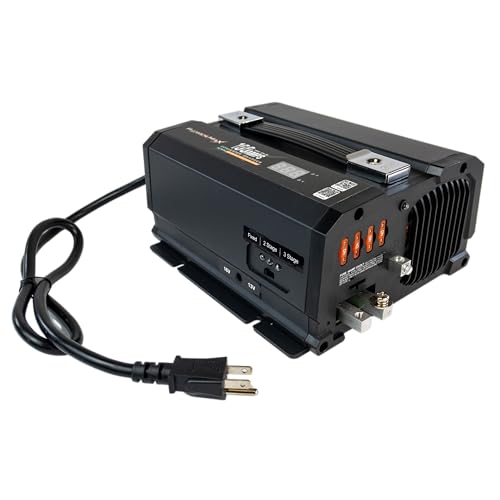
The PowerMax PMBC delivers 100 amps and includes a portable form factor with a simple setup for RVs, boats, and offshore systems. It emphasizes automatic thermal protection, reducing output to safe levels when temperatures rise and warns that the battery should not remain connected for more than 24 hours. This model is a robust option for those needing a strong 12V supply with straightforward operation.
Best for: RV enthusiasts and boaters needing a straightforward 100A charger with thermal protection. Limitations: Continuous long-term operation without breaks can risk overheating; monitor ambient temperature.
Schumacher Electric DSR Pro INC100
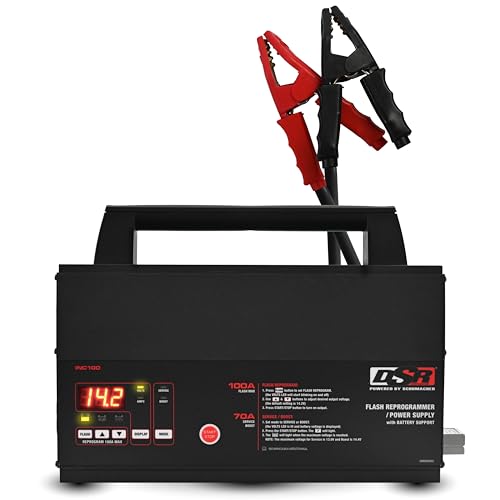
The Schumacher DSR Pro INC100 is a 100A heavy-duty charger with service mode, flash reprogram capability, and boost options. It is designed for professional-grade use, combining high-quality components with advanced features for demanding automotive and marine applications. The unit provides constant output up to 100A during ECU reprogramming and allows voltage selection for different charging scenarios.
Best for: Professionals and technicians requiring a stable 100A supply during ECU reprogramming or heavy maintenance. Limitations: Reprogramming scenarios may require careful voltage management to match specific vehicle needs.
NOCO Genius GEN5X3: 3-Bank, 15A Onboard Charger
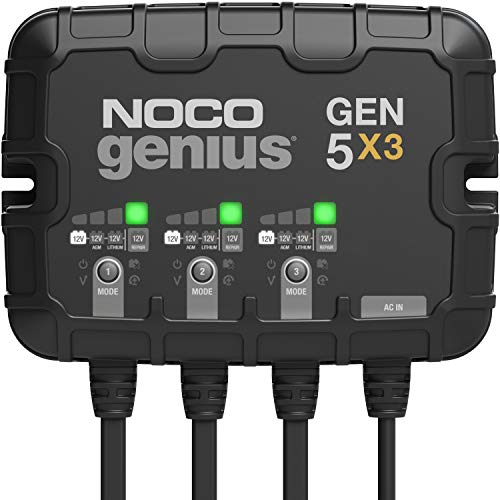
The NOCO Genius GEN5X3 provides three banks with a total 15 amps (5A per bank) and supports 12V lead-acid and lithium batteries. It includes overcharge protection and temperature compensation, making it reliable for marine environments. While not a 100A unit, its multi-bank design is useful for maintaining several smaller battery banks on a boat or vessel with space and weight considerations.
Best for: Boat owners with multiple small to mid-size 12V batteries needing independent bank maintenance. Limitations: Lower total amperage than true 100A models; slower for large packs.
NOCO Genius GEN5X2: 2-Bank, 10A Onboard Battery Charger
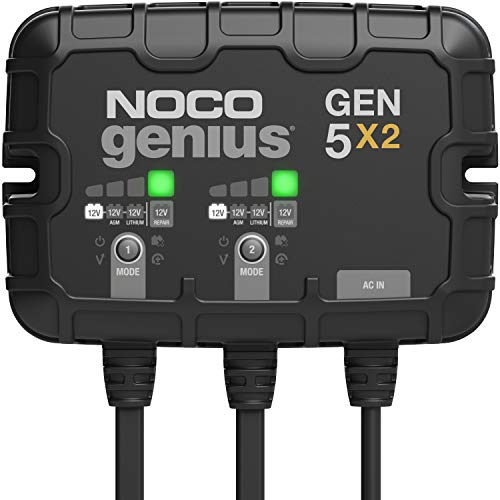
The GEN5X2 offers two banks at 10A total (5A per bank) with marine-grade waterproofing and temperature compensation. It’s compact and suitable for smaller boats or setups with fewer large batteries. The modular design helps keep weight and footprint down while still delivering reliable maintenance charging for mixed chemistries.
Best for: Smaller boats or vessels with two medium-sized 12V banks. Limitations: Not designed for high-output, single-battery rapid charging.
SOARFLY 3 Bank Marine Battery Charger

The SOARFLY three-bank charger handles 12V batteries with 10A per bank (total 30A). It supports multiple modes for SLA/AGM, Li-ion, and calcium batteries, and each bank can be controlled independently with a MODE button. It also includes a Force/Repair mode to attempt charging of deeply discharged cells. This model is a flexible option for mixed-battery systems on smaller boats or as a maintenance charger for larger ones.
Best for: Vessels needing independent bank control across three channels with mixed battery chemistries. Limitations: Lower overall output than true 100A units.
Buying Guide: Key Considerations for 100 Amp Marine Chargers
- Power needs: Count total battery bank capacity and determine if a single 100A charger or a multi-bank solution best fits the vessel’s charging workflow.
- Battery chemistry: Confirm compatibility with lead-acid, AGM, calcium, and LiFePO4 batteries. Some models handle multiple chemistries but may require mode selection.
- Environmental conditions: Marine environments demand corrosion resistance, IP ratings, and temperature compensation. Consider models with thermal protections and weatherproof housings.
- Input voltage and travel: For global use, choose chargers with wide input range (e.g., 90–265VAC) and reliable operation across different shore power sources.
- Maintenance and monitoring: Look for features like LED indicators, fault protection, and clear user manuals. Some units offer repair modes for dead cells, which can be beneficial but require careful handling.
- Bank configuration: If the boat has three or more battery banks, a three-bank charger offers convenient simultaneous charging. For fewer banks, two-bank or single-bank options may suffice.
- Safety and certifications: Ensure compliance with applicable standards (FCC/CE/RoHS where applicable) and proper installation practices to avoid electrical hazards.
Frequently Asked Questions
- What is the advantage of a 100A marine charger?
It can deliver a high charging current to quickly restore large battery banks, reducing downtime among boats, RVs, and off-grid systems. - Can I use a 100A charger with LiFePO4 batteries?
Yes, but verify that the charger supports LiFePO4 chemistry and use the correct mode or settings for lithium batteries. - Are multi-bank chargers better than a single 100A unit?
It depends on battery layout. Multi-bank chargers offer independent control for each bank and can be more space- and weight-efficient on boats with several batteries. - Is thermal protection necessary for marine charging?
Yes. Marine environments can be hot or humid; chargers with automatic thermal protection prevent overheating and extend charger life. - Should I choose a compact 15A or 30A per bank option over a 100A unit?
For smaller vessels or fewer batteries, a multi-bank 10–30A-per-bank system can be more suitable; for large bank setups, a true 100A unit provides faster charging. - Do I need professional installation for these chargers?
Installation involves high-current DC and AC connections. If you are not experienced with marine electrical systems, consider professional installation.