Best Towing Bridle for Dinghy: Safe, Even Pulling for Small Boats
The best towing bridle for a dinghy distributes pulling force evenly, improves straight-line tracking, and reduces the risk of capsizing or tangling. This guide highlights five top options suited for inflatables and dinghies, with clear guidance on who each product is best for and why. If you tow often in choppy waters or need reliable flotation, choose a bridle with visible, floating features and strong hardware. The following table summarizes key picks to help compare at a glance.
| Product | Best For | Why This Pick |
|---|---|---|
| C-Level, Inc 3 Point Dinghy Towing Bridle | American-made gear fans | Adjustable middle leg for even pull; USA-made; yellow float; stainless hardware |
| 3 Point Dinghy Towing Bridle with Float – Adjustable Middle Leg | Inflatable boats needing balanced force | Uniform force distribution; high-strength polyester; buoyant float; offshore-ready |
| Dinghy Towing Bridle with Float | Budget-friendly dinghies | Simple floating bridle with float; straightforward setup |
| 2 Point Dinghy Towing Bridle with Float | Inflatable boats needing compact option | Double-point design; reinforced stitching; floating line for visibility |
| C- Level Towing Bridle | Two-ring inflatables | Two-ring stability; red 3800 lb nylon webbing; yellow float |
C-Level, Inc 3 Point Dinghy Towing Bridle
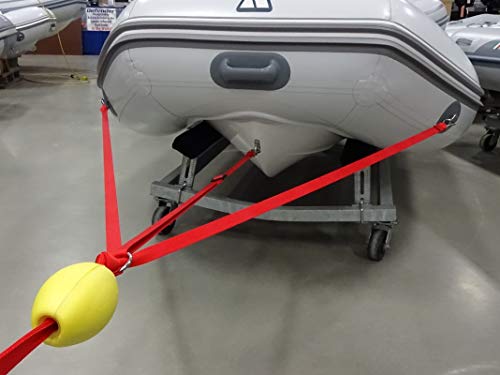
This 3-point system spreads the load across three attachment points with an adjustable middle leg to balance force. Best for buyers who want American-made hardware and corrosion-resistant stainless steel components. The yellow float keeps the bridle buoyant, reducing the chance of sinking. A potential limitation is the need for precise setup to achieve even pull in rough conditions.
- Best for demanding use where even pull distribution matters
- Stainless steel towing rings and snap hooks
- Made in the USA; designed to avoid overseas copies
3 Point Dinghy Towing Bridle with Float – Adjustable Middle Leg
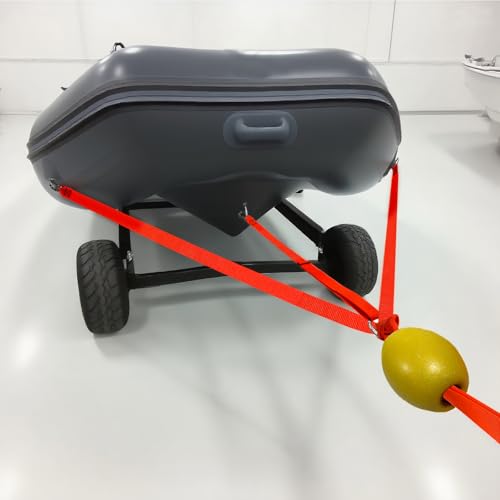
This model emphasizes uniform force distribution via an adjustable middle leg, keeping inflatable boats or dinghies on a straight course and reducing rollover risk. It uses 1-inch high-strength polyester webbing and includes a buoyant yellow float for visibility and safety. Best for: inflatable boats that need steady towing over longer distances. Limitation: polyester webbing may stretch under extreme loads, so monitor tension during heavy pulls.
- Uniform force distribution improves tracking
- 1-inch high-strength polyester webbing
- Floating yellow buoyancy module
Dinghy Towing Bridle with Float

This bridle offers a straightforward, floating design suitable for casual dinghy towing. It’s a simple option when you want a quick setup without multiple adjustment points. Best for: light to moderate towing tasks where simplicity is valued over advanced force distribution. Caution: may provide less precise control in heavy chop or crosswinds.
- Floating design enhances visibility and safety
- Simple, quick setup
2 Point Dinghy Towing Bridle with Float

This two-point design uses reinforced stitching and a high-strength 1-inch polyester webbing for dependable towing. The integrated high-density yellow foam float keeps the line on the surface, aiding visibility and reducing propeller tangling. Best for: inflatable boats that require a compact, sturdy option. Caution: fewer attachment points than a 3-point system may limit load distribution in rough seas.
- Reinforced stitching for reliability
- Floating line improves safety and hookup visibility
C- Level Towing Bridle

Designed for inflatables with two towing rings on the bow, this bridle provides more stable towing than a single line. The red nylon webbing has a 3800 lb test strength, and a yellow float helps prevent sinking. Best for: inflatables that require more stability with two attachment points. Limitation: not as feature-rich as three-point systems in terms of load distribution.
- Two-ring stability for inflatables
- High-visibility yellow float
TGL Tow Bridle

Includes a kinetic rope recovery bridle with a tree saver strap and two soft shackles, offering two-point vehicle attachment for safe recovery or towing. Best for: off-road or heavier vehicle towing where even force distribution matters. Caution: designed more for vehicle recovery contexts; ensure compatibility with boat towing use cases.
- Kinetic- and recovery-oriented design
- Two-point vehicle attachment with soft shackles
SENKEYFE Tow Straps V Bridle

A 3″ x 24″ recovery V-bridle with 8″ J hooks and a forged triangle ring offers high capacity for heavy-duty towing. Best for: scenarios needing strong recovery capability with secure attachments. Limitation: heavy and bulky, may require more space and setup time in tight docking areas.
- High capacity V bridle for heavy towing
- Included forged J hooks and triangle ring
VEVOR G80 V Bridle Chain

Grade 80 chain bridle with 3/8″ x 2′ chain and 15″ hooks designed for heavy-duty use. Best for: situations requiring high tensile strength and rust resistance in harsh environments. Limitation: heavier than webbing bridle options, which may be harder to handle in small setups.
- G80 grade for high strength
- Galvanized for rust resistance
Buying Guide
Key considerations when choosing a towing bridle for a dinghy:
- Pull distribution: Choose a design with multiple attachment points (3-point or 2-point) if you tow in variable conditions or with larger inflatables.
- Material and durability: Look for 1-inch high-strength polyester webbing or nylon with reinforced stitching; stainless hardware improves longevity in saltwater.
- Buoyancy: A floating or buoyant bridle reduces the risk of sinking and helps prevent tangling with the propeller.
- Visibility: Bright floats and colored webbing improve hook-up visibility in low light or rough seas.
- Intended use: For casual dockside tasks, simpler designs may suffice; for frequent or heavy-duty towing, prioritize higher load ratings and two-point or three-point configurations.
- 重量 and handling: Heavier chain bridle options offer strength but can be harder to manage on small boats.
FAQ
- What is a dinghy towing bridle and why use one?
– A towing bridle distributes tow force across multiple attachment points, improving stability and reducing the risk of capsizing or line failure. - What material should I look for?
– High-strength polyester webbing (1 inch or more) with stainless hardware is common for durability in saltwater. - Is a floating bridle safer for dinghies?
– Yes, a floating bridle stays on the surface, aiding visibility and reducing the chance of entanglement with propellers. - When should I choose a 3-point vs. 2-point bridle?
– A 3-point system offers more even force distribution, better for larger or heavier loads; a 2-point may be sufficient for small inflatables and casual towing. - Are there safety cautions to consider?
– Always inspect hardware for corrosion, avoid overloading beyond the rated strength, and ensure secure attachment points before towing. - Can these bridles be used for vehicle recovery as well?
– Some models (like kinetic recovery bridles) are designed for vehicle recovery; verify compatibility before dual-use.