Best 12 Volt Fuse Block Marine Solutions for Boats and RVs
Discover the best 12-volt fuse blocks for marine and mobile vehicles. These panels organize wiring, protect circuits, and simplify maintenance for boaters, RV owners, and automotive enthusiasts. The top picks below are suited for different needs: compact layouts for small boats, higher‑output blocks for larger systems, and blocks with clear LED indicators for quick fault location. Each product is evaluated for best use case, wiring neatness, and ease of replacement. See the quick summary table to compare core specs at a glance.
| Product | Circuits | Main Benefit | |
|---|---|---|---|
| WUPP 12‑V Fuse Block | 6 | LED indicators, damp-proof cover | Compact boats, small RVs |
| Blue Sea ST Blade 12 Circuit 5026 | 12 | Integrated negative bus, 100 A max | Higher demand DC systems |
| Cyrico 12‑Circuit Fuse Block | 12 | Neat wiring design, LED indicators | Organized multi‑device setups |
| Pautou 6‑Way Marine Fuse Block | 6 | LED warning, fire‑resistant materials | Medium wiring projects |
| DaierTek 12‑Way Fuse Block | 12 | LED indicators, 100 A panel, waterproof cover | Versatile marine/vehicle use |
The following sections provide practical details and usage guidance for each option. Each entry notes who it is best for, why it stands out, and any notable limitations to consider when wiring a boat, car, or RV.
WUPP 12-Volt Fuse Block Review
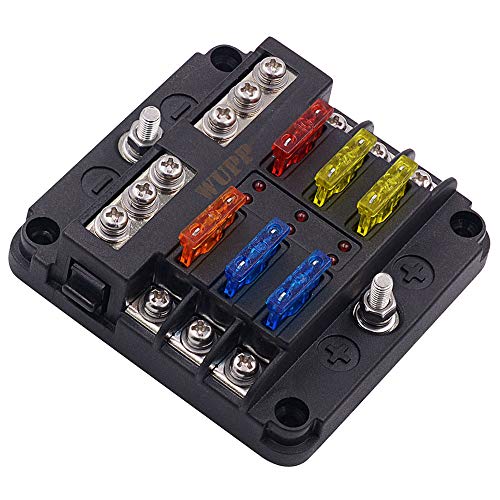
This six-circuit block is designed for damp environments with a waterproof cover and LED indicators. Each circuit has a dedicated fuse plus a ground bus to keep wiring organized. The input range is up to 32V, and each circuit can handle up to 30A. Best for compact boats or small RVs where space is limited and quick fault identification matters. The LED indicators help locate blown fuses quickly. Caution: there may be residual voltage across a circuit even when a fuse is blown due to the unit’s own lighting circuit.
Best for: boaters and campers who want an all-in-one, space-efficient fuse panel with clear fault signaling. Better for: installations requiring six separate circuits with straightforward wiring. Choose this if: you need a simple, damp‑proof panel with individual circuit indicators. Avoid this if: you require more than six circuits in a single block.
Blue Sea ST Blade 12 Circuit

Provides twelve circuits with an integrated negative bus and a 100 A maximum capacity. It supports up to 30 A per circuit with standard fuses, making it suitable for higher‑demand DC systems. The insulating cover includes a secure latch, spare fuse storage, and labeled sections for maintenance. This is a robust choice for larger boats or off‑grid setups that require more circuits and clear organization. Limitation: higher circuit count may demand more space and careful labeling during installation.
Best for: larger boats or systems needing many protected circuits with a centralized negative bus. Better for: installations where spare fuses and easy circuit IDs matter. Choose this if: you plan to run multiple high‑current devices. Avoid this if: you have limited space for a larger panel.
Cyrico 12-Circuit Fuse Block

The Cyrico fuse block emphasizes neat wiring with 12 circuit slots and a grounding bus. It uses nickel‑plated copper for busbars and fuse clips for good conductivity and corrosion resistance. A PC cover provides dust and splash protection. Each circuit is rated for up to 30A, with a panel capacity of 100A. Best for: organized multi‑circuit builds on boats or RVs that need dependable protection across many devices. Limitation: relies on standard ATO/ATC fuses, which should be matched to each circuit’s load.
Best for: users who want clean, labeled wiring and built‑in protection across many loads. Better for: installations requiring a durable cover and protective labeling. Choose this if: you value robust materials and a neat wiring design. Avoid this if: you require nonstandard fuse types beyond ATC/ATO options.
Pautou 6-Way Marine Fuse Block

This six‑circuit panel uses fire‑resistant PBT material and includes a ground bus. An LED indicator signals when a fuse blows, aiding quick replacement. The block is designed to keep wiring neat with six dedicated fuses and six grounding points. Best for: mid‑size installations where compact, organized protection is enough. Limitation: fewer circuits mean less expandability for larger systems.
Best for: moderate projects needing a compact, clearly indicated fuse panel. Better for: users who want a robust, flame‑resistant build with straightforward maintenance. Choose this if: you don’t need more than six circuits. Avoid this if: you anticipate adding more than six circuit loads soon.
FASTSTORM 12-Way Marine Fuse Block

The FASTSTORM block includes 12 circuits and comes with a complete fuse kit (30A, 25A, 20A, 15A, 10A, 5A), plus marine-grade copper main terminal hardware and insulation components. It features a red LED fault indicator and a protective cover to prevent dust and moisture intrusion. Best for: users who want a full kit ready to install, with multiple fuse ratings. Limitation: kit contents may be overkill for small setups needing fewer fuses.
Best for: do‑it‑yourself installers who prefer a complete, ready‑to‑use package. Better for: Marine or RV projects where a broad range of fuse ratings is helpful. Choose this if: you want a turnkey solution without sourcing separate fuses. Avoid this if: you only need a few low‑amp circuits.
Buying Guide
What to consider when choosing a 12V marine fuse block
- Number of circuits: Match the block to your current and anticipated load. More circuits offer future expandability but require space.
- Total amperage and per‑circuit limits: Ensure the panel supports your total system draw and individual device current needs.
- Environmental rating: Look for waterproof, damp‑proof, or IP‑rated housings for boats and outdoor setups.
- Wiring organization: A ground bus, labeled circuits, and neat wiring design simplify maintenance and troubleshooting.
- Indicators and diagnostics: LED indicators help identify blown fuses quickly, reducing downtime.
- Material quality: Corrosion‑resistant busbars, flame‑retardant housings, and durable covers extend longevity in harsh environments.
- Installation footprint: Consider panel thickness, mounting hardware, and clearance behind the panel for wiring and fuses.
How to plan your installation
- Draft a circuit map before wiring. Assign each device to a circuit and note fuse type and rating.
- Label each circuit on the housing to accelerate future replacements.
- Place high‑current lines (like pumps or lights) on circuits with dedicated fuses to minimize interference.
- Keep power and ground wires separate where possible to reduce ground loops and noise.
What buyers should ask
- Does the panel include a negative/ground bus, and how is it integrated?
- What is the maximum circuit current per channel, and what is the total panel capacity?
- Is the housing rated for marine environments and resistant to water exposure?
- Are spare fuses included or readily available for common amperages?
FAQ
- Q: Do these blocks work with 24V systems as well as 12V? A: Many models support 12–24V systems; check each product’s voltage range.
- Q: Can I use standard ATC/ATO fuses with these blocks? A: Most models support ATC/ATO fuses; verify per panel ratings.
- Q: Is a ground bus essential? A: A ground bus helps organize and protect multiple circuits by ensuring a common return path.
- Q: Do LED indicators indicate only blown fuses? A: LEDs typically illuminate when a fuse blows, aiding quick location of faults.
- Q: Is there any risk of residual voltage when a fuse is blown? A: Some voltage may remain due to the panel’s own illumination circuit; use caution.
- Q: What maintenance is required? A: Regularly inspect wiring, clean any dirt on the cover, and replace blown fuses with the correct rating.