Best Epoxy Primer for Boats: Top TotalBoat Picks for Gelcoat, Fiberglass, and Hull Protection
Answering your needs for durable, water-friendly protection, these epoxy primers and barrier coats are ideal for fiberglass, wood, and metal boat surfaces. The selections below cover barrier coats, topside primers, and bilge paints to help you choose the right product for above-waterline and below-waterline applications. Best for anglers, weekend sailors, and professional refinishers seeking reliable underwater protection and lasting topcoat adhesion.
| Product | Best For | Surface | Notes |
|---|---|---|---|
| TotalBoat TotalProtect Epoxy Barrier Coat System (White, Gallon) | Best overall barrier coat | Fiberglass, metal | High-build epoxy, versatile for below and above waterline |
| TotalBoat TotalProtect Epoxy Barrier Coat System (Gray, Quart) | Best budget barrier coat | Fiberglass, metal | Similar performance in a smaller quantity |
| TotalBoat Marine Topside Boat Paint Primer for Fiberglass and Wood (White, Quart) | Best topside primer (1-part) | Fiberglass, wood | One-part primer, flexible undercoat |
| TotalBoat Marine Topside Boat Paint Primer for Fiberglass and Wood (Gray, Gallon) | Best topside primer (gray, larger area) | Fiberglass, wood | One-part formula for easy application |
| TotalBoat TotalBilge Epoxy Based Bilge Paint (Gray, Quart) | Best bilge/below-deck area coating | Bilges, bulkheads | Epoxy-based, tough and waterproof |
TotalBoat TotalProtect Epoxy Barrier Coat System (White, Gallon)

Product overview: A high-build two-part epoxy primer and barrier coat designed for use above and below the waterline. It offers strong gelcoat blister prevention and is suitable for repairs on fiberglass boats. It also provides superior protection on all underwater metals.
Best for: Boat owners needing a robust barrier coat that can be applied to both fiberglass and metal hull sections, including areas prone to blistering. The white color helps with visibility during inspection and coating build-up checks.
Why chosen: This system combines barrier protection with an epoxy matrix that resists water intrusion and chemical exposure. It aligns with prep that includes cleaning, sanding, and priming prepared surfaces to ensure adhesion and long-term durability.
Caution: As a two-part epoxy, follow the mixing ratios and pot life precisely. Ensure adequate ventilation and proper PPE during mixing and application.
TotalBoat TotalProtect Epoxy Barrier Coat System (White, Quart)

Product overview: A white, high-build two-part epoxy primer/barrier coat suitable for above and below waterline use. It supports gelcoat blister prevention and works on fiberglass and metal hull sections.
Best for: Boat projects that require a durable barrier coat in a smaller quantity, or when working on a portion of the hull and nearby ballast areas. Quart sizing is convenient for touch-ups or partial recoats.
Why chosen: It mirrors the gallon system’s performance in a more compact package, making it ideal for repairs or limited-scope applications without sacrificing barrier quality.
Caution: Ensure you mix components thoroughly and adhere to the recommended cure times before applying next coats or topside finishes.
TotalBoat Marine Topside Boat Paint Primer for Fiberglass and Wood (White, Quart)
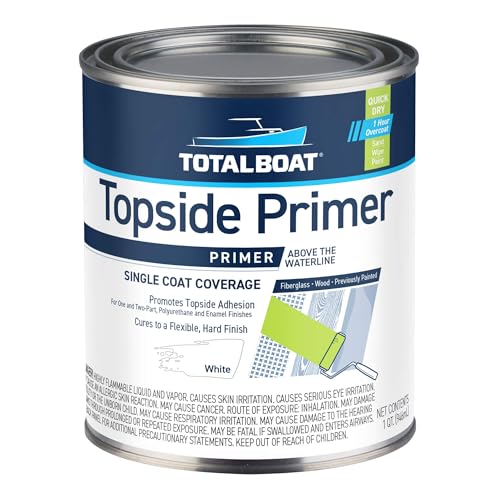
Product overview: A one-part marine primer for boats that serves as a flexible undercoat for 1-part and 2-part polyurethane and enamel topside paints. Designed for above-waterline use on fiberglass, wood, and gelcoat in good condition.
Best for: Simpler, faster priming projects where a single coat suffices and you plan to finish with compatible topside paint. Ideal for surfaces needing a quick, smooth seal before finishing coats.
Why chosen: This primer emphasizes ease of application—brush, roller, or spray—and minimizes build with a single coat, reducing labor time on smaller vessels or maintenance tasks.
Caution: If you need higher build for major imperfections, consider applying a second coat or using a fairing compound before priming to achieve a smoother surface.
TotalBoat Marine Topside Boat Paint Primer for Fiberglass and Wood (Gray, Gallon)

Product overview: A one-part marine primer particularly suitable for topside use above the waterline on fiberglass and wood. The gray variant offers a neutral base for topcoat matching and consistent color results.
Best for: Larger topside projects where a persistent, single-coat primer is preferred, followed by compatible topcoats. It is effective for good-condition surfaces and projects with wide areas to cover.
Why chosen: The gray tone can reduce glare during inspection of the coated surface and often aligns well with gray-toned topcoats or color matching strategies in marine painting schemes.
Caution: For severely pitted surfaces or large imperfections, consider a filler or fairing compound before priming to achieve a uniform base for the final paint.
TotalBoat TotalBilge Epoxy Based Bilge Paint (Gray, Quart)

Product overview: An epoxy-based bilge coating designed for tough, waterproof protection in bilges, bulkheads, engine rooms, and locker areas. It resists chemicals, oils, acids, alkyds, and solvents for durable interior protection.
Best for: Areas below deck where exposure to moisture, fuel, and oil is common, and where a hard, long-lasting coating is needed to simplify maintenance and leaks detection.
Why chosen: The epoxy matrix provides superior resistance to harsh marine environments, helping to maintain a clean, bright bilge while offering strong coverage and durability.
Caution: Follow surface prep guidelines to ensure adhesion, and prime metal surfaces with TotalProtect if needed for maximum bonding on bare metals.
Buying Guide: Key Considerations For Choosing Epoxy Primers And Barrier Coats
- Surface type and location: Choose barrier coats for below-waterline protection on fiberglass or metal hulls, and topside primers for above-waterline finishes on fiberglass or wood.
- Two-part vs. one-part: Two-part epoxies offer stronger protection and barrier capabilities but require precise mixing and longer curing; one-part primers are easier for quick jobs but may require more coats for higher build.
- Color and visibility: White primers help inspect coverage and film build; gray primers can aid color matching and glare reduction during inspection.
- Surface prep requirements: Most epoxy primers need clean, dry, sanded surfaces. For best results, follow manufacturer prep instructions and consider using a fairing compound for bulkier imperfections.
- Bonding and compatibility: Ensure compatibility between primer/barrier coats and the intended topside paints or finishes. When applying over bare metal, some systems recommend a dedicated bonding step.
- Application environment: Use proper ventilation, PPE, and temperature control to ensure proper curing and avoid solvent buildup in closed spaces.
- Maintenance and inspection: Barrier coats help detect gelcoat blistering and water intrusion early, while bilge coatings protect critical mechanical areas from moisture and chemical exposure.
Frequently Asked Questions
- What is the difference between a barrier coat and a topside primer?
– Barrier coats protect underwater and provide corrosion resistance, while topside primers prepare above-water surfaces for final paint layers. - Can I use a single product for both above and below waterline areas?
– Some barrier coats are formulated for both use cases, but ensure the product label supports the intended sections of the hull to avoid performance issues. - Do I need multiple coats of epoxy primer?
– For heavy imperfections or larger builds, multiple coats may be required. Follow the product’s cure times and recoat windows. - Is gray primer preferable to white for boat projects?
– Gray can help with glare reduction and color matching; white can aid visibility during application and inspection. - What surface prep is essential before applying epoxy primer?
– Clean, dry, and lightly sand the surface; remove old coatings where necessary; a fairing compound can help with large imperfections. - When should I prime bare metal hull sections?
– Prime bare metal with TotalProtect or an equivalent bonding surface primer as recommended by the product guidelines.