Best AIS Receiver With WiFi for Marine Tracking and Safety
Answering the question: if you need an AIS receiver with WiFi, these five models offer reliable data capture, easy connectivity, and practical marine integration. This guide highlights who each product is best for, from casual boaters to professional skippers, with clear reasons and limitations to consider.
Buyer-friendly overview:
| Product | Best For | Key Benefit |
|---|---|---|
| Naroote AIS Receiver | Budget-conscious sailors | Compact, USB-based reception |
| Furuno FA40 | Professional mariners | Real-time tracking and comprehensive data |
| Dioche Dual Channel Receiver | Portable setups | Dual channels for improved accuracy |
| Digital Yacht AIS100 USB | Casual boating | Simple USB interface |
| COMAR Systems R250 | Wi‑Fi enabled navigation | Wi‑Fi streaming plus NMEA and GPS multiplexing |
Naroote AIS Receiver Portable With USB Output

This AIS receiver is compact and USB-driven, ideal for boaters who want a lightweight, portable option. The telescoping stainless steel antenna improves durability and helps prevent bending or breakage, making it suitable for small craft and cabin boats. Best for sailors who want simple laptop or tablet AIS data access via USB without extra network complexity.
Best for: Budget-minded skippers needing a portable USB AIS source. Caution: The data path relies on USB, so networking or wireless streaming is limited without external adapters.
Furuno FA40 AIS Receiver

The Furuno FA40 emphasizes enhanced navigation with real-time vessel tracking and comprehensive AIS data (name, call sign, position, course, speed). It is designed for professional use, with multiple ports for integration to NavNet, AIS-capable radar, chart plotters, or navigation software. Best for users needing robust, real-time traffic information in busy or challenging waterways.
Best for: Professional mariners and serious navigators. Caution: Higher integration potential means more setup and cable management.
Dioche Dual Channel USB AIS Receiver

This portable, stainless steel, foldable antenna AIS receiver provides dual channels for improved reception at 162.025 MHz and 161.975 MHz. The lightweight design makes it easy to carry on small boats or kayaks, while still offering reliable data. Best for: Boaters who want better reception in variable conditions. Caution: Dual-channel performance benefits may depend on antenna position and local signal environment.
Digital Yacht AIS100 USB AIS Receiver

Digital Yacht’s AIS100 focuses on a straightforward USB interface for AIS data. It’s designed for ease of use, making it a practical option for casual boaters who want quick access to vessel traffic information on a laptop or tablet. Best for: Weekend sailors needing a simple, plug-and-play AIS source. Caution: Data presentation may depend on the software used to view AIS information.
Digital Yacht Ais100P USB Pro Receiver
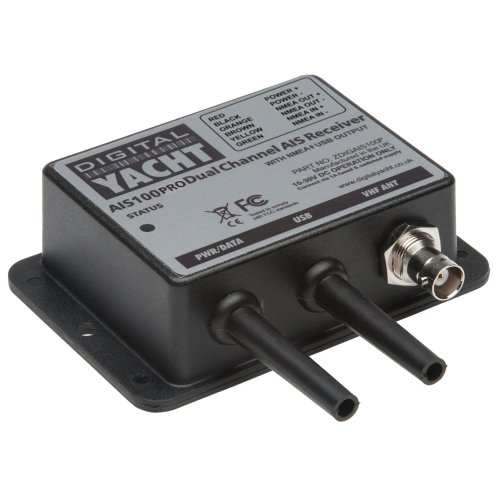
The AIS100P offers a pro-grade option within Digital Yacht’s lineup, suitable for users who want reliable data flow with a USB connection. Best for: Boats requiring stable, dependable AIS reception with straightforward setup. Caution: May require compatible charting software to display information effectively.
COMAR SYSTEMS R250 Dual-Channel AIS Receiver

The Comar Systems R250 combines dual-channel reception with USB, NMEA 0183, and built-in Wi-Fi for wireless data streaming to tablets, smartphones, and PCs. It also offers GPS multiplexing to align position data with AIS information. Best for: Users who want a single device for both wired and wireless data display. Caution: Wi-Fi setup can require additional configuration for stable connections across devices.
Buying Guide: Key Purchase Considerations
- Connection type: Do you need USB-only, or do you want Wi‑Fi or NMEA outputs for chartplottters and mobile devices?
- Portability vs. performance: Are you on a small craft needing light gear, or a larger boat needing robust data and multi-device access?
- Data depth: Do you require full AIS message types (A and B, SARTs, ATON) and position data, or is basic reception sufficient?
- Ease of integration: Will the device connect easily to existing navigation software and radar/chartplotters?
- antenna quality: Is the antenna rugged enough for offshore use, and does folding or telescoping matter for storage?
- Wi‑Fi reliability: If Wi‑Fi is desired, consider range, network stability, and compatibility with tablets and phones.
FAQ
- What is AIS and why do I need it on a boat? AIS broadcasts vessel identity and location to help with collision avoidance and situational awareness.
- Can I use these receivers with my laptop or tablet? Yes, most are USB-based and some include Wi‑Fi streaming for mobile devices.
- Is dual-channel reception always better? Dual channels can improve reception in challenging environments, but results depend on antenna placement and interference.
- Do these work in rough seas? Antenna robustness and mounting affect performance; choose a model with a sturdy, corrosion-resistant antenna for offshore use.
- Do I need a subscription or service to use AIS data? No subscription is required for basic AIS reception; some advanced features may require compatible software.
- Will these integrate with my chartplotter? Many models offer NMEA 0183 or USB outputs that work with common chartplotters and nav software.