Best Flexible Solar Panels for Boats: Top Picks for Off-Grid Power
Finding the right flexible solar panels for boats means balancing bendability, durability, and output. This guide highlights five top options suited for curved decks, cabin roofs, and irregular surfaces. For buyers, the best picks vary by mounting needs, surface texture, and portability. The following selections are organized for quick comparison and clear buying guidance.
| Product | Best For | Highlighted Feature |
|---|---|---|
| Topunive 100W 12V Flexible Solar Panel | Off-grid boats with uneven surfaces | 9BB monocrystalline cells for high efficiency |
| Callsun 200W Flexible Solar Panel Kit | Curved RV roofs and stealth setups | Up to 240° flexibility with all-black stealth design |
| Renogy 200W Flexible Solar Panel | Marine and RVs needing high output | Half-cut PERC technology for efficiency |
| Renogy 100W Flexible Solar Panel | Compact, low-profile boats | 240° bendability with high efficiency |
| BougeRV Arch 200W N-Type Flexible Panel | Longer surface coverage on curves | N-type cells with 25% efficiency |
Below are five detailed product sections to help with side-by-side comparisons, followed by practical buying guidance and frequently asked questions.
Topunive 100W Flexible Solar Panel for Boats

Best for versatile, irregular surfaces on small to mid-size boats. This 36.22″ x 23.22″ panel uses 9BB monocrystalline cells to maximize output on curved installations. With a very thin 0.11″ profile and a light 4.4 lb weight, it is easy to install on cabins, trampolines, or deck contours. The panel includes pre-drilled holes and PV connectors for quick mounting. Best for boat owners seeking a high-efficiency option that remains flexible on non-flat roofs. A limitation is that 100W may require multiple panels to meet larger power demands on extended trips.
Who it’s best for: small to mid-sized boats and campers needing a balance of flexibility and efficiency. Why selected: strong 9BB monocrystalline cells offer higher output per surface area and reduced microcrack risk compared with lower-busbar designs.
Caution: While highly flexible, ensure mounting hardware matches the panel’s weight distribution and avoid sharp edges that can cause wear over time.
Callsun 200W Flexible Solar Panel Kit (2x100W)

Best for stealth installations and curved RV or boat surfaces needing substantial power. This all-black, ultra-thin kit provides up to 240° flexibility per panel, contributing to a seamless look on curved roofs or decks. The kit is lighter than many rigid options, and the ETFE-coated modules resist hail, yellowing, and cracking while maintaining consistent output. Best for owners who want a high-flex, low-profile solution with strong weather resistance. Limitation: the combined weight and complex wiring may require careful planning for 24V or 12V integration on larger vessels.
Who it’s best for: long-range boaters and stealth campers who prioritize a low profile and dependability on curved surfaces. Why selected: excellent curvature tolerance and durable coating extend life in marine environments.
Caution: Ensure proper wind load considerations for exposed mounting locations on high seas or rough weather zones.
Renogy 200W Flexible Solar Panel

Best for boats or campers needing substantial, bendable power with advanced cell technology. Renogy’s 200W panel uses half-cut PERC cells to improve light capture and efficiency, while remaining flexible enough for curved surfaces. It weighs significantly less than rigid panels and offers a glare-free, all-black look. Best for high-output demands on boats with limited roof space. Limitation: higher price point compared with entry-level flexible panels.
Who it’s best for: power-intensive marine setups where weight and efficiency matter. Why selected: high efficiency from half-cut PERC design and 240° bend radius support curved installations well.
Caution: Verify compatibility with existing charge controllers and battery bank to avoid overvoltage on 12V systems.
Renogy 100W Flexible Solar Panel
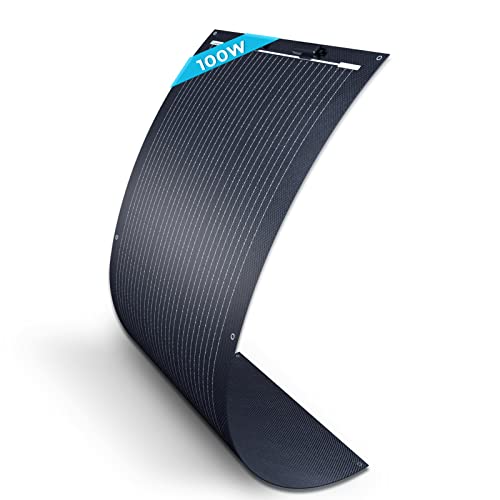
Best for compact boats needing a low-profile, portable solar solution. The 100W panel bends up to 240° and weighs about a third of rigid panels, offering a discreet power source for small cabins or deck spaces. It uses industry-leading half-cut PERC cell tech to boost energy capture and efficiency, making it a solid choice for limited space while still delivering reliable daily output. Limitation: 100W may require parallel panels for higher daily energy on cloudy days.
Who it’s best for: owners of compact boats or campers who value a stealth, lightweight installation. Why selected: efficient PERC technology and notable flexibility for curved surfaces.
Caution: Ensure secure mounting on irregular curves to prevent micro-motions that could wear cabling over time.
BougeRV Arch 200W N-Type Flexible Panel

Best for extended surface coverage on curved surfaces like boat arches or curved caravan roofs. BougeRV’s Arch 2.0 uses N-type cells with 25% efficiency and dual fiberglass layers to improve durability and impact resistance. ETFE coating protects against abrasion and weathering, helping long-term performance in marine environments. Best for users who need durable, high-efficiency panels that can be wired in series for 24V or higher systems. Limitation: heavier than some ultralight options, requiring robust mounting hardware.
Who it’s best for: boats and RVs that demand robust durability and higher system voltage. Why selected: N-type cells and enhanced shielding reduce crack risk and improve life span on dynamic marine surfaces.
Caution: Confirm wiring configuration when integrating into 12V or higher-voltage battery systems to prevent misconnection.
GRECELL UB200 Portable 200W Solar Panel Kit

Best for portable power stations and emergency backups on boats, caravans, and campers. This 200W kit features a folding design and a slim unfolded thickness of 0.98 inches, with four adjustable kickstands and four mounting holes for flexible placement. Its ETFE coating and high-efficiency monocrystalline cells deliver strong performance, even in partial sun. Limitation: portability comes with a need for careful setup to optimize sun exposure and battery charging efficiency.
Who it’s best for: boaters and outdoor enthusiasts needing a compact, high-output, easy-to-move solar kit. Why selected: portable form factor combined with high efficiency and weather-resistant features.
Caution: When storing, ensure the folded panels are protected to prevent edge damage or corner wear over time.
Buying Guide: Flexible Solar Panels For Boats
What matters most for a marine application is the balance between flexibility, durability, and output. Consider these factors when choosing a panel for a boat or RV on water or shore-based use.
- Surface contour and mounting method: For curved decks or hulls, choose panels with large bend radii (up to 240°) and lightweight construction.
- Cell technology and efficiency: Half-cut PERC cells offer better performance in limited sunlight. 9BB cells can improve reliability on flexible formats.
- Durability in marine environments: ETFE coatings resist abrasion and moisture better than PET; look for IP ratings on connectors and junction boxes.
- System voltage compatibility: Ensure the panel aligns with your battery bank (12V vs 24V or higher) and charge controller.
- Portability vs. fixed installation: Portable kits are convenient for temporary setups but require stable mounting when in use at sea.
- Weight and thickness: Lighter, thinner panels ease handling and installation on boats with limited space.
- Wiring and accessories: Check for pre-drilled holes, connectors, and compatible mounting hardware to simplify installation.
Frequently Asked Questions
- What distinguishes flexible solar panels from rigid ones for boats? Flexible panels bend to fit curved surfaces and are lighter, but may be more sensitive to impact and wear on mounting edges.
- How many watts do I need for a small boat? A typical off-grid boat setup might use 100–200W for cabin lighting, electronics, and charging; larger vessels may require 300W or more.
- Can flexible panels withstand saltwater environments? Yes, with proper enclosure and corrosion-resistant mounting hardware, and panels with ETFE coatings and weatherproof junction boxes.
- Is 240° bendability sufficient for most boat surfaces? For many hulls and cabins, yes. Verify the exact curvature and mounting clearance to avoid stressing connections.
- Do I need a specialized charge controller? Yes. A charge controller suited to your system voltage (12V or 24V) protects batteries and optimizes charging from flexible panels.
- Are all-flexible panels as durable as rigid panels? Modern flexible panels use durable laminates and stronger cell designs, but they require careful handling and mounting to prevent edge damage over time.