Best Marine Voltage Sensitive Relay for Dual Battery Setups
Answering the need for reliable, automatic battery management, voltage sensitive relays (VSRs) help keep your start battery ready while preventing deep discharge of auxiliary batteries. This guide highlights five top options ideal for boats, RVs, ATVs, and other marine or off-road setups. Each pick is evaluated for durability, automatic switching performance, and suitability for different battery types. The buyers best served by these products range from weekend boaters needing simple reliability to off-road adventures requiring rugged, high-current protection.
| Product | Best For |
|---|---|
| BEP 710-140A DVSR | Compact, easy-install dual-battery protection for small to mid-size systems |
| VEVOR Dual Battery Isolator Kit | Smart monitoring with LCD display and manual/auto modes |
| KeyLine 300 Amp Heavy Duty DVSR | High-amperage, rugged builds for large battery banks |
| Nilight 140A Dual Battery Isolator w/ Voltmeter | Budget-friendly with integrated voltmeter for quick status check |
| ISINSWIFT 140A Dual Battery Isolator | Compact, protected design with built-in safety features |
Note: All products listed are designed to cut in around 13.3V and cut out near 12.8V, a common threshold for healthy alternator charging while protecting batteries from deep discharge or overcharging. Use this guide to compare how each unit handles real-world conditions such as vibrations, moisture, and compact installation spaces.
BEP 710-140A Digital Voltage Sensing Relay (DVSR) 12/24V
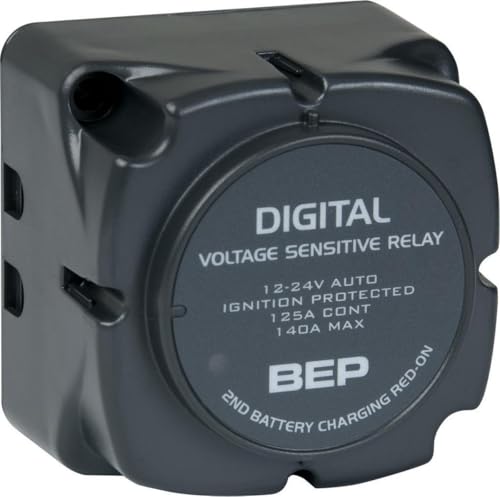
The BEP DVSR is a compact, digital voltage sensing relay designed for 12V and 24V systems. Its straightforward installation makes it a good pick for boats and small vehicles needing reliable auto-switching between batteries. Best for owners who want a simple, dependable dual-battery solution without extra features that complicate setup.
Best for: Small to midsize marine or automotive dual-battery systems where space is at a premium and straightforward operation is key. This model emphasizes reliable auto-switching with minimal fuss, making it an appealing option for boaters who prefer a turnkey solution.
Caution: Data on this unit is limited in some operator materials; verify compatibility with your exact battery chemistry and alternator configuration before wiring. This model prioritizes simplicity over additional monitoring features.
VEVOR Dual Battery Isolator Kit, 12V 140Amp

The VEVOR kit offers manual and automatic switching with an LCD display showing real-time voltage. It features automatic protection to disconnect below 11V or above 17V, helping protect both batteries. The unit supports a seamless, automatic transition between charging circuits, reducing manual intervention and providing clear status updates for the on-the-go user.
Best for: Users who want real-time voltage visibility and a blend of manual override and automatic switching for diverse vehicle or vessel configurations. Suitable for RVs, boats, and off-road vehicles where monitoring is part of daily operation.
Caution: The LCD display is helpful, but ensure the installation space allows for proper heat dissipation and cable routing to prevent snags during movement.
Dual Battery Isolator Kit 12V – 140 Amp VSR

This kit uses a smart VSR to ensure the starting battery remains charged while the auxiliary battery can receive charging at the same time. It is compact enough for under-hood installations and is designed for marine, automotive, and RV use. It emphasizes automatic control with protection against deep discharge and overcharging.
Best for: Boat and vehicle owners needing a reliable, mid-range isolator that balances performance with a compact footprint. Good for standard 12V dual-battery setups where space is modest but robustness is important.
Caution: This model targets general dual-battery use; verify compatibility with lithium or LiFePO4 if used, as some versions are optimized for single chemistry types.
Dual Battery Isolator Heavy Duty 300 Amp VSR

The KeyLine Pro HD 300-Amp DVSR is designed for high-capacity dual-battery systems requiring substantial current. It uses a voltage-sensitive relay approach with a focus on minimal voltage drop and high efficiency. The unit is IP65 rated for water, dust, and vibration resistance, making it well-suited for off-road and marine environments where rugged performance matters.
Best for: Larger boats, commercial vessels, or high-demand installs where a higher current, rugged isolator is needed. Choose this when your auxiliary battery bank and power demands exceed what a standard 140A unit can safely handle.
Caution: Higher current means more heat; ensure adequate airflow and proper mounting to prevent overheating in engine bays or confined compartments.
Nilight 12V 140AMP Dual Battery Isolator w/ Voltmeter

Nilight’s 140A dual battery isolator incorporates a built-in voltmeter for quick voltage checks and monitoring. It switches automatically at 13.3V and disconnects at 12.8V, ensuring reliable charging of the primary battery while defending against deep discharge of the secondary. IP66-rated housing provides moisture and dust resistance for marine and outdoor use.
Best for: Budget-conscious buyers who want integrated status monitoring and a straightforward, automatic VSR that fits under-hood or compact installations on boats, trucks, or RVs.
Caution: The unit’s primary benefit is simplicity and budget-friendly pricing; consider a model with higher current capacity if your auxiliary load demands exceed 140A combined peak.
Buying Guide
What should I consider when choosing a marine VSR?
Current rating, voltage thresholds, and enclosure IP rating determine compatibility with your battery bank and environment. Higher amperage supports larger auxiliary banks but requires careful heat management.
Automatic vs manual modes: which is better?
Automatic switching reduces daily handling, preventing accidental disconnections. Manual modes offer control in complex systems or in case of unplanned charging behavior. Choose based on how much you value simplicity versus control.
Battery chemistry and protection features
Verify compatibility with lead-acid, AGM, or lithium systems. Look for automatic protection against overcharge, deep discharge, and short circuits. In harsh environments, IP ratings (IP65/IP66) indicate better moisture and dust resistance.
Size, installation, and space considerations
Compact units (around 2.6″ x 2.6″ x 2″) fit tight engine bays or under-hood spaces. Ensure there is room for heat dissipation and cable routing to prevent wear or damage during marine or off-road use.
Monitoring and troubleshooting features
LED indicators or built-in voltmeters aid quick status checks. Choose models with real-time monitoring if you want ongoing visibility to prevent unexpected failures on the water or away from service centers.
Durability and water exposure
Look for rugged housings and high ingress protection. Marine environments demand sealed, vibration-tolerant designs to maintain reliability over time.
Compatibility with lithium and advanced battery types
Some units explicitly support lithium or LiFePO4; others are designed for lead-acid. Verify the product notes to ensure you aren’t exceeding the intended battery chemistry or risking improper charging behavior.
FAQ
-
What is a voltage sensitive relay (VSR) used for in boats?
A VSR automatically connects and disconnects a secondary battery from the starting battery based on voltage thresholds to balance charging and protect both batteries.
-
Can I install a VSR myself?
Installation is feasible for many DIY enthusiasts, but follow the wiring diagram precisely. If unsure, consult a professional to avoid wiring errors or battery damage.
-
What happens if the voltage drops below 12.8V?
The VSR will typically disconnect the auxiliary battery to prevent deep discharge and protect the starting battery’s ability to crank the engine.
-
Are VSRs compatible with lithium batteries?
Some models support lithium chemistries; others require lead-acid. Check the manufacturer’s specifications before pairing with Li-ion or LiFePO4 batteries.
-
Is a higher amperage VSR always better?
Higher amperage handles larger auxiliary banks but generates more heat. Match the unit to your total auxiliary capacity and install with adequate cooling.
-
Do VSRs protect against overcharging?
Yes, most VSRs automatically disconnect when the voltage rises above a safe threshold to protect both batteries from overcharging.