Best Single Side Band Marine Radio Options for Safe, Reliable on-Water Communication
Answering the need for clear, long-range communication at sea, these single sideband (SSB) and VHF/marine radios cover MF/HF to 25–150 watt options. They’re suited for coastal and offshore skippers, sailors, and boaters who require dependable distress signaling, weather updates, and ship-to-ship or ship-to-shore contact. This guide highlights five top picks with varying power, GPS, weather alerts, and DSC capabilities. Use the comparison table to quickly spot which model aligns with your vessel size, cruising plans, and safety priorities.
| Product | Best For | Key Benefit | Limitations |
|---|---|---|---|
| Icom M803 | Offshore and large boats | High MF/HF range with 150 W output | MF/HF requires antenna setup knowledge |
| Uniden UM385BK | Sailboats and small craft | NOAA weather alert and triple watch | Limited to fixed-mount use |
| Uniden UM435BK | All-around inland/coastal | IPX8 submersible, DSC, 4-digit channels | Basic fixed-mount features |
| Retevis RM20 | Recreational boats with GPS needs | Built-in GPS, IP67, DSC | Power output not specified in data |
| Cobra MR F77W | Emergency-ready boats | Built-in GPS, dual power 1/25 W, replay feature | Limited to 25 W on some channels |
Icom M803 Marine SSB Radio, 150 W MF/HF
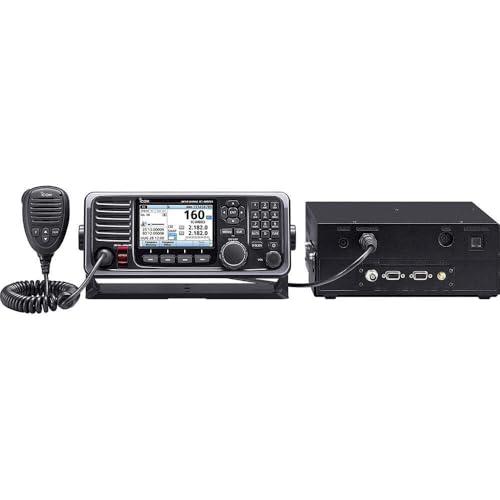
The Icom M803 is designed for offshore and larger vessels that require MF/HF access. It offers a broad frequency range from 0.5 to 29.99 MHz and a robust 150 watts of transmission power, enabling long-range distress signaling and inter-ship communication. Best for boats that routinely travel beyond coastal ranges, where MF/HF levels are essential for reliable contact even when VHF is limited by distance or terrain.
Best for: Offshore cruisers, commercial-leaning recreational boats, and crews needing MF/HF reach. This radio is chosen for its combination of MF/HF flexibility and strong output, which translates into improved chances of maintaining contact over long distances.
Caution: Setup and tuning of MF/HF systems can be more complex; ensure compliant antenna and grounding configurations before operation.
Uniden UM385BK 25 W Fixed Mount VHF, NOAA Alerts

The UM385BK is a compact, fixed-mount VHF radio with 25 watts of output and built-in NOAA weather alert. It features triple watch, DSC capabilities, and access to a broad set of international and U.S. channels. This unit is well-suited for small to mid-sized craft that prioritize weather awareness and reliable, easy communication on the VHF band during coastal cruising.
Best for: Small to mid-sized sailboats or motorboats where weather alerts and DSC improve safety. It’s a practical choice for boaters who want a straightforward, all-weather communications setup without MF/HF complexity.
Caution: Fixed-mount radios can be less flexible for boats that frequently move between zones or require handheld backup options.
Uniden UM385 25 W VHF with Triple Watch & DSC
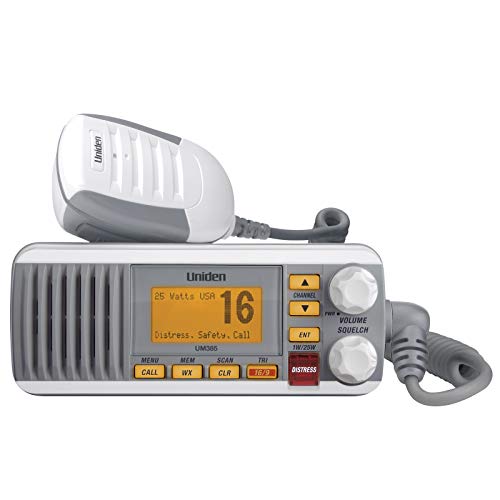
The UM385 (non-BK) offers triple watch, DSC, and S.A.M.E. weather alert, consolidating essential safety features into a compact design. It’s designed for versatility across international channels and is ideal for boats requiring a dependable VHF with weather updates and easy channel management.
Best for: Inland and coastal cruisers seeking a robust VHF with advanced safety features in a compact form. Choose this if you want a straightforward DSC-enabled radio with weather alerts and a familiar Uniden interface.
Caution: Ensure your vessel’s antenna and wiring support optimal VHF performance, especially in rough sea conditions.
Retevis RM20 Marine VHF With Built-in GPS
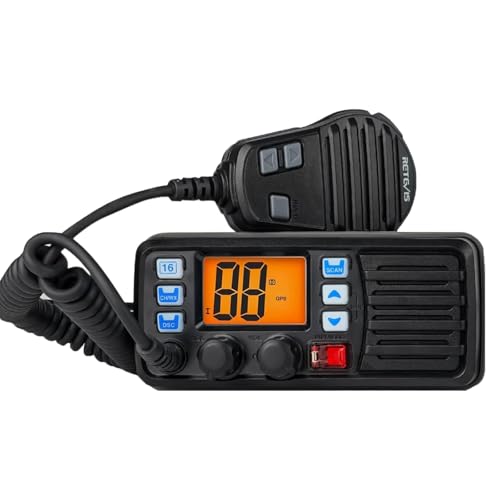
The RM20 integrates a built-in GPS and DSC functions, delivering position sharing and distress signaling alongside international channels and NOAA weather support. It’s designed for recreational boats that want DSC and location data without external GPS wiring, streamlining installation and ongoing operations.
Best for: Recreational and small commercial boats that value GPS-based DSC and ready-to-go installation. It’s a solid pick for those who want DSC with integrated positioning capabilities.
Caution: The data notes term “high power” but does not specify exact wattage; verify power output with your installation plan to ensure it meets range expectations for your vessel.
Cobra MR F77W GPS 25 W VHF Radio
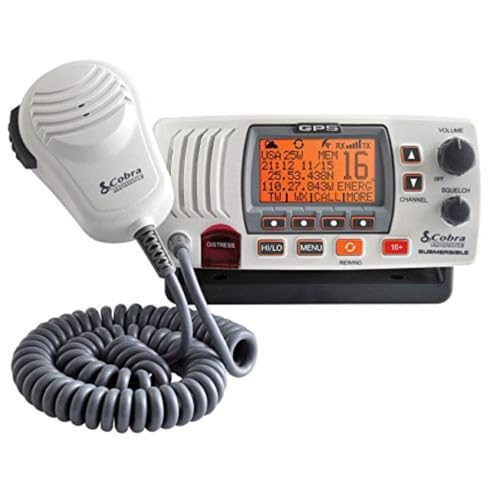
The Cobra MR F77W features built-in GPS, dual power output (1 or 25 watts), and a replay capability that stores the last 20 seconds of transmissions. This combination supports rapid distress signaling and reliable short-to-mid range communication, with an emphasis on emergency readiness in coastal and near-shore boating.
Best for: Boats that require quick location tagging and distress communication with a simple user experience. The 25 W setting delivers better reach for mid-sized vessels, while the 1 W option conserves power for handheld or compact setups.
Caution: Replay functionality is useful in noisy environments, but operators should test the feature in calm conditions to understand how it behaves in real-world traffic.
Buying Guide
How to choose between MF/HF SSB and VHF options depends on your cruising plans and vessel size. The MF/HF-capable models like the Icom M803 offer long-range reach suitable for offshore journeys, but require more extensive antenna and installation considerations. Fixed-mount VHF radios, including the Uniden and Cobra options, excel for coastal cruising, weather alerts, and DSC communications.
Key considerations include:
- Power output: Higher wattage yields greater range, especially across open water; match wattage to your vessel size and typical routes.
- GPS and DSC: Built-in GPS aids distress signaling and location sharing; DSC provides direct distress calls and channel management.
- Weather capabilities: NOAA alerts and S.A.M.E. weather features enhance safety on unpredictable seas.
- Durability and water resistance: IP ratings (like IPX8) and submersibility help in rough conditions; consider mounting location and protection needs.
- Ease of installation: MF/HF systems can demand more complex antenna setups; fixed-mount VHF radios are typically simpler to install on smaller boats.
- Future-proofing: If you anticipate crossing international waters, ensure the unit supports required channels and formats for the regions you’ll visit.
FAQ
- What is the difference between MF/HF and VHF radios for boating?
- Do all these radios include GPS?
- Is NOAA weather alert available on all models?
- What is DSC, and why is it important?
- Can I install these radios myself?
- What should I consider for international cruising?
MF/HF radios cover longer distances and are suitable for offshore communication; VHF radios are ideal for coastal and near-shore use and emergency signaling. MF/HF generally requires more complex installation.
Not all models have built-in GPS; some do (like Retevis RM20 and Cobra MR F77W), while others rely on separate GPS when needed for DSC or distress signaling.
No. Several units include S.A.M.E. weather alerts or NOAA weather channels, while others focus on channel variety and DSC features. Check the spec for weather functionality.
DSC enables digital selective calling for distress signals and pre-programmed calls. It enhances safety by reducing call setup time and improving reliability in emergencies.
Some radios are straightforward fixed-mount installations, while MF/HF models require more careful antenna integration and tuning. Follow manufacturer guidelines and, if needed, consult a marine electrical professional.
Check channel access, power output, GPS/DSC compatibility, and weather alert coverage for the regions you’ll visit. International use often requires broader channel availability and regulatory compliance.