Best Boat Bottom Paint Primers for Fiberglass and Wood
Answer: For protecting and preparing boat bottoms, choose durable primers that create a solid, corrosion-resistant undercoat for above- and below-waterline paints. This guide highlights top primers for fiberglass, wood, and mixed hull materials, plus an ablative antifouling bottom paint for ongoing protection. The selections are ideal for boaters seeking lasting adhesion, ease of application, and compatibility with common marine coatings. Below you’ll find concise comparisons and a buying guide to help you pick the right primer for your vessel and environment.
| Product | Best For |
|---|---|
| TotalBoat Marine Topside Boat Paint Primer for Fiberglass and Wood (White, Quart) | Above-waterline topside prep on fiberglass or wood surfaces |
| TotalBoat TotalProtect Epoxy Barrier Coat System (White, Gallon) | Barrier coat for above and below waterline protection |
| Rust-Oleum Marine Coatings Wood and Fiberglass Primer (White, Quart) | Base coat to improve adhesion of topcoats |
| TotalBoat Marine Topside Boat Paint Primer for Fiberglass and Wood (Gray, Quart) | Alternative color primer with same performance for topside use |
| TotalBoat JD Select Ablative Antifouling Bottom Paint for Fiberglass, Wood and Steel Boats (Black, Gallon) | Season-long bottom protection for hulls in salt and fresh water |
TotalBoat Marine Topside Primer White (Quart)
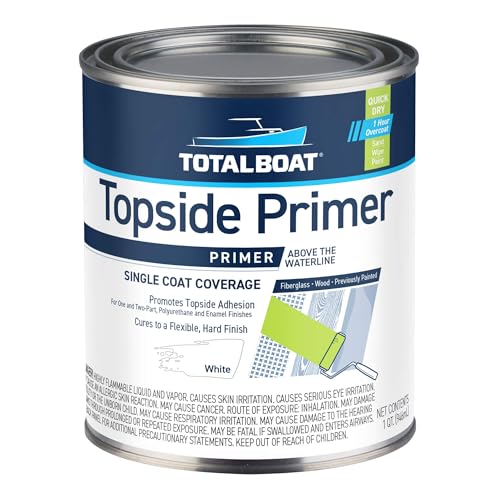
Product overview: A one-part marine primer designed as a durable, flexible undercoat for 1-part and 2-part polyurethane and enamel topside paint. Suitable for fiberglass, wood, and gelcoat surfaces above the waterline that are in good condition. It seals with one thin coat; a second coat is optional for higher build. Best for boaters seeking a simple, fast-drying primer for topside prep and easy application via brush, roller, or spray. Chromate-free and lead-free.
Who it’s best for: Ideal for boaters performing routine topside refinishing on fiberglass or wood hulls who want a straightforward, single-coat primer before topcoat application. Those prioritizing easy application will find this primer convenient for brush or spray use.
Limitation: For large surface imperfections, this primer should be followed by fairing with TotalBoat TotalFair epoxy before topcoat; ensure proper ventilation and PPE during use.
TotalBoat TotalProtect Epoxy Barrier Coat System (White, Gallon)

Product overview: This is a high-build two-part epoxy primer and barrier coat suitable for use above and below the waterline. It excels at gelcoat blister prevention and repair on fiberglass boats and provides robust protection on all underwater metals. The barrier coat helps create a moisture-resistant seal and a durable base for subsequent coatings.
Who it’s best for: Best for boaters needing a comprehensive barrier system to prevent blisters and corrosion, especially on boats subject to challenging water conditions or repair work. Suitable for both new builds and refits needing reliable underwater protection.
Limitation: Requires accurate mixing and adherence to curing times per instructions; not a standalone topcoat, must be followed by compatible topcoats.
Rust-Oleum Marine Coatings Primer (White, Quart)

Product overview: A primer designed for wood or fiberglass surfaces above the waterline. It serves as a base coat to improve adhesion of topcoats, helping achieve longer-lasting finishes. Dries to the touch in about an hour and covers roughly 100 sq ft per quart.
Who it’s best for: Suitable for boaters looking for a reliable, widely available base primer to improve adhesion before applying topside finishes on typical hull materials.
Limitation: Priming above the waterline only; not intended for below-waterline protection without additional specialized coatings.
TotalBoat Marine Topside Primer Gray (Quart)

Product overview: A gray version of the one-part marine primer for boats, offering the same durable, flexible undercoat for topside paints. Suitable for fiberglass, wood, gelcoat, and existing painted surfaces in good condition above the waterline. It shares the single-coat sealing feature and the option for a second coat if needed, with the same application methods and safety instructions as the white variant.
Who it’s best for: Boaters who prefer gray primer to match or differentiate from their chosen topcoat color or to better assess coverage during painting. Useful when color alignment between primer and topcoat matters for final appearance.
Limitation: Same caveat as the white variant; follow with fairing if large imperfections exist and ensure proper ventilation.
TotalBoat JD Select Ablative Antifouling Bottom Paint (Black, Gallon)

Product overview: An antifouling bottom paint designed for fiberglass, wood, and steel boats. This ablative coating wears away progressively as the boat moves through water, reducing bottom paint buildup and minimizing sanding next season. It has low odor and low VOCs with easy cleanup using soap and water, making it suitable for marinas with environmental restrictions.
Who it’s best for: Ideal for boaters seeking season-long antifouling protection with easier maintenance and lower environmental impact. Best for boats operating in both salt and freshwater environments where fouling is a concern.
Limitation: Because it is an ablative coating, reapplication strategy depends on water conditions and hauling schedules; expect periodic reapplication for sustained protection.
Buying Guide: Key Considerations for Boat Bottom Paint Primers
What surface and waterline coverage should I expect?
Choose primers designed for the surface you plan to paint (fiberglass, wood, or gelcoat) and verify whether they are intended for above-waterline, below-waterline, or dual-use protection. Barrier coats provide robust protection below the waterline, while topside primers focus on adhesion and preparation for upper hull finishes.
How important is color and build in primers?
Color matters for coverage visibility and final appearance. Gray or white primers can influence topcoat color perception and coverage. One-part primers are convenient, while two-part systems may offer greater durability for demanding conditions.
What about environmental and safety considerations?
Many marine primers emphasize low VOCs and low odor, especially for marina environments. Chromate-free formulations reduce hazardous exposure. Always follow PPE recommendations and ensure good ventilation during application.
Should I layer primers or use a barrier coat first?
For hulls exposed to harsh conditions, using a barrier coat (two-part epoxy) can provide superior underwater protection and blister prevention. Primers above the waterline can precede a topcoat, while barrier coats often pair with compatible topcoats and bottom coatings.
What maintenance or reapplication should I plan for?
Ablative antifouling paints wear away during use, requiring reapplication at regular intervals. Primers and barrier coats usually require a compatible sequence for recoat, with surface prep between steps to ensure adhesion.
How do I choose between white and gray primers?
White primers can help highlight imperfections during application and work well with lighter topcoats. Gray primers can help with color matching for certain dark-topcoats and may be preferred for visibility of coverage on darker finishes.
FAQ
- What is the main purpose of a boat bottom paint primer?
To create a durable, adherent base for Topside or bottom paints, improving adhesion, water resistance, and longevity. - Can I use a topside primer below the waterline?
Typically not; use a dedicated barrier coat or bottom paint designed for below-waterline protection. - Is an epoxy barrier coat necessary for every boat?
No; it’s especially beneficial for boats with blister-prone hulls or in harsh water conditions. Evaluate hull condition and environment. - Do primers affect antifouling performance?
Primers can influence adhesion and durability of antifouling coatings; follow product compatibility guidelines for best results. - How should I prepare a hull before applying primer?
Clean thoroughly, remove loose paint, sand as needed, and ensure the surface is dry and in good condition before applying primer. - What safety steps should I take when applying marine primers?
Work in a well-ventilated area, wear PPE, and follow the product’s safety data sheet for handling and disposal.