Best GPS for Boat Navigation: Top Picks for Seamless Coastal and Lake Adventures
Buyers seeking reliable marine navigation want devices that combine accurate GPS with easy-to-read sonar and charting. This guide highlights five top options, spanning handheld and dashboard models, to help you choose the best GPS for boat navigation based on your boating style. Perfect for anglers, day sailors, and offshore explorers alike, these models balance mapping detail, sonar clarity, and ease of use. Use the summary table to compare core capabilities at a glance.
| Product | Best For | Key Strength |
|---|---|---|
| Humminbird Helix 5 G3 | Mid-size boats and anglers | Dual Spectrum CHIRP sonar and Basemap with LakeMaster compatibility |
| Simrad GO9 XSE | Sport boats and center consoles | All-in-one multifunction display with premium cartography |
| Garmin Striker Vivid 7cv | Easy-to-use color sonar on mid-size boats | Vivid scanning sonar color palettes |
| Garmin GPSMAP 79sc | Rugged handheld navigation | Floating design with extensive waypoint and route capacity |
| Garmin Striker 4 | Budget-friendly fixed-mount fishing boats | Clear Vu scanning sonar and easy installation |
Humminbird Helix 5 G3 GPS Fish Finder

Best for anglers and mid-sized boats needing strong sonar and detailed mapping. The Dual Spectrum CHIRP sonar provides wide and narrow scanning modes, offering both broad coverage and precise target separation. Enhanced GPS navigation comes with Humminbird Basemap, covering 10,000+ lakes and U.S. coastlines, plus compatibility with premium LakeMaster, CoastMaster, and Navionics charts. This makes it a solid match for freshwater navigators and coastal anglers who value flexible charting and reliable fish-finding sonar.
Limitations: The data note repeats Basemap specifics in the features—assembly of premium charts requires external maps. Best used with compatible cartography services for the full benefit.
Simrad GO9 XSE Chartplotter and Fishfinder

Best for sport boats and center-console setups that demand a robust multifunction display. The GO9 XSE combines GPS navigation, sonar, and radar readiness in one unit. It ships with the C-MAP DISCOVER chart card featuring vector charts, tides, and high-resolution bathymetry. The included 83/200 kHz HDI transducer supports CHIRP sonar and DownScan Imaging for clear bottom structure and fish targets. This option suits boaters who want a single, capable system for mapping, sonar, and future radar expansion.
Caution: Card-based chart coverage requires compatible cards to access full features and regional data.
Garmin Striker Vivid 7cv with GT20 Transducer

Best for users who want a large 7-inch color display with vivid sonar palettes for easy interpretation of fish and structure. The GT20 transducer provides built-in CHIRP traditional sonar and CHIRP ClearVü scanning sonar. A high-sensitivity GPS helps mark waypoints, create routes, and monitor boat speed. This option is well-suited for anglers who value intuitive visuals and straightforward waypoint navigation on mid-to-large boats.
Limitation: Like many chartplotters, access to advanced maps may require additional map packages for full regional coverage.
Garmin GPSMAP 79sc Marine Handheld
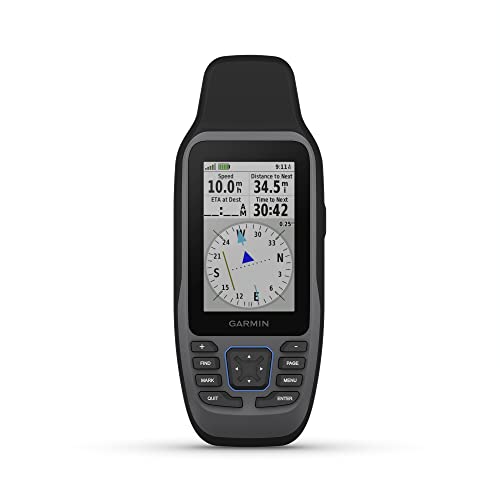
Best for rugged, floating handheld navigation on coastal trips and inland waterways. The 79sc is a floating, water-resistant handheld with a bright display and BlueChart coverage. It supports multiple satellite constellations for reliable global tracking and stores thousands of waypoints and routes. Choose this if you need a portable device for on-deck backup or when ashore scouting the best harbors before a voyage.
Limitation: Handheld units typically have smaller screens for long-range navigation compared to fixed-mount chartplotters, which can affect ease of use in rough conditions.
Garmin Striker 4 with Transducer

Best for budget-conscious boaters who still want reliable sonar and waypoint features. The Striker 4 provides Clear Vu scanning sonar and a high-frequency CHIRP option, along with easy installation. It supports waypoint navigation and has a compact 3.5” display that can be expanded on smaller boats. This choice is ideal when entry-level sonar plus straightforward navigation is the priority.
Limitation: Smaller display size may limit readability in bright sunlight or busy water conditions; consider a larger screen if you frequently navigate in dense structure zones.
Buying Guide: Key Purchase Considerations
- Display size and readability: Larger screens improve map detail and sonar interpretation; consider your boat size and cockpit glare when choosing.
- Sonar capability: CHIRP and DownScan/Live Sonar features help identify fish and bottom structure; dual-spectrum options offer broader search modes.
- Charting and maps: Look for Basemap or premium chart options (LakeMaster, CoastMaster, Navionics, C-MAP DISCOVER). Ensure compatibility with charts you plan to use.
- Transducers: Transducer type and frequency affect depth range and image clarity. External transducers may be needed for larger boats.
- Ports and expandability: Some models support radar, additional sonar modules, and more charting services. Consider future needs.
- Power and installation: Fixed-mount units require wiring and mounting space; handheld options offer portability but may have shorter battery life.
Frequently Asked Questions
- What should I prioritize for a boat GPS: maps or sonar? – Both map data and sonar clarity are important; prioritize models with CHIRP sonar and robust chart options for comprehensive navigation.
- Is a handheld GPS enough for boating? – For back-up navigation and port-to-port trips, handheld devices are useful, but fixed-mount units typically offer larger displays and more features for regular use.
- Do these devices support radar? – Some models are radar-ready or integrate with radar systems; check the specific model’s expandability.
- Are premium charts necessary? – Premium charts provide detailed depth, tides, and contour data, which enhance navigation in unfamiliar waters.
- Can I use any transducer with these units? – Not always; ensure the transducer is compatible with the chosen unit’s sonar system (CHIRP, DownScan, etc.).
- Do these devices float or withstand rough conditions? – Handheld units often float; fixed-mount displays vary by installation and mounting. Verify IP ratings and float features where needed.