Best Red and Green Navigation Lights for Boats and Night Boating
Answer: For safe night boating, choose durable red and green LED navigation lights that meet USCG visibility standards (2 nautical miles) and offer easy installation, whether via adhesive or screws. The top picks below suit different boat sizes and mounting preferences, from bass boats to pontoons and skiffs. This guide highlights who each product is best for and why.
| Product | Brand | Best For | Key Benefit |
|---|---|---|---|
| Seaperk Boat LED Navigation Lights | Seaperk | Small to mid-size boats, night fishing | Bright 5-mile visibility with adhesive install |
| Obcursco Boat Navigation Lights (Silver) | Obcursco | Pontoon, skiff, small yachts | IP67, 225-degree coverage, corrosion-resistant |
| Botepon Navigation Lights | Botepon | Pontoon, bass, jon boats | Significantly brighter than factory lights |
| QLOOASEA Boat Navigation Lights | QLOOASEA | Kayaks, dinghies, small boats | Strong adhesive, 3 NM, 225-degree beam |
| RVZONE Boat Navigation Lights | RVZONE | Yachts, big pontoons | Two mounting methods, low power 1.2W |
Seaperk Red & Green LED Navigation Lights

Best for quick, drill-free installation on rub rails or above/below rails. These lights use strong double-sided adhesive and a flexible body design for versatile mounting, ideal for bass boats, pontoons, and jon boats. With 18Pcs Germany 5050 LEDs, they deliver a light output described as brighter than original nav lights, enhancing nighttime visibility up to about 5 miles.
- Best for: owners who want a fast, no-tools install and strong brightness.
- Why chosen: Adhesive mounting reduces installation complexity on curved or irregular surfaces.
- Caution: Adhesive performance may vary by surface cleanliness and exposure to heavy moisture over time.
Obcursco Red & Green Marine LED Bow Lights (Silver)

Best for vessels needing robust IP67 protection and broad 225-degree coverage. This model uses a die-cast chrome zinc cover and a 2 nautical mile USCG-compliant visibility design. Suited for pontoons, skiffs, small yachts, and yachts that require corrosion resistance and reliable night signaling.
- Best for: boats that navigate in foggy or misty conditions where maximum visibility matters.
- Why chosen: Durable housing and corrosion resistance outperform simpler plastic housings.
- Caution: Heavier housing may influence mounting options on very slim rails.
Botepon Navigation Lights For Boats
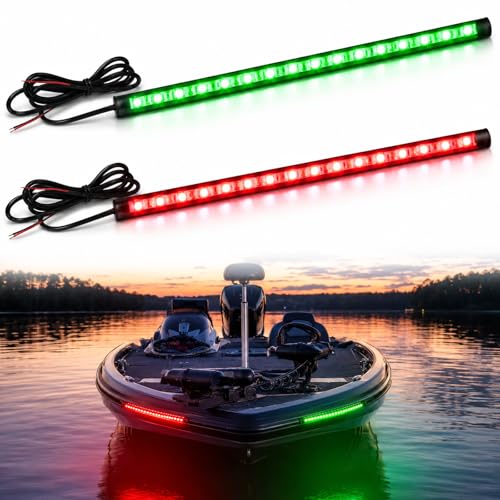
Best for boaters seeking a bright, noticeable upgrade over factory fixtures. The lights purposefully advertise higher brightness to improve nighttime safety for pontoon, bass, jon boats, and small craft. They emphasize red and green bow lighting suitable for navigation and deck area signaling.
- Best for: boaters who want a noticeable brightness upgrade and clear daylight-style color signaling.
- Why chosen: Emphasizes night visibility for safety beyond standard factory lights.
- Caution: Not all mounting surfaces are perfectly flat; plan for adhesive or screw options accordingly.
QLOOASEA LED Navigation Lights (Red & Green)

Best for boaters who prioritize minimal power use with solid visibility. These lights feature strong adhesive backing for rub-rail mounting, 3 NM visibility, and 225-degree illumination. They fit well on pontoon, bass, and jon boats as well as kayaks and small yachts.
- Best for: users who want energy efficiency without sacrificing beam width.
- Why chosen: 5050 LED efficiency aids long-life operation on 12V systems.
- Caution: Adhesive installation may require surface prep for best adhesion on certain plastics.
RVZONE Red & Green Marine LED Bow Lights

Best for multi-mounting options and low power operation. This model uses marine-grade composite nylon for corrosion resistance and includes two installation methods—screws or 3M adhesive—making it adaptable to various boat styles, from pontoon to yacht. It adheres to USCG visibility standards with a compact, low-power footprint.
- Best for: users who want installation flexibility and power efficiency.
- Why chosen: Dual mounting options increase compatibility with different hull designs.
- Caution: Screw mounting requires proper pilot holes to avoid hull damage on softer materials.
Buying Guide: Key Purchase Considerations
What mounting method fits your boat? Adhesive-backed lights are quick to install on rails and curved surfaces, while screw-mounted options can be more permanent and rugged in rough water. Consider your boat size, rail shape, and exposure to salt spray when choosing.
What beam angle and visibility are needed? Look for 225-degree coverage to minimize blind spots and ensure oncoming vessels can see you from the sides. A 3 NM to 5 NM visibility range provides strong safety margins for nighttime navigation.
How much power does it consume? LEDs with low wattage (around 1.2W to 6W per light) help conserve battery life on smaller boats while maintaining adequate brightness for signaling.
Are the housings protected against corrosion? IP67 or higher ratings and corrosion-resistant materials extend life on salty boats and humid environments. Die-cast zinc or reinforced plastics are common durable choices.
Do you need additional features? Some models add integrated deck task lighting or offer combinations of red/green with other functionalities. Evaluate whether you need a separate deck light or solely navigation signaling.
FAQ: Quick Answers For Buyers
- What does USCG visibility standard mean for these lights? Lights with USCG 2 nautical mile visibility meet basic regulatory signaling requirements for night boating.
- Can I install adhesive navigation lights on any boat? Adhesive systems work on clean, smooth surfaces but may be less reliable on textured rails or wet surfaces; ensure proper surface prep for best adhesion.
- Is 225-degree beam necessary? Yes, a wide beam minimizes blind spots and improves side visibility, especially in crowded waterways.
- Are red and green lights required for all boats? Most compliant vessels use red on the port side and green on the starboard side for navigation signaling.
- How do I choose between red/green bow lights and deck-mounted lights? Bow lights are essential for navigation signaling, while deck lights are useful for visibility near the work area; many setups use both.
- Will these lights fit my hull size? Most compact lights fit a range of boats; check the dimensions and mounting method to ensure a proper fit with your rub rail or rail height.