Best Solar Panels for Boat Battery Maintenance and Charging
Answering common buyer needs, these solar panels are designed to keep boat batteries charged, topped up, and ready for extended trips. This guide highlights options for boaters who want reliability, weather resistance, and easy installation. Best for: weekend boaters who need a simple trickle charger, saltwater skippers seeking durable builds, and anglers or sailors who want low-maintenance power on deck. The following table summarizes five suitable picks and their core strengths.
| Product | Best For | Key Benefit |
|---|---|---|
| SOLPERK Solar Panel Kit 20W | All-around boat setups | Waterproof, durable, smart MPPT controller |
| SUNER POWER 30W PRO | Higher power needs | Ultra-Smart MPPT and robust charging stages |
| Voltset 20W Solar Charger | Universal 12V batteries | Fast MPPT tracking and battery protection |
| POWOXI 7.5W Trickle Charger | Compact setups | Smart protection and durable glass |
| FlexSolar 20W Panel Kit | Flexible mounting options | Coin-thin design and versatile connections |
SOLPERK Solar Panel Kit 20W 12V

Best for: boaters who want a complete charging solution with built-in MPPT and mounting options. The SOLPERK kit uses monocrystalline cells with 21%-30% efficiency and includes an 8A smart MPPT controller. It’s designed to maintain 12V batteries such as LiFePO4, AGM, GEL, and more. The robust, waterproof build can withstand wind and spray, making it a strong choice for deck installations. Caution: the system’s higher efficiency depends on proper mounting and wiring to achieve peak performance.
What it’s chosen for
- High conversion rate from a compact panel
- Integrated smart charging to protect against overcharge
- Rugged, waterproof construction suitable for marine use
SUNER POWER 30W PRO MPPT Kit

Best for: boaters with higher power needs who want a larger 30W panel and advanced MPPT tracking. The Ultra-Smart MPPT controller delivers up to 99% tracking efficiency and roughly 20%-30% better utilization than competing trackers. It uses a three-stage charging sequence to optimize battery health. Caution: higher wattage requires adequate roof or deck space and secure mounting to handle marine conditions.
What it’s chosen for
- High MPPT efficiency for faster charging
- Comprehensive three-stage charging for battery longevity
- Low-maintenance operation with automatic shutoff when full
Voltset 12V Solar Battery Charger 20W

Best for: boaters seeking universal compatibility with various 12V chemistries. The Voltset kit uses a high-efficiency MPPT charger, 20-30% faster charging, and multi-layer protections. It’s ideal as an RV, trailer, or marine solar charger. Caution: ensure your battery’s chemistry matches the charger’s settings for optimal protection.
What it’s chosen for
- Broad compatibility with LiFePO4, AGM, GEL, and Lithium
- Advanced protection against overcharge and short circuits
- Reliable, water-resistant construction for marine use
POWOXI Upgraded 7.5W Trickle Charger
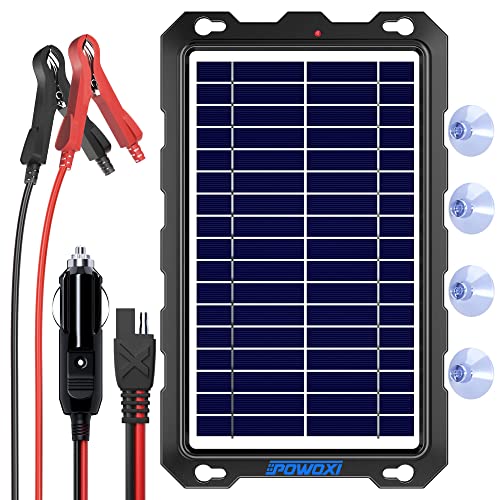
Best for: compact installations on small boats or emergency kits where a small, efficient charger is needed. POWOXI features an intelligent charge controller with protection against overcharge. It uses high-transparency glass and a robust waterproof build. Caution: lower wattage means slower charging for larger batteries or heavy daily use.
What it’s chosen for
- Small, portable, easy to mount
- Smart protection to guard battery health
- Durable, outdoor-ready construction
FlexSolar 20W Panel Kit With Controller

Best for: boaters needing flexibility and easy mounting on curved surfaces. FlexSolar uses a thin profile and a variety of connection options, including cigarette lighter, alligator clips, OBDII, and ring terminals. It’s well-suited for decks and non-traditional spaces. Caution: thin design can be more susceptible to physical damage if not protected on busy vessels.
What it’s chosen for
- Coin-thin design for flexible mounting
- Multiple plug options for quick setup
- Solid monocrystalline cells with decent efficiency
Buying Guide: What To Consider When Choosing A Boat Battery Solar Panel
Performance and durability matter most on water. Consider panel wattage, mounting space, battery type, climate, and maintenance needs. A marine-rated, waterproof build reduces corrosion risk. MPPT controllers help maximize charging in variable sunlight, but they add cost. If you have limited space, a smaller 7.5W unit might suffice for trickle charging. For larger battery banks or frequent use, a 20W–30W kit provides quicker top-ups while still remaining manageable on a boat deck.
Power needs: How much solar should you choose?
For small boats with a few essential electronics, 7.5W–12W can keep lead-acid batteries topped up. If you rely on more devices or power-hungry gear, a 20W–30W system provides better headroom. Always match panel wattage to battery capacity and expected daily sun exposure.
Battery compatibility: Which chemistry matters?
Most marine solar kits support LiFePO4, AGM, Gel, and Flooded batteries. Verify your battery’s chemistry and ensure the controller settings accommodate it. Using the wrong mode may shorten battery life or prevent full charging.
Controller: MPPT versus PWM
MPPT controllers optimize power extraction, especially in partial shade or lower sun. They’re worth the extra cost for performance and battery longevity. PWM controllers are simpler and cheaper but less efficient, particularly in cooler or variable conditions.
Durability and installation: What to look for?
Choose marine-rated panels with waterproof seals, corrosion-resistant frames, and tempered or laminated glass. Mounting options should secure the panel on deck or canvas without excessive wind load. Consider pre-drilled frames, adjustable mounts, and cable management features for clean installations.
Maintenance: How much work is required?
Most modern panels require minimal maintenance. The best options automatically stop charging when batteries are full and resume when discharge occurs. Regular inspection of wiring and seals helps prevent rust or water intrusion on a boat.
Installation tips: What helps?
- Place panels where they receive direct sun for most of the day.
- Use weatherproof connectors and protective conduits to reduce corrosion.
- Secure mounts to avoid vibration damage in choppy conditions.
FAQ
- Do I need an MPPT controller for a small boat system? Yes, MPPT typically improves efficiency and battery health, especially with fluctuating sunlight.
- Can I use a marine solar panel on an inland boat? Yes, as long as it is properly sealed and mounted for outdoor exposure.
- What battery types are best with these kits? LiFePO4, AGM, Gel, and Flooded are commonly supported; verify the controller’s settings for your chemistry.
- Will 20W be enough for a full day of use? It depends on battery size and loads; higher wattage provides faster charging and more headroom.
- Are these panels waterproof? Yes, most marine panels are designed to be water-resistant or waterproof for outdoor use.
- Is professional installation recommended? For complex wiring or high-wattage setups, professional installation is advisable to ensure proper wiring and safety.