Best AGM Marine Starting Batteries to Power Your Boat or RV
When choosing an AGM starting battery for marine or RV use, the right choice balances starting power, deep-cycle capability, longevity, and compatibility with your gear. This guide highlights five top options that are well-suited for different boat sizes and electrical demands. It helps buyers decide who each battery is best for, from anglers needing reliable cranking power to vacationers who rely on deep-cycle support for lights and accessories. The following table summarizes key strengths of the selected batteries for quick comparison.
| Product | Best For | Key Strength |
|---|---|---|
| Interstate Batteries Marine/RV Battery 12V 100Ah 825CCA | Mid-to-large boats; RVs needing strong cranking | Dual-purpose, long life, high CCA |
| Interstate Batteries Marine/RV Battery 12V 70Ah 750CCA | Smaller boats; lighter setups | Compact dual-purpose with solid cranking |
| WEIZE BCI Group 31M Dual Purpose AGM Battery | Mid-range boats; RVs with loads | High RC, dual-purpose power |
| Mighty Max Battery MM-G24M 12V 90Ah | Dual-use power for boats and road use | Strong deep cycle, solid CCA |
| Renogy 12V 70Ah AGM Car Battery H6 | Vehicles with marine needs; compact layouts | Reliable safety, temperature durability, good CCA |
Interstate 12V 100Ah 825CCA AGM Marine Battery

This dual-purpose AGM battery is designed to start the motor and power a trolling motor, even with the engine off. It emphasizes long life, with claimed service life advantages over conventional alloy AGM and flooded options. It uses a pure lead design aimed at high deep-cycle support for onboard accessories. Best for boaters who want one battery to handle starting and auxiliary power with rugged reliability.
Best for: larger boats or RVs needing strong starting power plus deep-cycle use. Caution: real-world cycle life can vary with discharge depth and charging habits.
Why selected: The 100Ah capacity paired with 825CCA provides ample cranking reserve while delivering extended cycles for on-board electronics and accessories.
Interstate 12V 70Ah 750CCA AGM Marine Battery

This dual-purpose battery serves as a reliable starting battery while providing ample cycle life for trolling motors and accessories. It’s a practical pick for mid-sized rigs where space and weight are considerations. It’s built to endure rugged use, aiming to reduce downtime.
Best for: anglers or campers with moderate electrical demands. Caution: lower capacity than the 100Ah model, so plan for times when both starting and deep-cycle loads are heavy.
WEIZE BCI Group 31M Dual Purpose AGM Battery

WEIZE’s 31M model emphasizes dual-purpose performance with a high RC and robust starting capability. The battery has a clear dual-use design intended to power engines and deep-cycle electronics. It supports long life through features like thick plates and AGM safety benefits. Best for: boaters who need a capable all-in-one unit for both starting and sailing-day electronics.
Caution: ensure correct terminal orientation for left/right posts when installing in tight compartments.
WEIZE BCI Group 24M Dual Purpose AGM Battery

This 24M model offers dual-purpose deep-cycle and starting power with a 90Ah rating and quick-charge capability. It’s designed to balance cranking reliability with long-term power for electronics. Best for: smaller boats or RVs where space is at a premium but you still need dependable starts and enduring power. Caution: charging guidelines should be followed to avoid overcharging and to achieve optimal cycle life.
UPLUS BCI Group 27M Dual Purpose AGM Battery
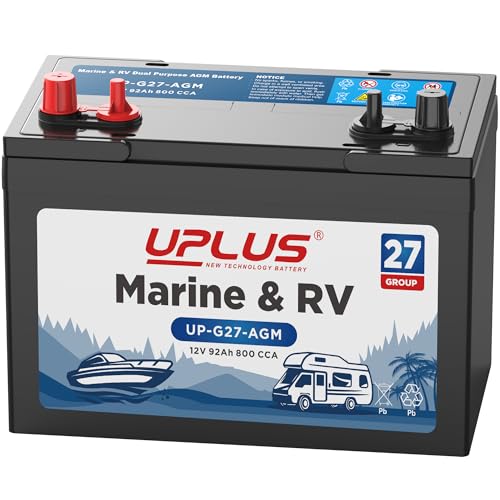
With 92Ah and 800CCA, this dual-purpose unit supports both starting and deep-cycle needs in marine and RV settings. The 27M designation indicates suitability for larger compartments and higher power demands. Best for: boaters requiring strong cranking plus dependable electrical support with a compact footprint. Caution: verify fitment dimensions against your battery tray before ordering.
Buying Guide: AGM Marine Battery Essentials
What is an AGM battery, and why choose it for marine or RV use?
AGM stands for absorbed glass mat. It’s a sealed lead-acid design that resists spills, handles vibration, and provides stable performance across a range of temperatures. For marine and RV applications, AGM batteries offer safer operation, faster recharge, and reliability in rough conditions compared with flooded options.
How to pick the right capacity and CCA/RC
– Capacity (Ah) determines how long a battery can sustain loads. More Ah means longer runtime for electronics and accessories.
– Cold Cranking Amps (CCA) reflects starting power in cold conditions. Higher CCA is better for engines in cooler climates or larger marine engines.
– Reserve Capacity (RC) indicates how long the battery can run essential systems if the alternator isn’t charging. A higher RC supports longer operation between starts.
Space, weight, and fit considerations
Measure the battery compartment to ensure the chosen size (Group size) fits. Some dual-purpose batteries save space by combining starting and deep-cycle roles, but space constraints in smaller boats may necessitate more compact formats.
Charging and maintenance tips
- Follow manufacturer charging guidelines to maintain cycle life and performance.
- Avoid deep discharges to maximize lifespan; frequent shallow cycles are gentler on AGM plates.
- Periodically inspect terminals for corrosion and ensure proper torque on connections.
Durability and warranties
AGM batteries used in marine environments benefit from rugged construction and thick plates. Look for batteries designed to withstand vibration and temperature swings. Warranties vary; check terms for coverage during use in sun and saltwater conditions.
Frequently asked questions
- What is the difference between a starting battery and a dual-purpose AGM battery? A starting battery emphasizes high CCA for engine starts, while a dual-purpose battery also supports deep-cycle loads for electronics and accessories.
- Can I use any AGM battery for trolling motors? Yes, as long as the capacity, CCA, and size suit your trolling motor’s draw and physical space.
- How often should I recharge AGM batteries? Recharging after use and avoiding prolonged self-discharge helps maximize cycle life. Follow the manufacturer’s charging profile.
- Is it better to use one large battery or multiple smaller ones? A single larger unit can simplify wiring, but dual or multiple batteries can provide redundancy and balanced load management in some setups.
- Are AGM batteries resistant to wrecks or tipping? AGM designs resist leaks and are well-suited to vibration, but secure mounting is always essential in transportation and boating.
- What should I do if my battery is not holding a charge? Check for parasitic drains, verify charging system function, inspect terminals, and consider professional testing to verify capacity.