Best Dual Battery Boat Switches for Boats and RVs
Answering the need for reliable power management, dual battery boat switches help you isolate, combine, or protect battery banks with ease. This guide highlights five well-suited options for boaters and RV enthusiasts who want safe, simple switching between two or more batteries. The featured products vary in size, mounting options, and load capacity, making it easier to pick the right unit for starting power, critical electronics, and long-term storage. Ideal buyers include small- to mid-size boat owners, weekend travelers, and anyone who values preventable downtime and battery savings.
| Product | Key Benefit | Best For |
|---|---|---|
| Seachoice Battery Select Switch | Simple two-battery selection with isolation | Boats needing straightforward switching up to 50V |
| Blue Sea Systems 4-Position Mini Selector | Compact, emergency combine, flexible mounting | Tight spaces, emergency power sharing |
| Nilight 1-2-Both-Off 600A | 4-position, high current, versatile for 12V systems | Vehicles, boats, and trailers with 2 battery banks |
| Nilight 1-2-Both-Off 200A | 4-position, lighter continuous rating, robust housing | Smaller boats or RVs with moderate loads |
| Blue Sea e-Series 4 Position | Ignition protected design, multiple mounting options | Engines rooms and tight engine bays |
Seachoice Battery Select Switch

This Seachoice unit provides a straightforward selection between two battery sources for starting, charging, or parallel operation. It’s suitable for systems under 50V and is UL listed with ignition protection and CE approval. Best for boats needing a dependable, easy-to-use switch with minimal wiring complexity. A clear limit is the 50V cap, which may exclude higher-voltage configurations in some marine setups. Ideal for boats seeking a simple, compliant dual-battery solution without advanced signaling features.
Blue Sea Systems 4-Position Mini Selector

This compact 4-position selector supports emergency combine and helps draw power from both batteries during engine starts or essential radio use. It offers flexible mounting with surface, flush, or rear options to fit tight installations. Best for users who prioritize redundancy and rapid battery pairing in limited spaces. It may be over-specified for very small systems that only need a simple on/off switch, where a smaller unit could suffice.
Nilight Battery Switch 1-2-Both-Off 600A

Nilight’s 1-2-Both-Off 600A model uses a 12V to 48V range with 600A continuous rating at 12V. It features a heavy-duty ABS housing, rear insulation, and four-position operation (1-2-Both-Off). This unit is well-suited for boats with two battery banks and higher draw needs. A potential limitation is the 600A continuous rating; extremely high-draw systems might require a higher continuous rating or a different model for sustained use.
Nilight 1-2-Both-Off 200A

This Nilight model covers 12V-48V with 200A continuous operation, offering a lighter option for smaller boats or RV setups. It supports 1-2-Both-Off with four positions, delivering practical battery switching without excessive current capability. Choose this if your system is moderate in load and you want a compact, cost-efficient switch. Limitation: lower continuous current means less headroom for high-power starts or heavy equipment.
Blue Sea e-Series 4 Position
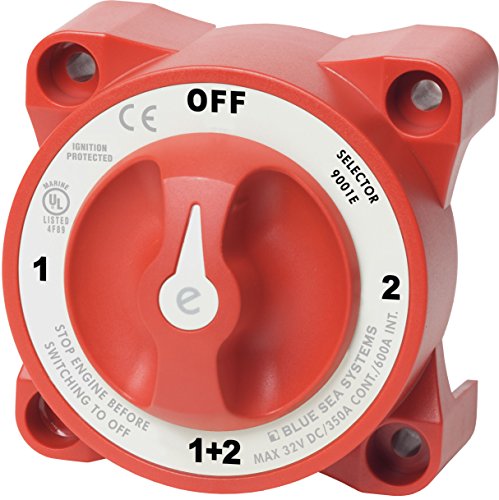
The e-Series 4-position selector features a compact design with multiple mounting options and ignition protection. Designed for tight engine rooms on gasoline-powered boats, it provides a robust, safe switching solution suitable for demanding marine environments. Best for installations where ignition protection and secure mounting are essential. A potential caveat is that some users may require additional space for the unit’s mount and wiring routes in smaller compartments.
Buying Guide
What to consider when choosing a dual battery switch
- Voltage and current ratings: Match the switch to your battery bank voltage (often 12V or 24V) and expected continuous current.
- Number of batteries and positions: Ensure the switch supports 2 banks and the desired on/off/both configurations.
- Ignition protection and safety: For engine rooms or marine environments, select ignition-protected and sealed housings.
- Mounting space: Consider compact designs for tight panels or engine bays, including surface, flush, or rear mounting.
- Wiring and corrosion resistance: Look for corrosion-resistant terminals and robust housings (ABS or marine-grade plastics).
- Emergency features: Some models offer a combine mode to draw from both batteries during heavy starts or essential electronics use.
- Ease of installation: Prefer switches with simple wiring diagrams and standardized terminal layouts to minimize installation time.
How to pick among top styles
- Best for simple needs: Seachoice or Nilight 600A units offer straightforward 1-2-Both-Off operation with clear control.
- Best for tight spaces: Blue Sea Mini Selector or Blue Sea e-Series provide compact or versatile mounting options with reliable safety features.
- Best for higher loads and rugged use: Nilight thousand-amp-style options or larger Blue Sea e-Series can handle heavier electrical demands.
Professional vs. DIY installation considerations
DIY installation is feasible for many boaters with basic electrical knowledge, especially for standard 12V marine systems. When in doubt, consult wiring schematics and ensure the selected switch meets marine electrical code and safety standards. For complex installations or higher voltage systems, professional installation can prevent miswiring and potential battery drain issues.
Maintenance and long-term use
Inspect connections for corrosion, ensure seals remain intact, and verify no loose terminals after the first voyage. Periodic testing of the switch’s ability to isolate, connect, and run both banks helps prevent unexpected power loss during critical moments.
FAQ
- What is a “4-position” battery switch? It offers four settings: Battery 1, Battery 2, Both, and Off, enabling flexible power management.
- Can these switches handle automotive and marine use? Yes, many models are designed for 12V-48V systems and marine environments with ignition protection.
- Is an emergency combine feature important? It can improve starting reliability by drawing from both batteries if one is weak.
- Do I need a high continuous current rating? If you have high-draw equipment, select a switch with a higher continuous rating to avoid overheating.
- How do mounting options affect installation? Surface, flush, or rear mounting affects space planning and accessibility; choose based on your panel layout.
- Are these switches weatherproof? Many marine switches are insulated and designed to resist moisture; verify IP ratings if exposure is extreme.