Best Fast Electric Outboard Motors for Speed on the Water
Answering buyers who want quick, quiet propulsion, this guide highlights the fastest electric outboard motors for kayaking, small boats, and dinghies. The top pick for speed is the Newport NT300 with high thrust and extended range. The others provide strong performance for trolling and day-long outings. This comparison helps you choose based on speed, endurance, and use case, whether saltwater or freshwater, day trips or longer voyages.
| Product | Top Speed (when stated) | Best For |
|---|---|---|
| Newport NT300 Electric Outboard Motor | Up to 6.5 MPH | Speed-focused boating, long trips, quiet salt/freshwater use |
| Newport NV-Series 55lb Thrust | About 4 MPH | Trolling, all-day quiet operation |
| Minn Kota Endura C2 | Typically around 3-4 MPH | Freshwater trolling, reliable control |
| SJXHRFXY 12V 80lb Thrust Electric | Up to 4.34 MPH | Durable, higher thrust for kayaks and inflatables |
| PEXMOR 8 Speed Electric Trolling Motor | Eight speeds; thrust 26 lb | General trolling, compact boats |
Newport NT300 Electric Outboard Motor — 3HP 1300W

The Newport NT300 delivers 110 lb of thrust with a 36V system, designed for salt and freshwater use. It includes a digital throttle, LCD display, 24.6″ shaft, and a 9.8″ 2-blade composite propeller. Trim/tilt options (0°, 7°, 14°, 21° / 70°) and field-oriented control support smooth handling across water conditions. A top speed around 6.5 MPH and a range up to 66 miles on a single charge suit extended fishing trips. Best for boaters who value speed, longer range, and quiet operation. A potential limitation is runtime depending on boat weight and water conditions.
- Best for: Speed-focused anglers and small boaters seeking strong propulsion with quiet performance.
- Why selected: Highest stated speed and longest range among the listed electric options.
- Caution: Real-world range may vary with boat type and conditions.
Newport NV-Series 55lb Thrust Saltwater Trolling Motor

This 12V electric trolling motor provides 55 lb thrust with a 30″ shaft, 5 LED battery meter, a 6″ telescoping tiller, and a 3-blade propeller. Eight speeds (5 forward, 3 reverse) offer versatile control for trolling scenarios. Best for: boaters who need reliable, all-day trolling without overheating or noise spooks from fish. Limitation: Top speed around 4 MPH, so it’s not the fastest option here.
- Best for: Quiet, all-day trolling in salt or freshwater.
- Why selected: Strong endurance and adjustable mounting for versatile setups.
- Caution: Not designed for high-speed propulsion.
Minn Kota Endura C2 Transom-Mount Electric Trolling Motor
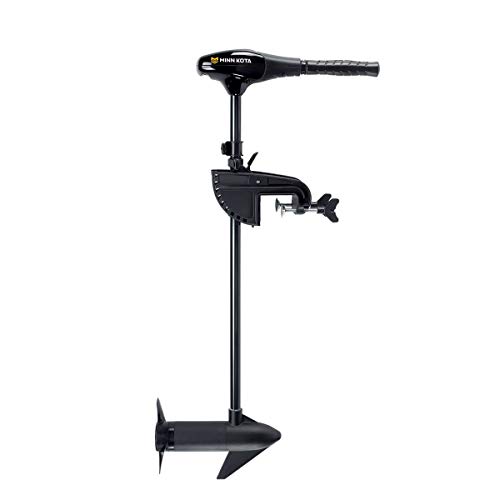
With a 30″ shaft and 30 lb thrust, the Endura C2 blends durability with straightforward operation. It features a 6-inch telescoping tiller for comfortable control, a 10-position lever lock bracket for quick angle changes, and a reinforced composite body to withstand UV exposure and waves. Best for: Freshwater anglers who prioritize accessibility and proven reliability. Caution: Lower thrust means slower start in bigger water or current.
- Best for: Everyday freshwater trolling and simple setup.
- Why selected: Easy-to-use, durable, and well-supported platform.
- Caution: Limited thrust compared to higher-power electric models.
SJXHRFXY 12V 80lb Thrust Electric Outboard

This model delivers 80 lb thrust, a durable aluminum main pole, and corrosion resistance suited for salt or freshwater use. It offers a long-lasting power solution with a silent operation profile, up to about 4.34 MPH in suitable conditions. Best for: Heavier kayaks or inflatables needing more bite and steadiness without gas engines. Limitation: Speed is modest despite high thrust; performance is context-dependent.
- Better for: Higher thrust to maintain control in wind or current.
- Why selected: Strong thrust with corrosion-resistant construction.
- Caution: Real-world speed depends on vessel load and conditions.
PEXMOR 8 Speed Electric Trolling Motor

PEXMOR provides 26 lb thrust across eight speeds, with a 6″ telescoping handle and adjustable depth and angle. Built for saltwater and kayak use, it emphasizes efficiency and stable operation with a 3-blade propeller for predictable low-speed torque. Best for: Light-draft boats and kayaks requiring efficient, maneuverable trolling. Limitation: Low thrust may be insufficient for larger craft or strong currents.
- Choose this if: You need compact, controllable trolling for small vessels.
- Why selected: Balance of speed options and easy handling.
- Caution: Not a high-thrust solution for larger boats.
Buying Guide: Key Purchase Considerations
What should you evaluate when choosing a fast electric outboard motor? Focus on thrust, speed, range, shaft length, and suitability for saltwater or freshwater use. Consider your boat size, weight, and typical cruising conditions to align performance with expectations.
- Speed vs. thrust: Higher thrust can improve acceleration and maintaining planing in modest boats, but actual speed depends on boat weight and water conditions.
- Battery and range: Look for range claims that fit your typical trip length; heavier boats require larger batteries and higher voltage systems.
- Shaf t length and mounting: A longer shaft is better for deeper transoms; verify compatibility with your boat hull and mounting brackets.
- Water conditions: Saltwater models require corrosion resistance; freshwater models may allow lighter builds and different propellers.
- Control features: Digital throttles, LCD displays, and adjustable tillers enhance ease of use and precision in steering.
FAQ
- What is the fastest electric outboard in this guide? The Newport NT300, with a top speed around 6.5 MPH under suitable conditions.
- Do electric motors work well in saltwater? Yes, many models are rated for saltwater use, but choose corrosion-resistant builds and proper maintenance.
- Is higher thrust always better for speed? Not always; speed depends on boat weight, current, and hull design. Higher thrust helps with acceleration and planing on heavier craft.
- Can I use these motors for trolling? Yes, several models are designed for trolling with multiple forward/reverse speeds and adjustable tillers.
- How do I choose a shaft length? Longer shafts help with deeper transoms and avoid hitting the prop in rough water; confirm your boat’s transom height.
- What maintenance is needed for electric outboards? Regular inspection of wiring, battery health, propeller condition, and cleaning the prop to prevent debris buildup.