Best 12V Marine Starting Battery Options for Boats and RVs
Answering your search for a reliable 12V marine starting battery: these five models balance strong starting power with deep-cycle capability, making them suitable for boats, RVs, and marine applications. Choose based on your primary need—quick starts, long deep-cycle use, or space and weight constraints. The table below summarizes key points to compare at a glance.
| Product | Type | Capacity (Ah) | Starting Power (CCA) | Best For |
|---|---|---|---|---|
| Interstate Batteries Marine/RV Battery 12V 100Ah | Dual-Purpose AGM | 100 | 825 | High crank power + deep cycle for boats with trolling motors |
| WEIZE BCI Group 31M Dual Purpose AGM | Dual-Purpose AGM | 110 | 825 | Strong cranking and extended cycles, versatile for RVs |
| Interstate Batteries Marine/RV Battery 12V 70Ah | Dual-Purpose AGM | 70 | 750 | Compact, light-duty boats and smaller rigs |
| LiTime 12V 165Ah Dual Purpose LiFePO4 | LiFePO4 Dual-Purpose | 165 | 1200 | High starting power with long life and space savings |
| Mighty Max Battery MM-G24M 90Ah | Dual-Purpose AGM | 90 | 550 | Reliable mid-range deep cycle with solid starts |
Note: All models listed are designed for mixed loads typical of marine and RV use, including engine starts, trolling motors, lighting, and accessory equipment. Consider your boat size, engine horsepower, and how often you use electrical accessories when selecting a battery type and capacity.
Interstate 100Ah Dual-Purpose AGM Battery

The Interstate 100Ah dual-purpose AGM battery functions as both a starting battery and a deep-cycle power source. It’s designed to power motors and trolling motors, lights, and onboard accessories. It uses pure lead AGM technology intended to deliver longer life and faster recharge compared with conventional flooded options. This battery is best for vessels that require robust cranking with extra endurance for weekend trips and moderate accessory use.
Who it’s best for: boaters needing strong starting power with dependable deep-cycle capacity, especially in saltwater or frequent use scenarios. Why selected: high 825 CCA supports quick engine starts while the 100Ah capacity offers ample energy for accessories during trips.
Caution: As a dual-purpose unit, extreme deep-cycle demands may slowly reduce capacity over years if frequently discharged deeply. Plan for a balanced charging routine to maximize lifespan.
WEIZE 110Ah Group 31M Dual Purpose AGM

The WEIZE Group 31M dual-purpose AGM battery emphasizes high performance with low internal resistance and strong output power. It’s engineered for reliable starting and deep cycling, making it well-suited for boats with trolling motors and RVs with extended electrical needs. It also highlights faster recharge characteristics compared with traditional flooded batteries.
Best-for: boaters who want a balanced battery capable of quick starts and sustained power for electronics. Why selected: 825 CCA aligns with quick engine starts, while 110Ah capacity supports longer use between charges.
Limitation: Quick charging is beneficial, but ensure you adhere to safe charging practices and avoid prolonged high-current charging without monitoring the temperature.
Interstate 70Ah Dual-Purpose AGM Battery

This 70Ah Interstate model provides a compact solution for smaller boats or RVs with limited space. It maintains dual-purpose capability to start the engine and power essential devices. It’s a practical choice when weight and size are primary constraints but you still need reliable starts and moderate cycle life.
Best-for: small to mid-size boats, shallow-water anglers, or RVs with tight battery compartments. Why selected: compact 70Ah size with solid 750 CCA ensures reliable starts without overloading space. Caution: smaller capacity means shorter runtime for high-electrical-demand setups; plan for efficient energy use or additional power management.
LiTime 165Ah LiFePO4 Dual-Purpose Battery

The LiTime 165Ah LiFePO4 battery represents a higher-energy, longer-lasting option with dual-purpose use for starting and deep-cycle needs. With 1200 CCA starting power, it can reliably crank engines in cold conditions while providing extensive power for marine electronics and trolling motors. The LiFePO4 chemistry delivers weight savings and longer cycle life compared with lead-acid options.
Best-for: boaters seeking long service life, reduced weight, and high starting performance. Why selected: significantly higher starting power and much longer usable life, which reduces the frequency of replacements. Caution: LiFePO4 chemistry requires compatible charging and BMS considerations; verify system compatibility before installation.
Mighty Max Battery MM-G24M 90Ah Dual-Purpose AGM
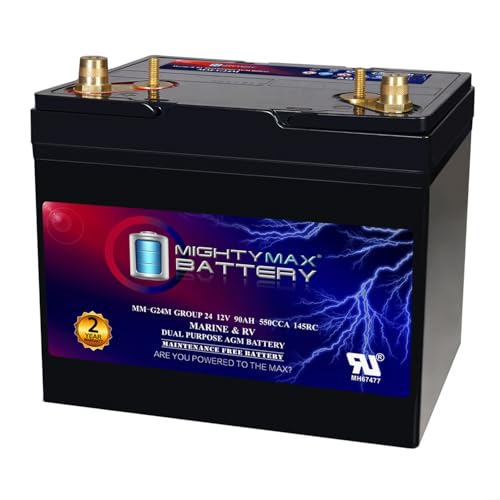
The Mighty Max MM-G24M 90Ah is a compact, dual-purpose AGM option with a 550 CCA starting capability and 700 MCA. Its 90Ah capacity makes it suitable for mid-sized boats and RVs that require reliable starts while maintaining essential electronics. The spill-proof, maintenance-free design reduces upkeep in marine environments.
Best-for: mid-sized boats and RVs needing dependable starts with moderate deep-cycle capacity. Why selected: good balance of starting power and cycle endurance in a compact footprint. Limitation: 90Ah is mid-range; for heavy power users, a higher Ah model may be preferable.
Buying Guide
What should I prioritize: starting power or deep-cycle capacity?
For most starting-focused needs on boats, prioritize higher cold-cranking amps (CCA) and enough amp-hour (Ah) capacity to power essentials when the engine is off. If you run multiple electronics or trolling motors for extended periods, choose a battery with strong deep-cycle capability and adequate Ah.
Which chemistry works best for marine environments?
Absorbent Glass Mat (AGM) batteries are common for marine use due to maintenance-free operation, vibration resistance, and better spill resistance. LiFePO4 stacks offer longer life and lighter weight but require compatible charging and monitoring systems. Consider your charging setup before mixing chemistries in the same system.
How important is space and weight?
Boat and RV installations often have tight compartments. Measure the battery bay and compare dimensions and weight of each option. LiFePO4 can save weight, while smaller AGM units may fit where space is limited.
What about charging compatibility?
Follow manufacturer guidance on charging voltage and current. AGM batteries typically charge at 14.4–14.8V. LiFePO4 cells often use 14.4V with a tailored charging profile. A proper charger helps maximize life and performance for each battery type.
Durability and lifespan considerations
Dual-purpose AGM batteries are convenient but may wear faster if frequently discharged deeply. Models with thicker plates and advanced lead formulations tend to offer longer life. If you cycle deeply often, a LiFePO4 option can provide superior longevity with proper BMS.
Which battery best fits different buyer profiles?
- Casual weekend boater: balanced AGM with solid starting power and decent cycle life (examples: 100Ah or 110Ah AGM).
- Small boat or limited space: compact 70Ah AGM or a 90–110Ah option with integrated deep-cycle capability.
- Heavy electronics user: higher Ah or LiFePO4 for longer runtime between charges.
- Weight-conscious skipper: LiFePO4 provides weight savings and longer life, with proper charging setup.
Practical maintenance and usage tips
- Regularly inspect terminals for corrosion and secure connections.
- Keep alternator and charger settings aligned with battery type.
- Avoid complete discharge of AGM batteries to prolong life; use a suitable float charging strategy.
- Store spare batteries in a cool, dry place and protect from freezing temperatures.
FAQ
- Can I mix AGM and LiFePO4 batteries in the same system? Generally not recommended due to different charging needs and BMS considerations.
- What is CCA and why does it matter? Cold Cranking Amps measure starting power at cold temperatures; higher CCA helps engine starts in cold weather.
- How long do marine starting batteries typically last? Lifespan depends on use and maintenance; AGM units may last 3–5 years, LiFePO4 options often exceed 8–10 years with proper care.
- Is a higher Ah always better? Not always. Consider your load, engine size, and cycle expectations to avoid overpaying for unused capacity.
- What charging voltage should I use for AGM vs LiFePO4? AGM: about 14.4–14.8V; LiFePO4: around 14.4V with a compatible BMS-aware charger.
- Should I choose a dual-purpose battery or separate starting and deep-cycle batteries? Dual-purpose can save space and simplify wiring, but dedicated batteries may offer optimized performance for start or long-term power.