Best VHF Radio for Boat: Top Marine Radios for Safe, Clear Communication
When choosing a VHF radio for a boat, the primary goal is reliable, clear communication in all conditions. This guide highlights five top options suited for recreational boaters, commercial crews, and coastal anglers. Each product section explains who it’s best for, why it stands out, and any practical limitations. The featured models cover fixed-mount and handheld solutions, with varying power, GPS, weather alerts, and saltwater durability to match different watercraft and budgets.
Quick comparison of chosen products:
| Product | Type | Best For | Key Benefit |
|---|---|---|---|
| Uniden UM385 | Fixed Mount | All-around boating needs | Triple Watch and NOAA Weather Alert |
| Cobra BlueBound 350 (Black) | Handheld | Compact, floating backup | 6W power, IPX7, USB-C |
| Retevis RM01P | Handheld | Rugged operations, IP67 | Floating, long endurance, NOAA |
| Cobra MR F77W GPS | Fixed Mount | GPS-assisted distress signaling | GPS receiver, loud mic |
| Uniden UM725GBT | Fixed Mount | GPS, Bluetooth integration | GPS built-in, Bluetooth |
Uniden UM385 25W Fixed Mount Marine VHF Radio
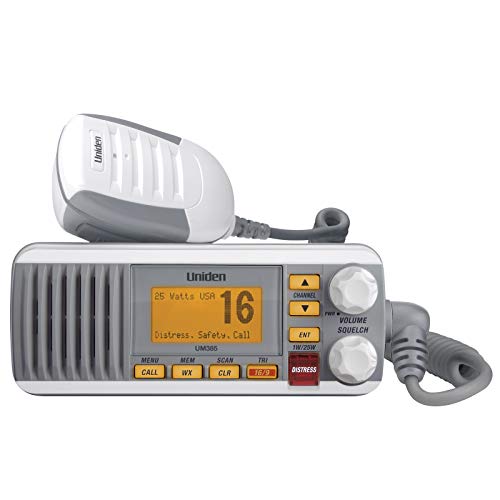
The UM385 combines DSC capabilities, triple watch, and a full range of international channels with NOA A weather alerts in a single compact design. It’s ideal for boaters who want a robust, all-in-one fixed-mount unit for coastal and offshore use. The rugged microphone facilitates hands-on steering while staying connected. Best for: general boaters needing reliable weather alerts and emergency features in a compact package.
Caution: While feature-rich, this model’s performance depends on proper antenna installation and power supply on the vessel.
Uniden UM385BK 25W Fixed Mount Marine VHF Radio

This black version offers the same triple watch, DSC, and S.A.M.E Weather Alert features as the UM385, designed for boaters who prefer a matte unit with international channel support. It’s best for crews needing a reliable fixed-mount radio with weather information and quick distress signaling. Best for: boats that require international channel coverage and consistent NOAA alerts.
Caution: Control layouts are similar to the UM385, so users familiar with one may find the other’s cosmetic differences minimal in critical moments.
Cobra BlueBound 350 VHF Handheld Marine Radio – Black

The BlueBound 350 features a high-visibility orange floating core, 6W power with 1/3/6W selectable options, and an easy Day/Night LCD display. It’s well suited for small boats, kayaks, or as a reliable secondary radio on larger vessels. Best for: boaters needing a buoyant, easy-to-read handheld radio for near- and far-range communications. Caution: While floating, ensure it’s fully charged and protected from prolonged submersion in deep water.
Cobra BlueBound 350 VHF Handheld Marine Radio – White

This white variant shares the same features as the black model, including the high-visibility floating core and versatile power options. Use this when you want a clearly visible handheld in bright conditions or when mounting color-coding radios by vessel section. Best for: crews that want quick retrieval and distinct identification on deck. Caution: Ensure compatibility with your existing charging setup and USB-C accessories.
Uniden UM725 Marine VHF Radio

The UM725 offers IPX8 submersible protection, NOAA weather channels with alerts, DSC distress, and a large LCD. It supports 1W/25W output to balance range and battery life, and includes a speaker mic for flexible operation. Best for: boaters who need a rugged, highly visible fixed radio with advanced distress capabilities. Caution: Some users may prefer GPS integration or Bluetooth for mobile device pairing, which this model does not include by default.
Uniden UM725GBT Marine VHF Radio

The UM725GBT combines GPS built-in, Bluetooth, and IPX8 waterproofing with NOAA Weather Alerts and DSC. It supports global channels and includes a GPS integration for rapid distress signaling. Best for: boaters who want built-in GPS and wireless connectivity to mobile devices. Caution: Bluetooth functionality may require pairing steps and device compatibility considerations for some smartphones.
Buying Guide
What should you consider when selecting a VHF radio for your boat?
- Fixed mount vs handheld: Fixed units are permanent, highly integrated with antennas, and often offer larger displays. Handhelds are portable, useful as backups, or for small craft.
- Power and range: Look for 1W/25W dual power or 6W handhelds for flexibility. Higher power improves range at the cost of battery life on handhelds.
- Weather and safety features: NOAA weather alerts, DSC distress, and GPS distress signaling can be critical in emergencies. Consider models with S.A.M.E. alerts if you operate near storms.
- Durability and water resistance: IPX ratings indicate water resistance; IPX8 is submersible to protect against full immersion, while IPX4 or IPX7 covers splashes and rain.
- Additional connectivity: GPS built-in, Bluetooth, and NMEA compatibility enable integration with other devices and ship systems.
- Ease of use: Large, legible displays, simple control layouts, and reliable microphone ergonomics reduce response time in emergencies.
FAQ
- Q: Do I need GPS on my VHF radio? A: GPS helps with quick distress signaling and location sharing in emergencies, and some radios can share data with other devices.
- Q: Is a handheld VHF radio sufficient for offshore use? A: Handhelds are great as backups or for small vessels; for long-range offshore use, a fixed-mount radio with an external antenna is typically preferred.
- Q: What does DSC enables distress mean? A: DSC allows you to send a digital distress signal and location to rescue authorities and other radios, often more reliable than voice alone.
- Q: How important is weather alert capability? A: NOAA weather alerts provide critical updates about storms and marine conditions, helping you plan safer routes.
- Q: Can I use Bluetooth with VHF radios? A: Some models offer Bluetooth to connect to phones or other devices; check compatibility with your phone and apps.
- Q: Are IPX ratings necessary for all environments? A: For coastal or offshore use, higher IPX ratings offer better protection against water exposure and corrosion.