Best 60 Amp Marine Battery Charger for Boats and Yachts
Answer: A 60 amp marine battery charger is best for boat owners who need fast, reliable, multi-bank charging while at sea or on shore power. This guide highlights top 60A options for 12V systems, including multi-bank capability, safety safeguards, and compatibility with common marine battery chemistries. The best fits are for larger boats, US coastal users, and those needing flexible bank management. The following table summarizes five strong choices with their core strengths.
| Product | Best For | Why It Stands Out |
|---|---|---|
| ProMariner ProNautic 1260P | Multi-bank, digital control | Advanced 12-selectable profiles and smart distribution |
| Sterling ProCharge Ultra 1260 | Global use, ease of setup | 11 charge curves, auto-maintain, simple meters |
| Victron Energy Centaur 12-Volt 60A | Worldwide power, temperature sensing | Auto-ranging input, smart temp management |
| Renogy DC to DC Charger 60A | On-board marine/ RV charging | Multi-battery compatibility, 3-stage charging |
| RENOGY REGO 60A DC-DC Charger | Universal chemistry and tough environments | Auto-detects battery type, LiFePO4 activation |
ProMariner ProNautic 1260P (12V) 60A, 3-Bank Charger

The ProNautic 1260P provides 60 amps across three banks with Gen 3 digital control and software-based power conversion. It automatically senses and distributes charging capacity to each bank, ensuring efficient use of available power. It supports up to 12 digitally controlled 4-stage profiles, including Charge, Condition, Auto-maintain, and Recondition. This makes it a versatile option for boats with multiple battery banks and varied chemistries. Best for: boaters who want intelligent, bank-specific charging with a broad profile library. Caution: complex settings may require careful setup to match battery types.
Sterling ProCharge Ultra 1260 – 12V, 60 Amps

The Sterling ProCharge Ultra offers 60 amps with 11 pre-programmed charge curves, including LiFePO4, GEL, AGM, Calcium, and custom profiles. It features a four-step charging profile that safeguards battery health by maintaining a safe float after charging. Two digital meters display real-time current and voltage, while three isolated outputs let you direct power to a single battery if needed. Best for: users who value a wide chemistry library and straightforward setup. Caution: may be overkill for single-battery systems.
Victron Energy Centaur 12V 60A 3 Bank

The Victron Centaur features auto-ranging input (90-265VAC), enabling worldwide use. It includes internal temperature sensing to keep components within safe limits, reducing wall-plug heat and extending life. It charges at a bulk rate until output reduces to 70% of rated amps, then switches to a 4-hour timer and float mode to prevent overcharging. Best for: marine owners who travel internationally and need robust, temperature-aware charging. Caution: some users may require mounting space for three banks and separate wiring considerations.
Renogy DC to DC Charger 60A Lifepo4 – On-Board Marine/RV
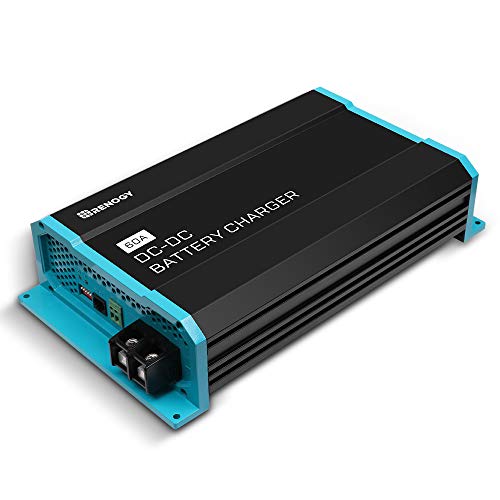
The Renogy 60A DC-DC charger is designed for on-board charging from the alternator to house batteries. It supports multiple battery types, including AGM, Flooded, Gel, and Lithium, and follows a three-stage charging (Bulk, Boost, Float) for optimal conditioning. It includes protections for over-voltage, over-temperature, and reverse polarity, and isolates input/output to prevent interference. Best for: dual-battery systems on boats or RVs where a dedicated DC-DC charger is preferred. Caution: primarily a DC-DC charger, not a standalone AC-DC marine charger.
RENOGY REGO 12V 60A DC-DC with LiFePO4 Activation

The RENOGY REGO is a 60A DC-DC charger that auto-detects battery chemistry (LiFePO4, AGM, Gel, Flooded) and supports mixed battery banks. It advertises 60A turbo charging, fast recharges, and 12V to 12V charging. It is designed for dual-battery setups on boats and trucks, with smart engine-start detection to protect the starting battery. Best for: owners who require universal chemistry compatibility and high-speed charging on the go. Caution: marketing-heavy wording; verify compatibility with your starter battery and alternator.
Buying Guide
What to consider when choosing a 60A marine charger
- Bank configuration: Do you need 2 or 3 banks, and how will you allocate power across them?
- Battery chemistry support: Ensure compatibility with your lead-acid, AGM, GEL, or LiFePO4 packs.
- Input voltage and frequency: For international use, select models with auto-ranging 90-265VAC, 50/60Hz.
- Charging stages and safety: Look for multi-stage charging (Bulk/Absorb/Float), temperature sensing, and over-temperature/over-voltage protections.
- Dimensional fit and mounting: Verify size, heat dissipation, and mounting space on your vessel.
- Ease of use: Gauges or meters, presets, and the ability to customize charging profiles can save time.
FAQ
- What is the difference between a multi-bank charger and a DC-DC charger?
Multi-bank chargers feed several batteries from AC power directly, while DC-DC chargers run off the boat’s alternator or auxiliary DC source to charge house batteries. - Can I use a 60A charger on a small boat?
Yes, but ensure you do not exceed the capacity of individual batteries and wiring. Some models offer adjustable outputs per bank. - Is LiFePO4 compatibility important for marine batteries?
Only if you use LiFePO4 cells; otherwise choose a charger that supports your battery type (AGM, Gel, Flooded). - Do all 60A chargers support 90-265VAC worldwide use?
Not all; some models require specific input ranges. Look for auto-ranging inputs when traveling internationally. - Should I choose a charger with temperature sensing?
Temperature sensing helps prevent overheating and prolongs battery life in hot or enclosed spaces. - What is “float” or “auto-maintain” mode?
Float mode keeps a full charge without overcharging by delivering a low, steady current.