Best Marine Door Latch Hardware for Secure Boat Cabinets and Hatches
Answering the demand for durable, corrosion-resistant marine latches, this guide highlights five top options that balance strength, ease of installation, and reliable locking or catching action. Best for boat owners, yacht deck installers, and marine cabinet updates, these picks cover slam latches, tension catches, door hasps, and key-locked latches. The selections emphasize stainless steel or marine-grade materials to resist saltwater and humidity, while staying user-friendly in tight boat spaces. Below, compare what each product does best and who should consider it.
Summary of selected products
- Searoam Boat Slam Latch 2″ Lift Handle Deck Hatch – Best for standard 2-inch hole cutouts on deck hatches.
- Frienda 2 Pack Marine Grade 316 Stainless Steel Cabinet Tension Catch 70 mm – Best for reliable deck or cabinet mounting with corrosion resistance.
- Tearom Marine Boat Door Catch Latch – Best for foam-sealed doors and hatch enclosures in saltwater environments.
- Southco MF-01-110-60 Flush Entry Door Latch – Best for secure access control with a clean flush design.
- Shimeyao 2 Pack 2-1/2 Inch T Handle Boat Latch – Best for keyed locking in boat hatches and compartments.
Searoam Boat Slam Latch 2″ Lift Handle

The Searoam slam latch is built from stainless steel zinc alloy designed to withstand harsh marine environments. It fits a standard 2-inch hole cutout and provides two backplates for various door thicknesses, from 2 mm to 20 mm. The latch system uses a flush pull design with mirror-polished finish, delivering corrosion resistance in saltwater settings. Best for boat deck hatches and weathered exterior compartments where a clean, low-profile secure latch is needed. Limitations include the need for a compatible 2-inch cutout and compatibility with specific door thickness ranges.
- Best for: Deck hatch applications requiring a flush, corrosion-resistant latch.
- Material: Stainless steel with zinc alloy components.
- Backplates included: Yes, supports 0.078″–0.787″ door thicknesses.
- Limitations: Only supports standard 2-inch cutouts; check your hatch thickness.
Frienda 2 Pack Marine Grade 316 Stainless Cabinet Tension Catch

The Frienda tension catches come in a two-pack set and use marine-grade 316 stainless steel for corrosion resistance. Designed for deck installations on ships or marine cabinetry, these latches provide reliable clamping for doors and storage compartments. They feature a precise base size for compatibility, with a 0.16″ mounting hole and specific base dimensions to facilitate installation in tight marine spaces. Best for long-lasting cabinet doors on vessels; a caution is that mounting requires accurate hole alignment to ensure smooth operation.
- Best for: Marine cabinets and deck storage that require strong tension latches.
- Material: 316 stainless steel for saltwater resistance.
- Base dimensions: 2.75″ x 0.47″ x 0.55″ (lock base 1.45″ x 0.47″ x 0.55″).
- Limitations: Requires precise mounting alignment for optimal function.
Tearom Marine Boat Door Catch Latch

The Tearom door catch latch is made of 316 stainless steel, offering maximum corrosion resistance and durability in saltwater environments. It is lightweight yet sturdy, designed for doors or hatches that may have foam or rubber weather seals around them. Best for marine doors where a smooth latch action with strong corrosion resistance is required; it may be less suitable where a heavy-duty locking mechanism is needed, as it emphasizes latch robustness over built-in locking security.
- Best for: Doors or hatches with foam seals in saltwater settings.
- Material: 316 stainless steel.
- Key benefit: High corrosion resistance and durability.
- Limitations: No built-in lock; use with external security if needed.
Southco MF-01-110-60 Flush Entry Door Latch

The Southco flush entry door latch features a key-locking mechanism with a natural aluminum finish. It is designed for 12.7 mm (0.50 in) door thickness and operates as a sliding door latch. This option is best for secure access control on cabinet doors or small hatches where a minimal external profile is important. It provides a controlled entry solution rather than a generic catch, making it suitable for areas where unauthorized access must be deterred. A potential limitation is the targeted door thickness range; verify your panel before installation.
- Best for: Secure access control on flush doors and hatches.
- Feature: Key locking with natural aluminum finish.
- Door thickness compatibility: 10–12.7 mm.
- Limitations: Not ideal for thicker or thinner panels outside stated range.
Bonsicoky 2Pcs Marine Grade 316 Stainless Hasps
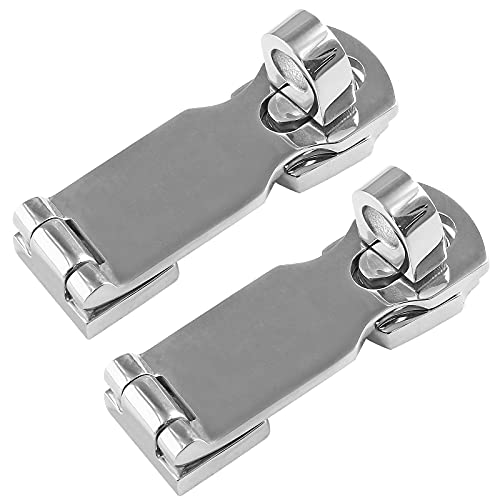
The Bonsicoky set includes two 316 stainless steel door hasps, sized at 76 x 25 mm with a 4 mm thickness. These heavy-duty swiveling hasps are designed for ships, yachts, doors, windows, cabinets, and other marine hardware applications. They resist rust and corrosion and feature a polished surface without burrs for safe handling. Best for secure latching where turning padlock eyes are needed; consider the hasp’s size to ensure compatibility with your padlock and mounting surfaces.
- Best for: Heavy-duty marine doors and cabinets needing turning padlock eyes.
- Material: Marine-grade 316 stainless steel.
- Dimensions: 76 x 25 mm, 4 mm thick.
- Limitations: Requires appropriate padlock compatibility and mounting space.
Buying Guide
What’s the right latch type for my boat?
Choose slam latches for quick, one-step access on deck hatches. Use tension catches for cabinet doors and drawers that demand steady closure. Hasps are ideal for adding padlock security to larger doors or exterior compartments, while flush latches prioritize a low-profile look with secure key access for smaller panels.
How important is material when selecting marine hardware?
Marine-grade stainless steel (316/316L) resists saltwater corrosion and humidity, extending the life of hardware in harsh environments. Stainless steel with zinc alloy components can balance strength and cost for standard deck applications. Always check the corrosion rating and ensure parts are suitable for saltwater use.
What installation considerations matter?
Confirm door thickness and hole cutout compatibility before purchasing. Some products specify mounting hole diameters and base dimensions, which affect where you can install them. Accurate alignment reduces misfit issues and ensures smooth operation in rough seas or jolting conditions.
Security versus convenience
Key-locked variants offer added security for valuable or restricted areas, but may require extra time to operate. Consider whether you need external locks, or if a simple latch with robust corrosion resistance suffices for your application.
Maintenance and durability
Routinely inspect for corrosion, especially on saltwater boats. Clean and lubricate moving parts as needed to preserve function. If your vessel frequently encounters harsh seas, prioritize sealed or gasketed designs to reduce moisture intrusion.
Comparison at a glance
- Best for quick deck access: Searoam slam latch
- Best for cabinet and deck storage: Frienda 316 stainless tension catches
- Best for foam-sealed doors: Tearom 316 latch
- Best for discreet locking: Southco flush latch
- Best for padlock-ready security: Bonsicoky hasps
FAQ
- What material is most weather-resistant for marine latches?
- Are these latches easy to install on existing hatch doors?
- Do all latches require keys?
- Can I mix latching types on the same vessel?
- How should I maintain marine latch hardware?
- What should I consider for security on exterior compartments?
316 stainless steel offers high corrosion resistance in saltwater environments, making it a common choice for marine latch hardware.
Yes, most come with standard mounting dimensions or show the required hole sizes. Precise alignment and proper screw selection help achieve best results.
No. Some models are standard latches, while others incorporate key-locking mechanisms for added access control.
Yes. Latches can be selected per location based on function—deck hatches, cabinets, and external doors may benefit from different designs.
Regularly inspect for corrosion, clean with fresh water, and apply appropriate marine-grade lubricants to moving parts to sustain performance.
Choose key-locked or heavy-duty hasp options where unauthorized access is a concern, and ensure the lock and hasp are compatible in size and mounting surface.