Best Dual Battery Chargers for Boat: Stay Powered on the Water
Answering the boat owner’s search for reliable dual battery chargers, these models provide independent charging for two batteries, support multiple chemistries, and protect sensitive electronics from overcharge. Ideal buyers include anglers needing steady trolling motor power, live-aboards maintaining house and starting batteries, and casual cruisers seeking 12V reliability during long days on the water. Below, you’ll find five top options with clear pros, limits, and who each is best for. A quick comparison table helps you choose at a glance.
Summary table of chosen products:
| Product | Best For | Key Benefit |
|---|---|---|
| NOCO Genius GEN5X2 | All-around boat systems | Two independent 5A banks with multi-mode charging for lead-acid and lithium |
| NOCO GENPRO10X2 | High-demand boats | 20A total, 10A per bank, advanced charging for harsh environments |
| 2 Bank Marine Battery Charger 5X2 (FirstPower Pro) | Everyday boats needing durable 5A per bank | IP68 waterproof, independent mode per battery |
| Smart 2 Bank Marine Charger (Zrfmib) | Budget-conscious or startup maintenance | Multiple modes and dead-battery recovery |
| ProMariner 44020 ProSport HD | Pro-systems with precise charging | Dual-bank, software-controlled charging for fast, accurate fill |
NOCO Genius GEN5X2: 2-Bank, 10A Onboard Battery Charger
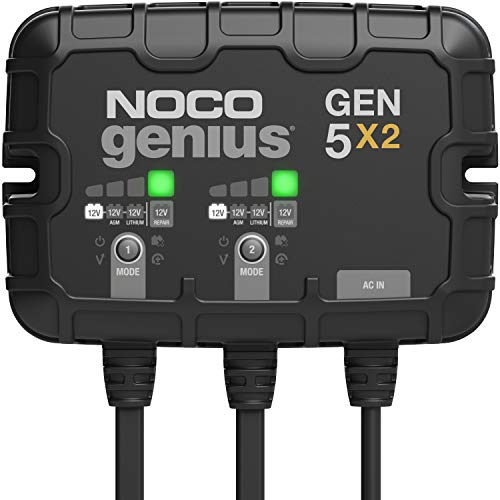
Best for boat owners who want compact power with flexible mode options. The GEN5X2 offers two independent banks at 5A each (10A total). It supports 12V lead-acid and lithium batteries and includes 12V modes for AGM, Lithium, and a repair/conditioning function. The unit is described as smaller and more powerful than earlier models, designed for harsh marine environments. Choose this if you need robust performance in tight engine bays and multi-battery configurations. Caution: Higher-end models require mounting considerations to ensure proper ventilation and heat dissipation.
NOCO GENPRO10X2: 2-Bank, 20A Onboard Battery Charger

Best for boats with higher power demands or larger battery banks. The GENPRO10X2 delivers 10A per bank (20A total) and provides selectable charging modes for 12V lead-acid and lithium batteries, plus a 12V Repair Mode. It’s designed to withstand demanding marine conditions while maintaining precision in charging. This option is preferable when you routinely juggle multiple deep-cycle and starting batteries. Limitation: It may be larger and pricier than entry-level dual-bank chargers, so space and budget should be considered.
2 Bank Marine Battery Charger 5X2 (FirstPower Pro)

Best for boats needing durable, 24/7 sustainment with reliable IP68 waterproof sealing. This charger provides two independent 5A banks and supports SLA/AGM, LiFePO4, and calcium batteries. It can charge two batteries simultaneously with separate mode selection. A good pick for liveaboards or vessels with long days on the water where weather exposure is a factor. Caution: Some users may want to verify exact mode compatibility with newer LiFePO4 chemistries before long-term use.
ProMariner 44020 ProSport HD Dual Bank

Best for systems seeking distributed charging with software-like control. The ProSport HD 20A dual-bank uses Microprocessor and software-controlled charging with a Distributed-On-Demand approach to maximize available amps as needed. It is well-suited for boats where precision and fast replenishment of multiple batteries matter. Limitation: The description emphasizes algorithmic distribution; real-world results depend on battery health and connection quality.
Buying Guide
What should you look for in a dual battery charger for a boat?
Capacity per bank: Match to your battery size and how quickly you want each to recover. Typical boat setups use 5A or 10A per bank. If you have multiple deep-cycle batteries or a large start battery, consider 10A per bank or more.
Battery chemistries supported
Ensure compatibility with lead-acid, AGM, gel, and lithium LiFePO4 batteries. Some models add calcium or specialty chemistries. If you use lithium batteries, confirm the charger has a dedicated lithium mode and proper termination protection.
Protection and safety features
Look for overcharge protection, temperature compensation, waterproofing (IP68 is common for marine use), and safe automatic mode transitions from bulk to float. Thermal sensors help prevent overheating in engine compartments.
Installation considerations
Check size, mounting options, and ventilation. Verify that the charger’s IP rating and cable length fit your boat’s layout. Some units support 12V repair mode or “dead battery recovery” for batteries below 1V.
Operational convenience
Independently functioning banks, dedicated modes per battery, and a maintenance/float mode can simplify long cruises. Some models offer desulfation or desulfator features that may help marginal batteries regain some capacity.
Reliability and warranty
Choose brands with proven marine performance and clear warranty terms. Strong build quality and consistent performance across environments are important for boats exposed to corrosive salt air and humidity.
FAQ
Q: Do I need a lithium-specific charger for LiFePO4 batteries?
A: If you use lithium batteries, choose a charger with a dedicated lithium mode and proper voltage regulation to avoid overcharging.
Q: Can a 2-bank charger handle both starting and deep-cycle batteries?
A: Yes, with independent banks and proper mode settings, you can charge different battery types simultaneously.
Q: What happens if a battery is completely dead?
A: Some chargers include a dead-battery recovery feature or manual mode to help start charging even if a battery is below 1V.
Q: Is IP68 waterproof protection necessary?
A: For exposed marine installations, IP68 or similar sealing helps protect the charger from water, salt, and dust.
Q: Should I pick a higher amperage model?
A: Higher amperage can speed charging on large banks or harsh cycles, but requires enough space, wiring, and a budget suitable for the boat’s electrical system.