Best 800 Watt Marine Amplifier Guide for Boats
What to buy if you need robust, waterproof amplification for a marine sound system? This guide highlights five top 800-watt marine amplifiers, explained for boaters and RVs on the water. Each option is evaluated for best-use scenarios: saltwater environments, limited space, and compatibility with common head units. The top picks are grouped by use case, such as all-weather reliability, compact size, and strong overall power delivery. A quick buying table follows to help compare at-a-glance and pick the right fit for your boat’s audio setup.
| Product | Best For |
|---|---|
| Skar Audio RP-800.1DM | Best all-around marine monoblock for single-channel sub setups |
| Pyle Hydra 800W PLMRMP3B | Best value, four-channel versatility with RCA inputs |
| Rockford Fosgate M5-800X4 | Best for compact, high-durability 4-channel power |
| Pyle PLMRA420 (4-Channel 800W) | Best 4-channel bridgeable option with marine protection |
| KICKER 48KMA8001 | Best for rugged, weather-resistant mono power |
Skar Audio RP-800.1DM 800 Watt Monoblock Class D Marine Subwoofer Amplifier
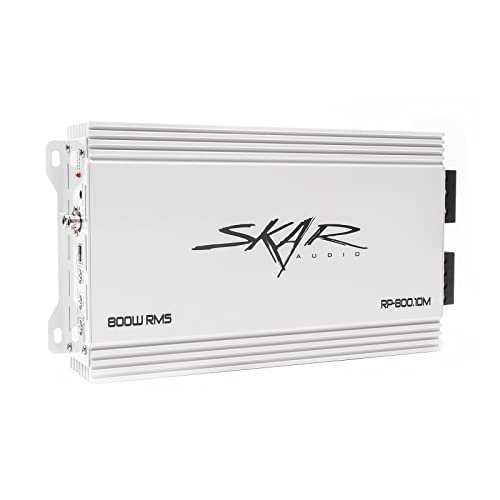
- Features: Marine Class D MOSFET Monoblock Power Amplifier; Peak Power at 1 Ohm: 1,200 Watts; RMS Power at 1 Ohm: 800 Watts; Fully marinized with waterproof coating on circuit board and rust-proof painting on the mechanical case.
Best for: Boat owners needing a single-channel, high-power sub amp with strong marine protection. This unit is designed to deliver reliable subwoofer performance in salty conditions. Limitations: A mono configuration is best when matching a dedicated sub; you’ll need suitable sub(s) and a compatible head unit with a sub out.
Pyle Hydra Marine Micro Amplifier PLMRMP3B (800W, 4-Channel)
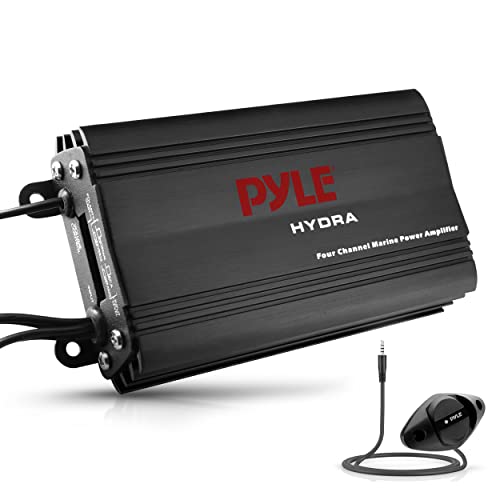
- Features: 4-channel marine amplifier; premium RCA inputs; 3.5mm-to-RCA adaptor; remote control for volume; short protection with built-in power protection circuitry.
Best for: Boats or vehicles needing a flexible 4-channel solution with easy input options and remote volume control. Limitations: May be better suited to moderate power demands rather than maximum subwoofer grunt.
KICKER 48KMA8001 KMA800.1 Mono Sub Amplifier

- Features: Conformal-coated circuit boards; stainless-steel hardware; compact footprint designed to tuck away; 800W x 1 at 1 ohm; rugged construction for marine use.
Best for: Small to mid-sized boats needing durable, dedicated mono power for a sub or a single speaker channel. Limitations: Mono output means you’ll pair with a sub or dedicated speaker channel; not ideal for multi-speaker setups without additional amps.
Rockford Fosgate M5-800X4 IPX6 Element Ready 800-Watt 4-Channel

- Features: 800 watts (4-channel); ultra-compact size; Element Ready design with IPX6 rating; rugged against water, dust, mud, and UV; Dynamic Power ratings up to 400W x 2 @ 4Ω or 125W x 4 @ 4Ω.
Best for: Boating environments where space is tight but reliability and weather sealing matter most. Limitations: Slightly higher complexity in tuning for optimal 4-channel balance may be required.
Pyle 4 Channel Marine Amplifier 800 Watt PLMRMP3B

- Features: 4 x 16W max and 4 x 8W RMS at 4 ohms; distortion under 0.05%; signal-to-noise ratio above 95dB; electronic crossover network; adjustable inputs; remote volume gain controller.
Best for: Users seeking clean, distortion-free sound with strong protection features in a four-channel marine setup. Limitations: Real-world power may vary with impedance and vehicle electrical conditions.
KICKER 48KMA8001 800 Watt 1-Ohm Mono Amplifier Bundles

- Features: 800W x 1 @ 1 ohm; DYNAMIC POWER 1200W; wired remote included; compact dimensions; precise frequency response specification; high and low input sensitivity options.
Best for: Power-hungry mono setups where a remote bass level control is desired. Limitations: Bundled controller adds cost and wiring complexity; ensure compatibility with your head unit.
Buying Guide: Key Considerations For 800 Watt Marine Amplifiers
- Power needs: Determine if you want a single-channel mono amp for a sub, or a multi-channel amp for full-range speakers. Mono amps typically pair with subwoofers; multi-channel amps power multiple speakers.
- Marine protection: Look for IP ratings and marine-grade coatings. Components exposed to salt, spray, and sun benefit from conformal coatings and corrosion-resistant hardware.
- Impedance and stability: Check Ohm compatibility (1Ω, 2Ω, 4Ω) and whether the amp is bridgeable. This affects the final wattage delivered to each speaker.
- Size and mounting: Assess available space on board. Compact amps save valuable dash or console space, but must still dissipate heat effectively.
- Input options: RCA inputs and remote control usability help ease of installation on boats with diverse head units.
- Protection features: Short-circuit protection, soft-turn-on/off, thermal protection, and anti-thump capabilities help prevent speaker damage.
- Installation considerations: Ensure compatible fusing, grounding, and power wiring to safely handle 800W plus system demands.
Frequently Asked Questions
- What is the difference between a mono 800W amplifier and a 4-channel 800W amplifier for marine use? A mono amp concentrates power to a subwoofer, while a 4-channel unit can drive multiple full-range speakers. Choose based on your speaker configuration and space.
- Do marine amps require special wiring? Yes, use marine-grade wiring and proper fusing. Saltwater exposure increases corrosion risk; ensure connectors and hardware are corrosion-resistant.
- Is IPX rating essential for all boat amplifiers? It’s highly recommended for outdoor marine environments. IPX6 or better helps resist water spray and dust exposure.
- Can I install an 800W amp on a small boat? Yes, if space and electrical capacity permit. Consider heat dissipation and wiring needs for safe operation.
- Should I choose a bridgable four-channel amp over a dedicated mono sub amp? Bridgable four-channel amps offer versatility for speakers and subwoofers, but a dedicated mono amp can deliver higher wattage to a single sub when needed.
- What about remote controls—are they necessary? Remote volume control is convenient for bass levels on boats. It’s optional but helpful for quick adjustments while underway.